Nothing But Blue
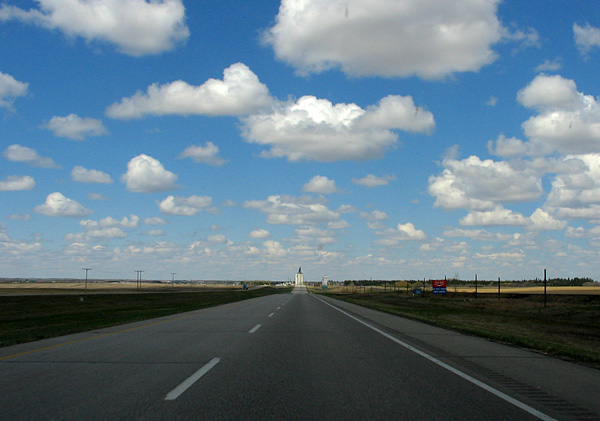
Eastern Saskatchewan
Cruising down the Pembina Highway in the middle of the day, I had one of those moments of perfect stillness and perfect clarity, the sort of moment that only happens when you are alone and speeding. The sky was bluer than prairie blue, the sun was bright, and I was in the middle lane with no traffic for two blocks in front of me or two blocks behind. The road was absolutely straight and clear, and the traffic light ahead was green. What could possibly go wrong?
Glancing at the speedometer I realized that, with that sense of serenity and no nearby reference point, I was moving far faster than I had thought. Easing my foot from the gas, I wondered if that feeling of stillness at speed might be analogous to the situation for many species, during the long intervals in evolution when environmental conditions are relatively stable and they are under little selective pressure.
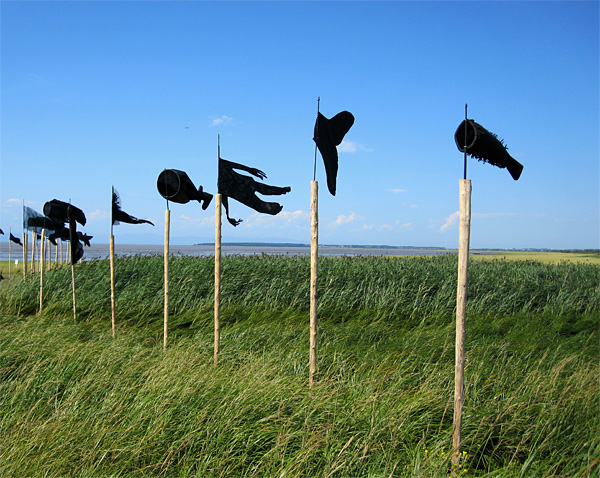
La Pocatière, Québec
Do they, metaphorically, coast along with not a care in the world, with no idea of how fast they are going or when they are going to hit a sudden curve or a hidden red light? The trilobites, driving Model T Fords (obviously), chugged along every highway in the early days, but their wheels fell off and one by one they all went into the weeds. The dinosaurs, in their Detroit steel Camaros and Boss Mustangs, drove fast but eventually hit the sort of multi-car pileup that fills a commuter’s darkest dreams.
Meanwhile, the horseshoe crabs and lingulid brachiopods must be the little old ladies of the evolutionary highway. They have driven longer and farther than anyone else, their Plymouth Valiants meandering a slow and steady way well below the speed limit in evolution’s right-hand lane. They probably drive the species behind them crazy!

This Dodge Diplomat reminds me of the horseshoe crabs and lingulids: slow-moving, rather the worse for wear, but it still keeps moving along, and the load of lumber on the roof provides plenty of contingency!
And what of the fabulously clever Homo sapiens? We have our gleaming new Lamborghini, fresh out of the showroom. We gun the motor and make obscene gestures at the other species, using our massive acceleration to transform them into specks receding in the rearview mirror. But we never bother to check the speedo or the gas gauge, and there is a big patch of black ice just around the next bend, hidden in the blinding glare out of that clear blue sky …
Times Square (photo by Vicki Young)
© Graham Young, 2011
Look Where You Lunch
This is a follow-up to my post of a few weeks back. Please forgive me if I repeat myself sometimes …
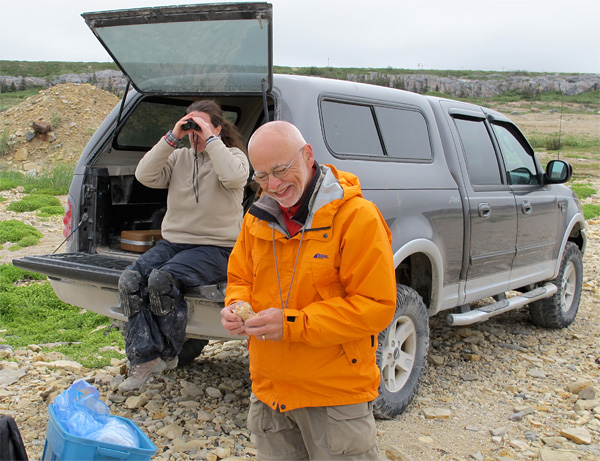
Debbie Thompson and Dave Rudkin, at lunchtime during Churchill fieldwork in summer 2011. Debbie is not using the binoculars to look for fossils: she is watching polar bears a kilometre away on the tidal flat.
I have heard several paleontologists state the maxim that you should always look for fossils in the exact spot you have chosen to have lunch. And there is some truth in this: I recall many years ago relaxing after lunch on top of a Silurian reef on the coast of the Gaspé Peninsula, pulling trilobite after trilobite from the gravel I was resting on. Similarly, last summer I found one of the most complete Ordovician eurypterid specimens at Airport Cove just below my seat on the slope, without having to move at all from where I had consumed my sandwich.

Part of an articulated eurypterid, found at Airport Cove last summer (photo © David Rudkin, Royal Ontario Museum)
Why should this be? Are we supernaturally drawn to eat at those places that hold the secrets we seek? This seems very unlikely. Rather, it is probably related to the fact that we look with “different eyes” when we are relaxed, yet those eyes still hold the image of what we seek. I was thinking of this as I walked to the bus this afternoon; it was the same old neighbourhood, but add a layer of snow and take a slightly different route, and you will see many things that you have not observed before.
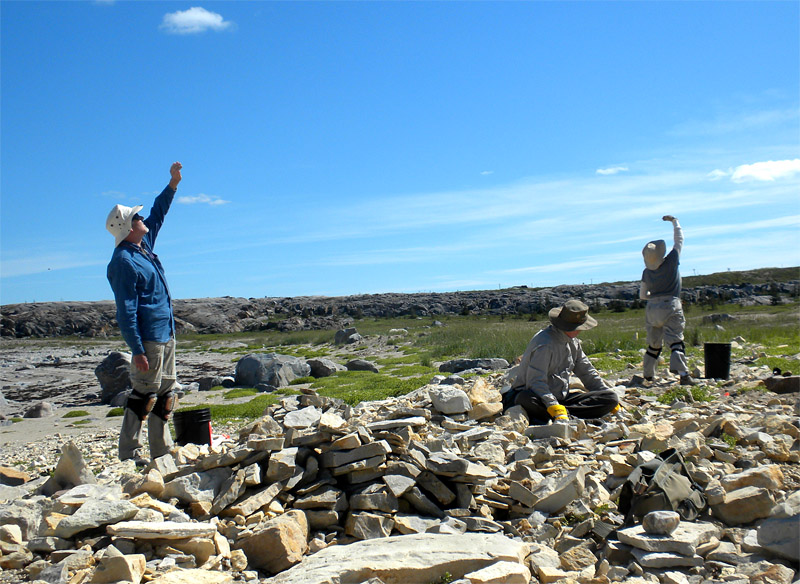
Looking with different eyes: no, this is not some strange sun-worshipping ritual. Rather, Debbie Thompson had told me that, if you blocked the sun at the right angle, you could see that the air was actually full of floating seeds. And she was right, though Sean Robson was clearly not convinced! (photo © David Rudkin, Royal Ontario Museum)
The other critical factor with lunchtime discoveries is that lunch provides an opportunity to look intensely at everything that can be seen in one tiny area. The entire fossil-collecting site may not be all that large, but we are still unlikely to see all the details if we are considering the site as a whole.
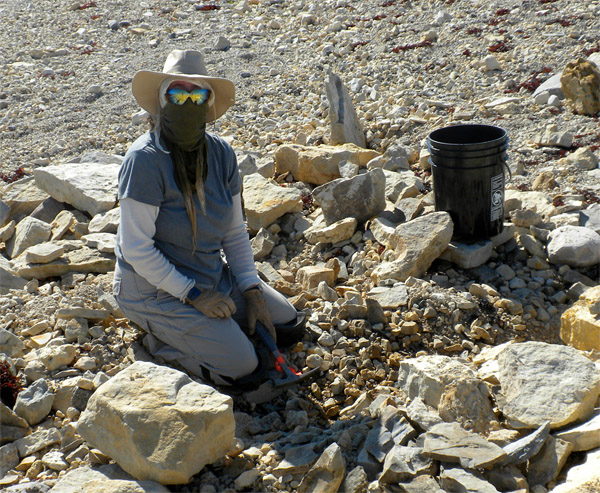
The aliens are among us, and they see things that we cannot. Debbie, protecting herself from the sun and the voracious flies, is hunkered down examine her little patch of rock. (photo © David Rudkin, Royal Ontario Museum)
It is far too easy for a place to become so familiar that we walk over it daily without ever seeing what is under our feet. I still find it shocking that the Airport Cove soft-tissue biota lurked for years right beside where we parked the truck, as we went to collect fossils such as trilobites and corals farther down the shore. Considering mineral exploration across the huge expanse of northern Ontario, it is also surprising that the immensely rich Hemlo gold deposit was not found in some unknown place far from human activity. Rather, it was in easy sight of where the Trans Canada Highway had been pushed through many years before.
It is for these sorts of reasons that I don’t find it the least bit restrictive to do research at a provincial museum. I might sometimes envy university colleagues as they fly off for fieldwork in India or Australia, but I also think that we are more likely to find unusual things here, because we have the opportunity to contemplate a limited area. Soft-tissue fossils in Konservat-Lagerstätten may be little known and rarely found, but that doesn’t necessarily mean that they are rare. It may just be that we aren’t all that good at finding them!
By focusing on smaller areas, we may be more likely to locate the really unusual and significant things. I would not be the least bit surprised if we find one or two more unusual fossil sites in the coming years; we just have to make the time to eat lunch on enough outcrops.

Ed Dobrzanski surveys the expanse of Airport Cove near low tide: it is a challenge to find unusual things in an immense area!
© Graham Young, 2011
Trimetallic Trilobites*
Looking on the shelf the other day, I realized that trilobites must be popular subjects for moulding and casting, as there seem to be various examples lying around in metals, plastic, and ceramic. They are, of course, attractive fossils, and have a form that makes them pleasing tactile objects. Perhaps cast trilobites have become amulets, modern equivalent of the scarabs treasured by ancient Egyptians?
I was most taken with three of the modern arthropodan amulets. Each is in a different metal, and each a somewhat different take on a medium-sized trilobite, in the range of 5-12 centimetres long (roughly 2-5 inches).
The first is an Isotelus in aluminum. This one, which resides on my office filing cabinet, is the result of a miscommunication.

The accidental aluminum arthropod. This is a replica of a specimen of Isotelus sp. from the Upper Ordovician Red River Formation, Cat Head Member, central Manitoba. (original specimen is in the collection of The Manitoba Museum)
Our artists, Betsy and Debbie, had made moulds of a couple of trilobites, to be used to produce stainless steel “touchables” for the Earth History Gallery. For some reason, the people at the metal casting place thought that aluminum was wanted, rather than steel. This resulted in this imperfect cast: too soft for the robust day-to-day handling that would happen in the gallery, and with an oddly flecked and roughened surface. So a re-cast was done, producing the excellent replicas that sit in our gallery, in front of the giant trilobite Isotelus rex.

This exhibit at The Manitoba Museum describes the discovery and significance of the world's largest articulated trilobite, Isotelus rex. The stainless steel replica Isotelus is arrowed. (© The Manitoba Museum)
The second metal trilobite, in brass, is another Isotelus. I’m not sure why Isotelus is such a popular trilobite for this sort of thing; maybe there is just a lot of it around!
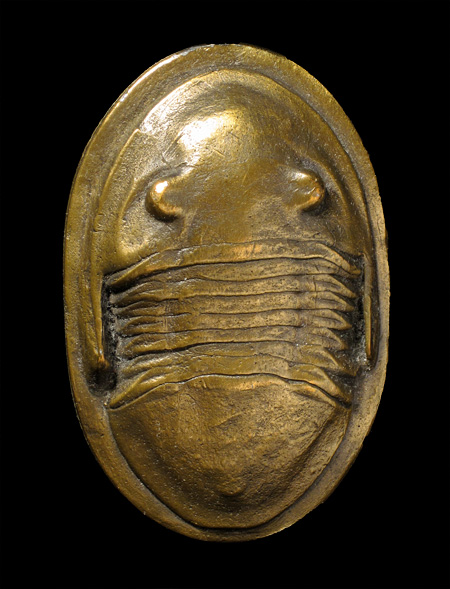
Isotelus belt buckle, Ohio Geological Survey
I bought this belt buckle years ago, back when the Ohio Geological Survey used to carry Isotelus-themed gift items in addition to their wonderful selection of popular publications (Isotelus is Ohio’s state fossil). The buckle is apparently a direct replica of a specimen of Isotelus from the Cincinnati area. I am guessing that it is I. maximus, but it seems a bit ambiguous in features; perhaps someone from the Dry Dredgers can either confirm or refute this identification?
There is no such classification issue with the last and best metalbite: this silver one is more the spirit of the trilobite than a depiction of a fossil.

"Trilobuckle" by Carolyn Young (I have had this for a long time and am responsible for the scratches!)
This is also a belt buckle, which I was lucky enough to receive as a gift from its maker, my sister Carolyn. She was not aware of the Isotelus belt buckle at the time, but had thought that a trilobite was a worthy subject for such a piece. This lost-wax one-off was loosely based on at least a couple of the Cambrian trilobites that I described (with Rolf Ludvigsen) a very long time ago, blended with a large dollop of creative licence.
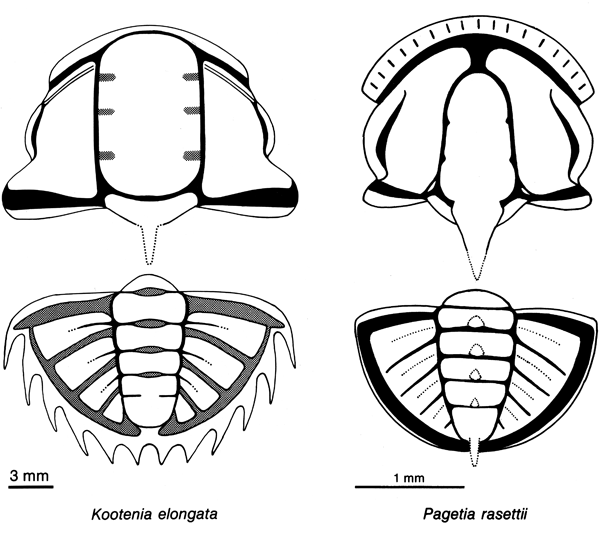
Sketches of components of two mid-Cambrian trilobites from western Newfoundland (Young and Ludvigsen, 1989)
© Graham Young, 2011
Reference:
Young, Graham A. and Rolf Ludvigsen. 1989. Mid-Cambrian trilobites from the lowest part of the Cow Head Group, western Newfoundland. Geological Survey of Canada, Bulletin 392, 49 p.
* Yes, I know that “trimetallic,” strictly speaking, might only be considered to refer to sheet metal composed of three different metals bonded together. But it is hard to find alliterative titles, and the trilobites ARE composed of three different metals, when considered together!
Looking at Windows

Exchange District, Winnipeg (photo by Juliana Young)
The past couple of weekends we have been installing the storm windows on our tall old house. As I pull them from the rack in the garage, I find that every few windows there is one that needs a bit of repair: some putty to replace, a hook that needs tightening, or a strengthening plate to be added. This is work that gives me time to think about anything and nothing. Usually it is the latter, I admit, but when I do think, one of the things I find myself contemplating most is the windows themselves.
These windows are presumably almost 90 years old, the same age as the house. Their materials are simple: frames of clear hard fir, a bit of steel hardware, glass, paint, and mastic putty. This traditional sash window/storm window system is based on a combination of renewable resources and plentiful, nearly infinite Earth resources (silica sand, iron) that could be sourced locally in many parts of the world.

Rain through Fredericton windows
If we had a “100-mile diet” for construction materials, then the traditional sash window could feasibly have the majority of its components sourced within that radius. Somewhere like Winnipeg, wood of suitable quality might be a scarce commodity if we were to depend on local trees, but nonetheless most of the window (other than the steel hardware) could come from resources near at hand. Since windows have always been among the more complex parts of a house, what holds for the windows probably holds for much of the rest of the house, too.
(We Don’t) Expect the Unexpected
“Unless you expect the unexpected you will never find it, for it is hard to discover and hard to attain.” – Heraclitus (writing some time around 500 BC)

A standard field posture: splitting rock at the William Lake site. (photo © Dave Rudkin, Royal Ontario Museum)
At the Geological Society of America meeting a couple of weeks back, I attended many presentations that shared new scientific results (yes, including that now-famous talk about Mesozoic kraken). Some of these lectures I found quite exciting, and a couple were genuinely eye-opening. The eye-opening ones were about scientific work that is closely related to mine, but with results that were either quite different, or that said things that I really had not thought about.
In other words, they were unexpected.
As a paleontologist who works in an area that depends partly on the discovery of previously unknown fossils, you might think that I would not be surprised by new discoveries. After all, my job is partly to go out and find things that people have never found before. But how do I do this? I do it by studying where and how people have found other strange things, and by developing hunches based on where we have found unusual fossils. In other words, I am influenced by experience, and depend on my expectations.
Forest Fire Revisited

Each day, driving between William Lake and Grand Rapids, we pass the site of the 2008 forest fire. One evening near sunset the light is perfect, and Dave and I stop to take photos.
The ground is green, but above where there should be canopy is only superstructure. The trees slowly disintegrate, branchlet to branch to trunk to stump. As extremities crumble, so the bark unfurls to reveal white skeletons beneath. These bones are desiccated, hardened to freeze-dried iron toughness, but as summers pass they too will fall to time and decay.
No birds sing, and the wind soughs gently between the trunks; I wonder if it wonders why it makes so empty a sound. Under the cold setting sun it is an eerie place.
We contemplate for a minute or two and snap a few more shots. It is definitely time to see what is on the menu in Grand Rapids. Somewhere warm, where there are people.


© Graham Young, 2011
A Giant Leap?
Skimming the digital waves this evening, I noted that an awful lot of zeros and ones are being consumed by a single presentation among the many hundreds of papers at this year’s Geological Society of America meeting. Unlike the commentators whose pieces I saw concerning this talk, I actually attended Mark McMenamin’s presentation about an ichthyosaur death assemblage in Nevada this afternoon. Therefore, I have seen rather more than those writers about this idea that the bones of Shonisaurus had been laid out by giant cephalopods as some sort of Mesozoic environmental art installation (imagine, perhaps, a monstrous molluscan Richard Long working with enormous vertebrae as his medium).
The bloggers are quite correct that this presentation travelled some considerable distance into the realm of pure conjecture and imagination, and that many in the media exhibited bad journalistic practice by homing in on this talk without seeking comment from other scientists.
As I sat through McMenamin’s presentation it struck me that, taken individually, most stages in the exposition were unremarkable and in fact similar to sections of many other scientific presentations. Scientists work by making inferences from the available data, and most of us try to be as thorough and cautious as humanly possible. Nevertheless, the discussion part of a scientific paper will typically have some elements that reach into speculation. If the solid data are considered as “A”, then a paper’s discussion will typically say, “since A is known to have taken place, therefore B is likely.” And I have seen countless conference presentations (particularly in fields such as dinosaur paleontology) where the presenter felt the freedom to speculate further, saying, “since A took place, and B is almost certain, therefore C is also likely.”
The basic issue with today’s presentation is that McMenamin took this several stages farther, saying effectively, “since A is true, B is almost certain, and C is likely, so therefore D may have occurred, and thus E followed, and F, and …” Each step in the progression was a relatively small one, but their cumulative effect was a giant leap into a place where the suggestions were no longer supported by science. Like a stealth predator, conjecture crept up on science, overwhelmed and consumed it, and then placed the few robust facts into an artistic and intriguing arrangement.
This is unfortunate; it was an interesting idea, and I would love to see McMenamin follow this up with the years of field- and lab-based work that would be required to demonstrate whether his conjecture is at all likely. But without this sort of slogging to support it, it will remain just that: conjecture.
Incidentally, this talk followed after an excellent student presentation about fossil lungfish burrows in Madagascar; why don’t the media consider taking a look at some of the superb student work that is being shared with us here?
Autumn Sojourn

I realize that it has been a while since my last post on this page. It might be considered a fair excuse that “I’ve been busy,” and that is true in part, but this time it was also something more than that. I am often busy, but the busy-ness of late has been of a sort that seems to preclude blog-writing. Almost everything I have been working on has occupied the visual/spatial part of my brain: I have been drawing diagrams, and when I wasn’t drawing I was editing and laying out photo plates or posters, and when I wasn’t doing that I was tracing fossil comb jellies under the microscope.
All very enjoyable tasks, but when I tried to switch to writing I found that the words just would not flow. The middle-aged brain can still do each sort of thinking very well, but its flexibility has clearly diminished. It is much tougher than it used to be to switch from one type of work to another, so it seemed most reasonable to give the blog-writing a break.

A purposeful-looking Dave Rudkin is dressed to address the cold northeast wind.
I also gave the drawing/sketching/photography a break last week, however, as Dave Rudkin and I had scheduled a bit of fieldwork in the Grand Rapids Uplands (several hundred kilometres north of Winnipeg). It was wonderful to spend a few days splitting Ordovician bedrock and examining the surfaces for horseshoe crabs, eurypterids, jellyfish, and whatever other creatures might decide to pop out.

We spent hours crouched over the bedrock surfaces.
It was chilly the first day with a bitter northeast wind, and the blackflies showed up in swarms when the wind subsided, but the repetitive activity in this peaceful place was very good for the soul. And the site has continued to yield fresh treasures: we came back to Winnipeg with a modest number of slabs of rock, but these contained articulated horseshoe crabs, eurypterids, and a couple of superb jellyfish.

My set of collecting tools: crack hammer, splitting chisel, Gad pry bar, and brushes.
Now I am back to the “real” work world of report writing and administration, so my brain is more than happy to take a break and write a couple of blog posts. As long as they are as simple and undemanding as this one!
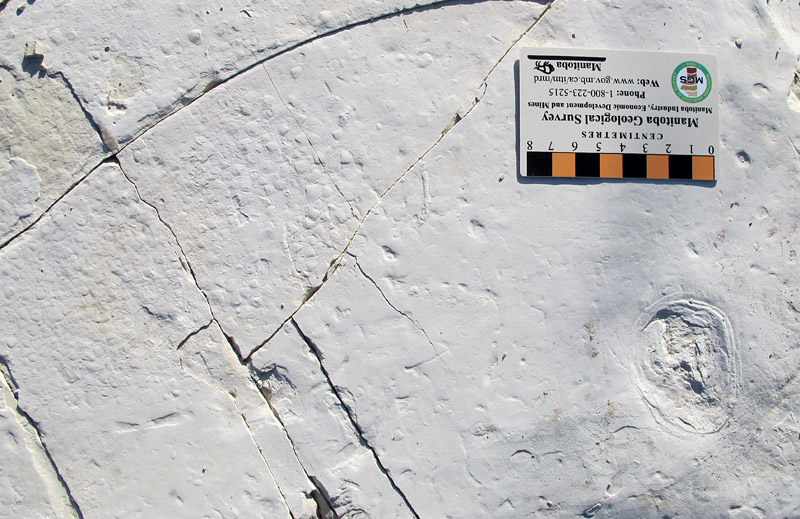
Abundant linguloid brachiopods to the left cover a bedding plane surface. The jellyfish on the right is in a mud body that overlies the brachiopod layer.
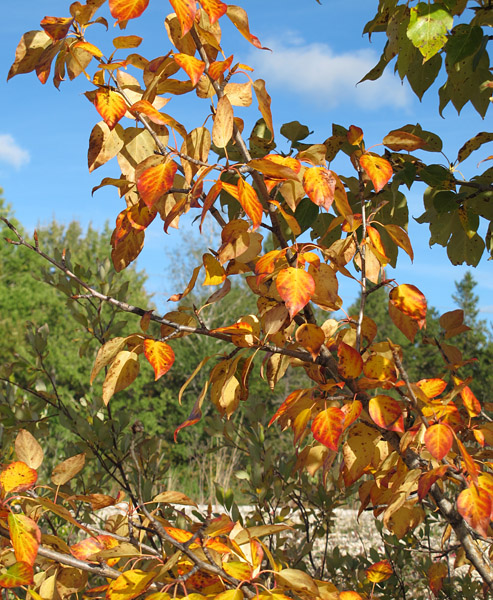
Autumn in the Grand Rapids Uplands was already well along.
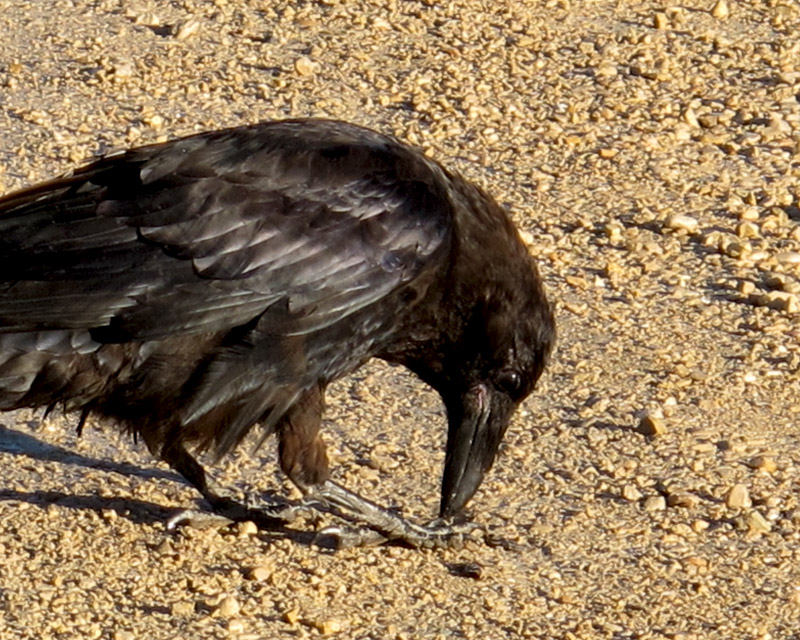
Ravens are everywhere in the Uplands!
© Graham Young, 2011
If anyone ever asked me about this, I’m sure I would have thought that the role of the horseshoe crab in art of any era was limited. In fact, until a couple of weeks back I would have stated that any role for limulids was nonexistent, as I had never seen a reference to horseshoe crabs in a work of art in any major gallery. But earlier this month I was at the Museum of Modern Art in New York, and glancing into a small case of sculptural works I saw this piece:
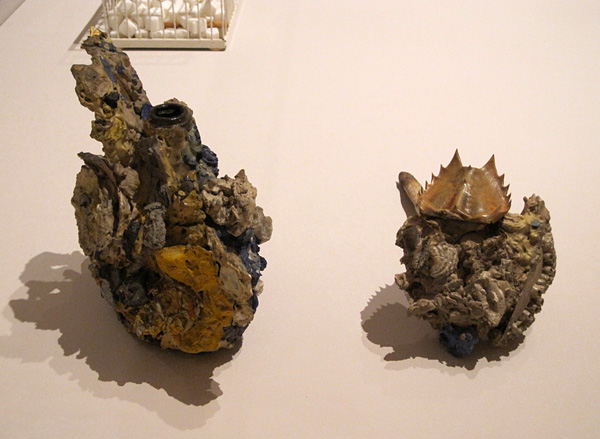
The label stated:
Lawrence Vail
American, 1891-1968
Bottle 1945
Glass bottle and stopper encrusted with shells, glass, barnacles, coral, and metal
Gift of Peggy Guggenheim, 1965
Of course, what caught my eye was a wonderfully sculptural natural form attached to the stopper of the bottle. This elegant shape, above the barnacles and other encrusters, was the thoracetron of a horseshoe crab.
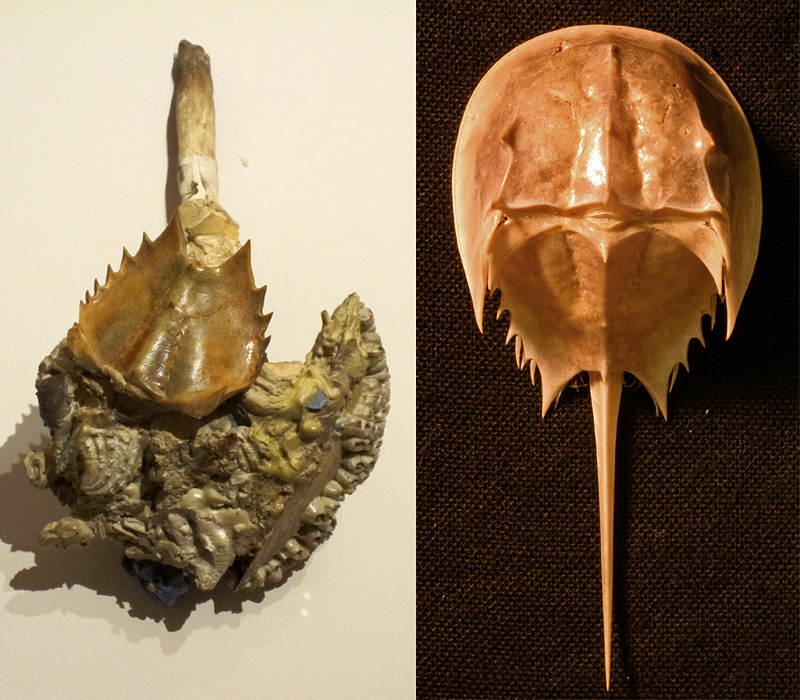
The stopper on the left, with a preserved horseshoe crab specimen for comparison
I had to know why or how this piece came to be, since it is the only modern art work I have seen that contains a xiphosurid (though other marine arthropods appear, such as in Salvador Dali’s Lobster Telephone). As I dug into the story of this Vail piece, I realized that it, like the Lobster Telephone is something of an artistic joke. In fact, based on my slender research I would venture to say that Vail’s bottle is very close to 100% joke.
Lawrence Vail, or more accurately Laurence Vail, was the scion of an American artistic family, son of the famous painter Eugene Lawrence Vail. He was a writer and artist associated with the Dadaist movement, but perhaps more notable as a drinker who consorted with Ernest Hemingway and Ezra Pound. It was in this latter avocation that he attracted the attention of the New York Times, as he was arrested in 1926 for hitting a French captain, Allain Lemerdy, with a champagne bottle in a Montparnasse cafe. The possible jail sentence was dropped when, during negotiations between families, Lemerdy fortuitously fell in love with and became engaged to Vail’s sister.
It might be as a result of this episode, or more likely a development from Vail’s longterm relationship with their contents, that much of his artwork seems to have been based on bottles. Many of these are unusual and interesting pieces, but in comparison with some of these other works the bottle in MoMA looks like a bit of a throwaway. I did not examine it thoroughly enough to determine how it was constructed, but it looks as though it may be a naturally-encrusted bottle discovered on a beach, augmented with a few additional items such as the horseshoe crab tail.
As such, maybe it fits into such (possibly) found-art pieces as Marcel Duchamp’s brilliant Fountain, but as a museum scientist I have to say that I see it as an appropriation of voice more akin to Damien Hirst’s pickled creatures. I enjoy such works, I find them entrancing, but at the end of it all they are facile and completely shallow. I really think that the artists, like so many other humans, exhibit no affinity whatever for the creatures they have chosen to exploit, and this is a great pity.
But perhaps someone else knows of a work that shows the soul of the crab?
Text © Graham Young, 2011. The artwork shown is in the collection of the Museum of Modern Art, and the Limulus specimen is at The Manitoba Museum.
Morquartzite
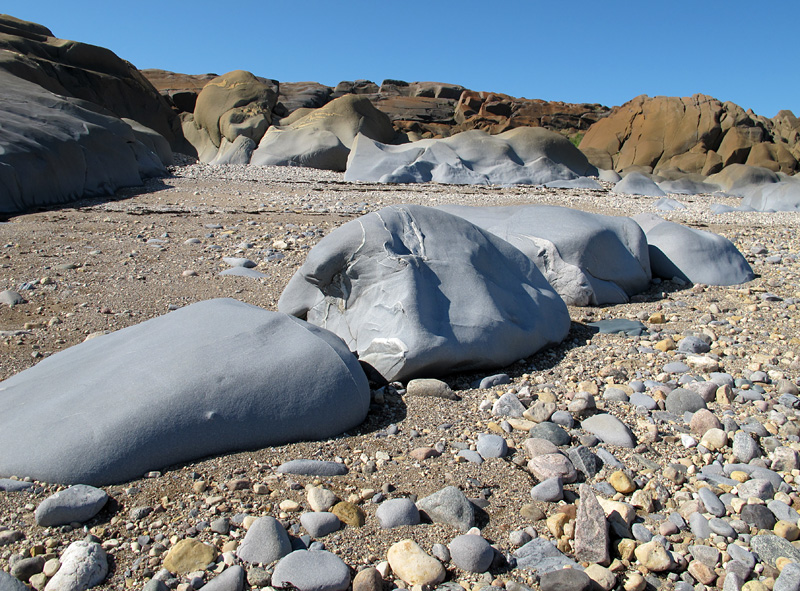
Boulders on the shore, with the quartzite scarp behind
A couple of years ago I wrote a post about the Proterozoic Churchill quartzite. At the time, I thought that I had said all I would ever need to say about this beautiful tough metagreywacke. But on July 25th of this year, we visited the sculpted scarps east of Churchill, and the stone was looking so completely photogenic that I ended up with dozens of fresh photographs. This is a small sample.
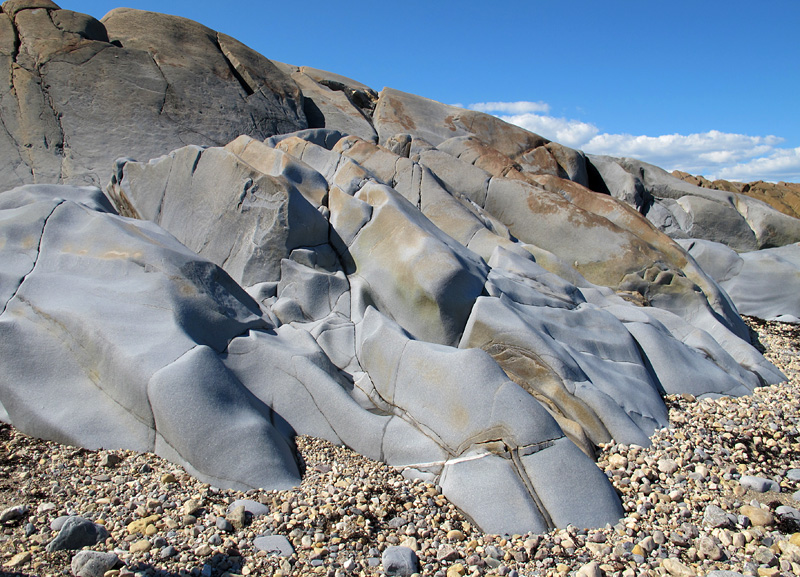
Weathered "fingers" of quartzite extend toward the bay.
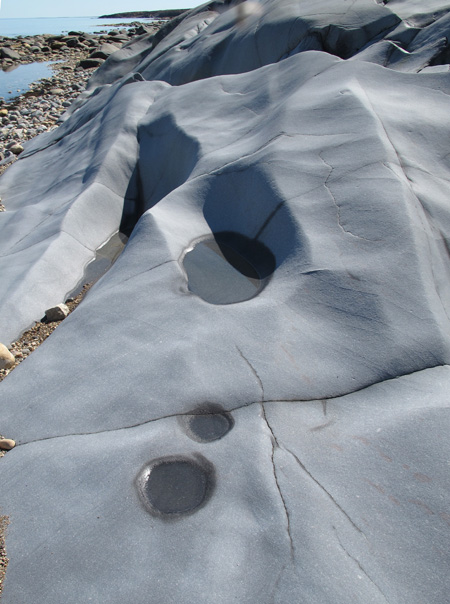
Temporary pools on a quartzite slope
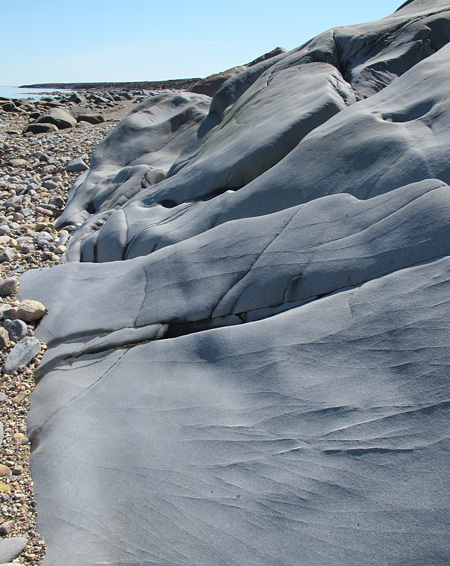
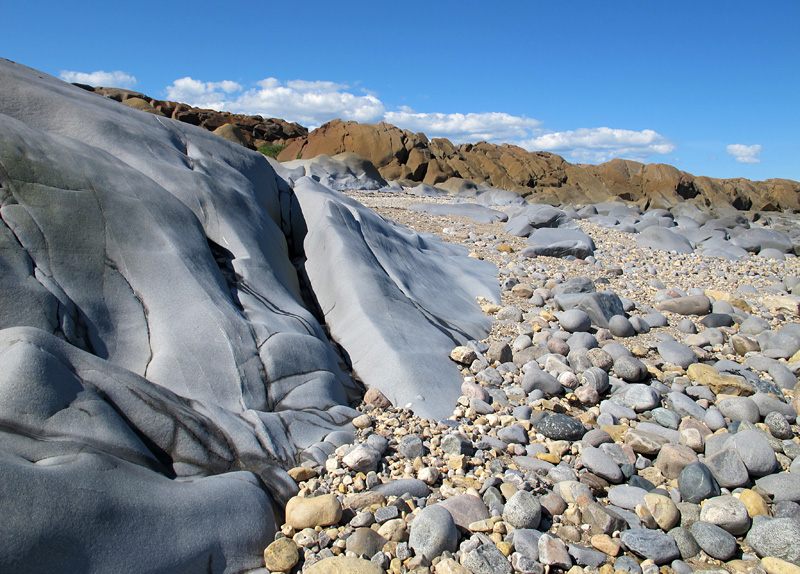
Varied forms along the scarp; the rocks behind are coloured by orange lichen.
© Graham Young, 2011


 Ancient Shore