Evolution and Extinction of the F-150 Community
Wherein we examine the brief flowering of a wonderfully diverse marine ecosystem, the incursion of nefarious invasive species, and an eventual collapse and extirpation.
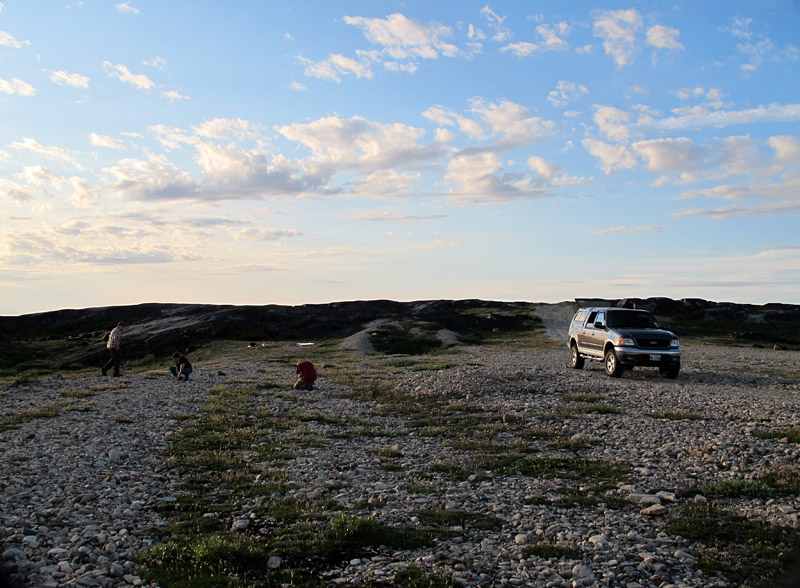
Once upon a time, there was a Ford F-150 truck. This well-aged vehicle was the trusted field conveyance of a group of paleontologists enjoying the dusty Churchill summer. When first seen, the truck’s surface was smooth and unmarked. It was a blank canvas, a fresh environment ripe for colonization.
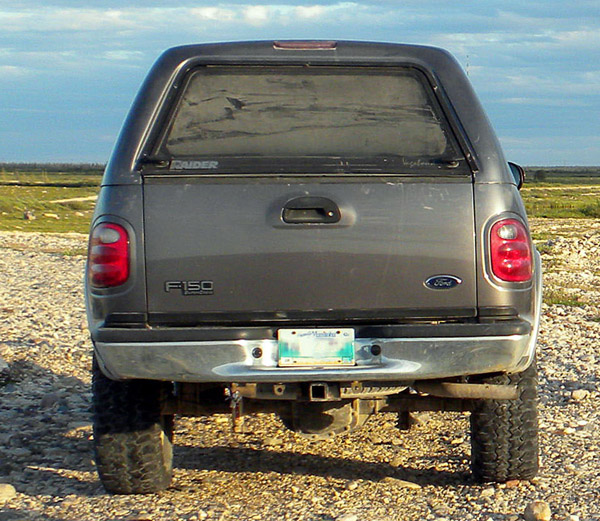
(photo © Dave Rudkin, Royal Ontario Museum)
The potential of this substrate was recognized by opportunistic species (chiefly Matt and Debbie). These moved in to colonize it.
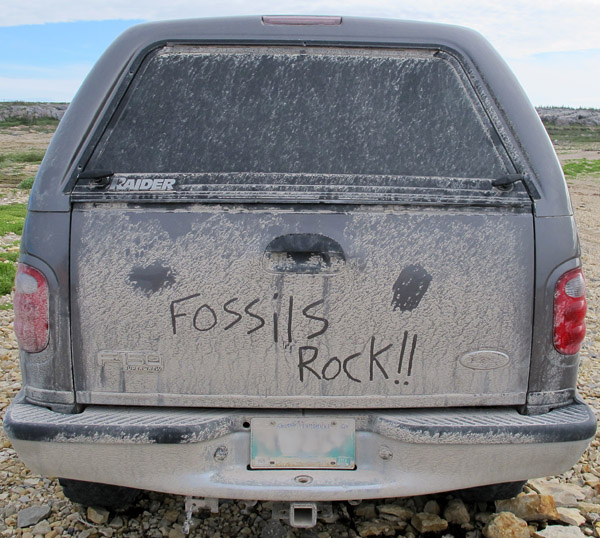
This colonization was followed by an interval of diversification in the marine realm. Life on land did not yet exist.
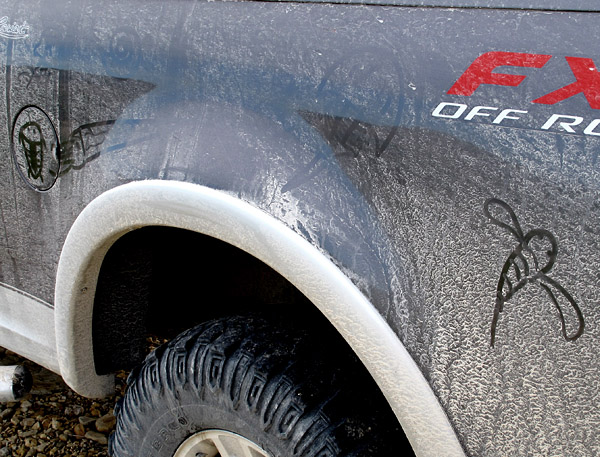
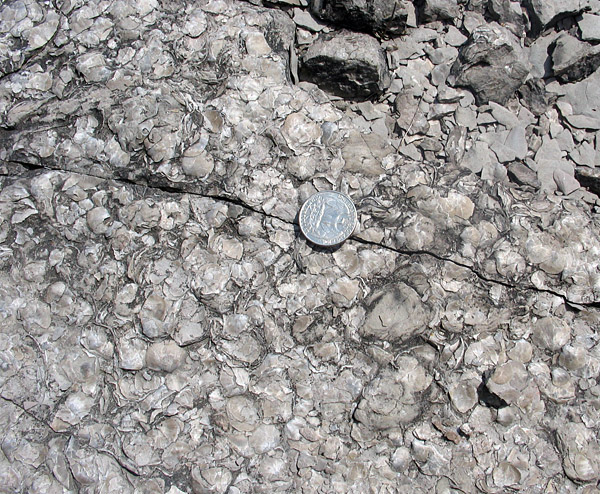
Some elements of the community, such as the jellyfish, were relatively simple.
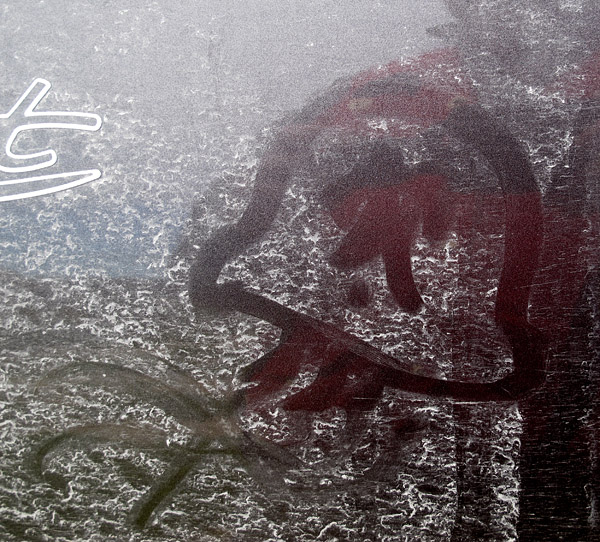
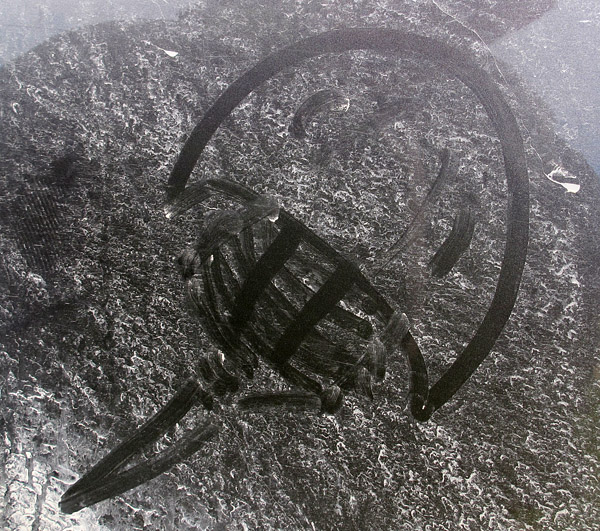
Others, such as horseshoe crabs, were complex and showed considerable innovation.
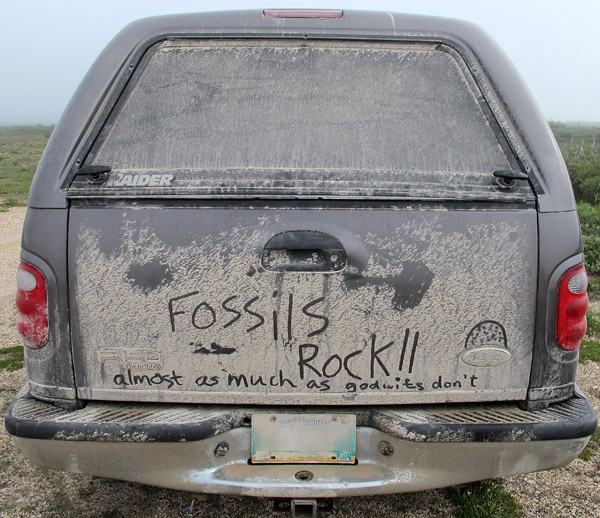
The community evolved and diversified, until one evening there was a sudden incursion of invasive species in the form of some ornithologists who parked their truck near ours. They modified the community with the statement that “Fossils rock almost as much as godwits,” an assault blunted by the indigenous biota with the addition of a defensive “don’t.” Note that, by this time, every bit of available hard substrate (such as the Ford insignia) had been colonized by benthic epifauna.
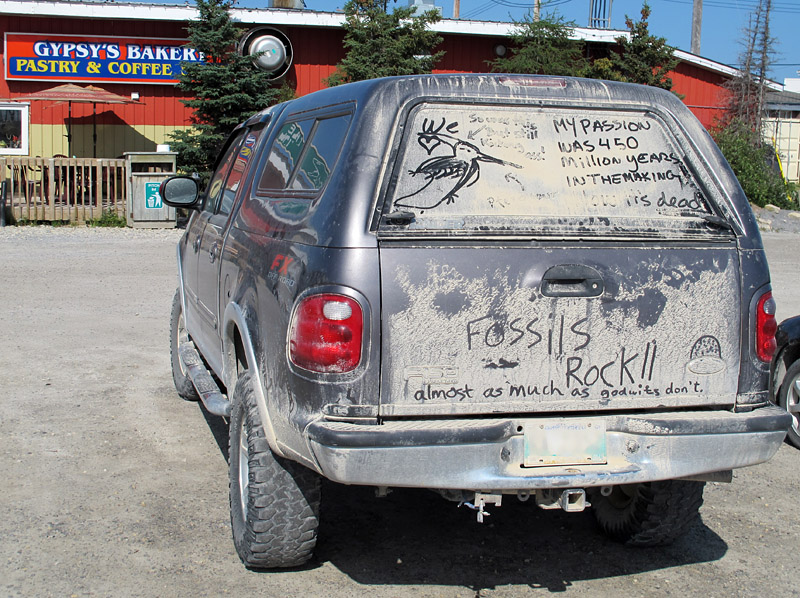
Although the initial incursion was successfully countered, there were further invasions in the following days, resulting in community instability and chaos. In the final days, land life appeared, typified by a godwit that underwent modification into a scruffy-looking pterosaur.
The entire ecosystem, in this unstable form, was clearly ready for collapse. Nevertheless, science could not predict how this would occur. As it turned out, the mass extinction was sudden, shocking, and catastrophic. In a few seconds on our last morning, a dramatic event spelled the doom for all of this wonderful and diverse life.
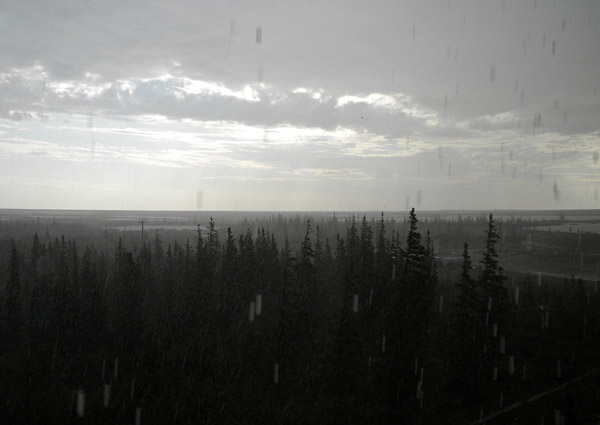
(photo © Dave Rudkin, Royal Ontario Museum)
Will the fauna ever recover? Will we see its like again?
© Graham Young, 2011 (with thanks to Matt Demski, Debbie Thompson, Dave Rudkin, and a flock of guerrilla ornithologists)
Zen Garden Tidal Flat
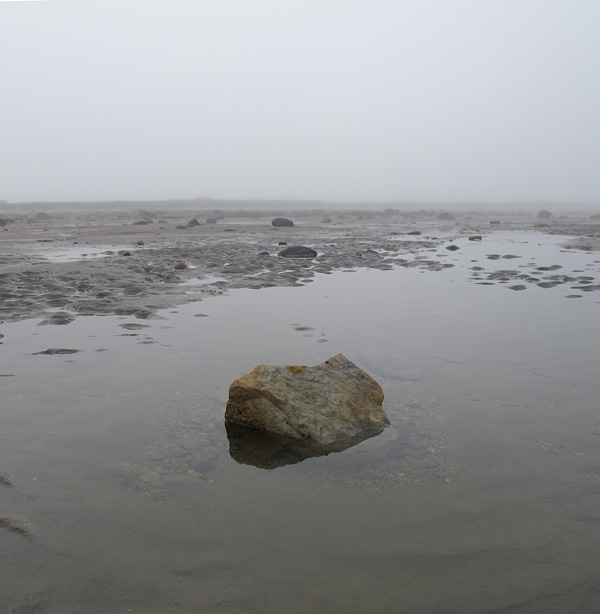
Since I study the creatures that lived along ancient shorelines, I often contemplate tidal flats. This is, however, a scientific, mostly objective contemplation.
This evening I saw another side of these wonderful places between sea and land. We took a walk in Bird Cove near Churchill, Manitoba, and in the quiet bright fog it was a place of utter peace and openminded contentment. As my friend Debbie pointed out, it was like a Zen garden, and we felt a serene calm as we walked slowly and silently back toward the shore. The only hindrance to reaching a higher plane was that we had to remain constantly vigilant in case a polar bear just happened to wander up through the thickening mist.
These are tonight’s photos.

Broad shallow channels shine silver in the fog.
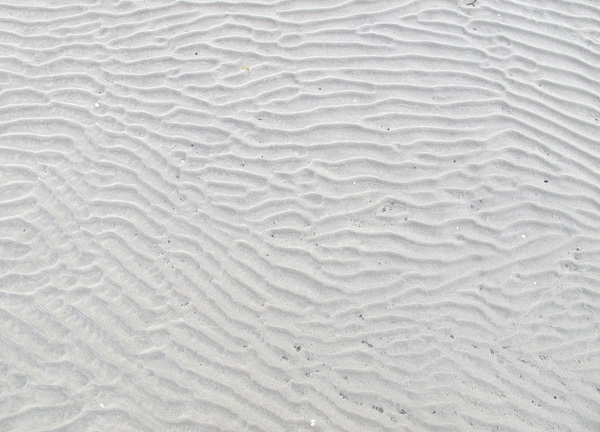
Ripples form a Bertillon Pattern.

A knob of Proterozoic Churchill quartzite looms out of the fog.
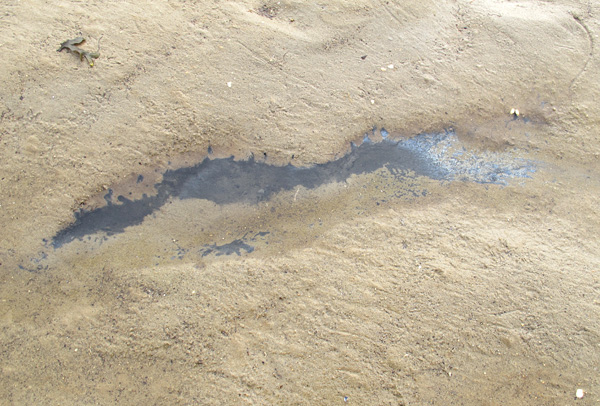
This narrow pond penetrates into the dark reduction zone hiding below the pale sediment surface.

From some angles the ripples seem to go on forever.

Interference ripples take on the appearance of a ruched fabric.

If only the snails that made these tracks could spell, they would produce a beautiful cursive script.
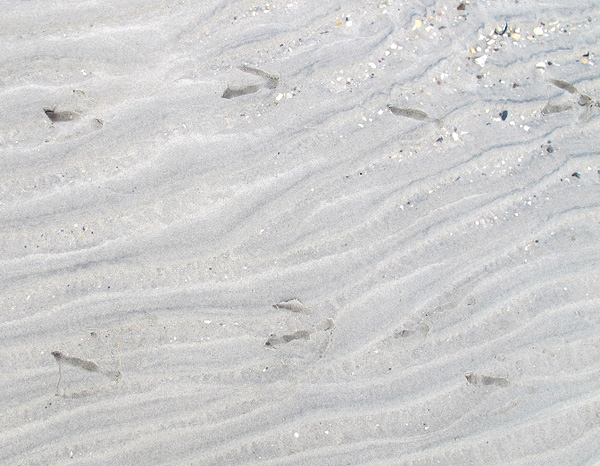
Ten out of ten paleontologists think of Velociraptors every time they see large bird tracks. These particular theropod prints were made by a Canada Goose.
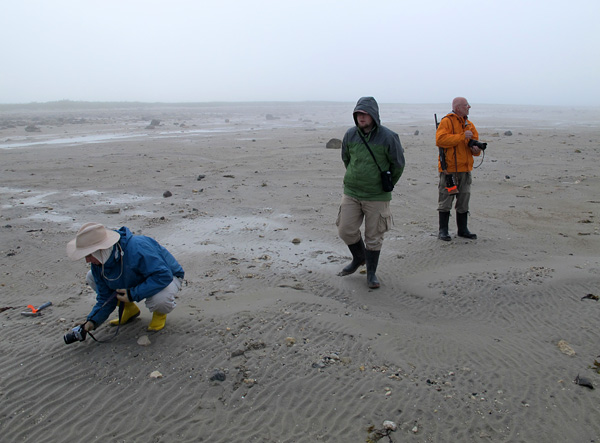
In Bird Cove this evening: Debbie Thompson, Matt Demski, and Dave Rudkin
© Graham Young, 2011
To the Shore
Scenes from Northern Summers (3)
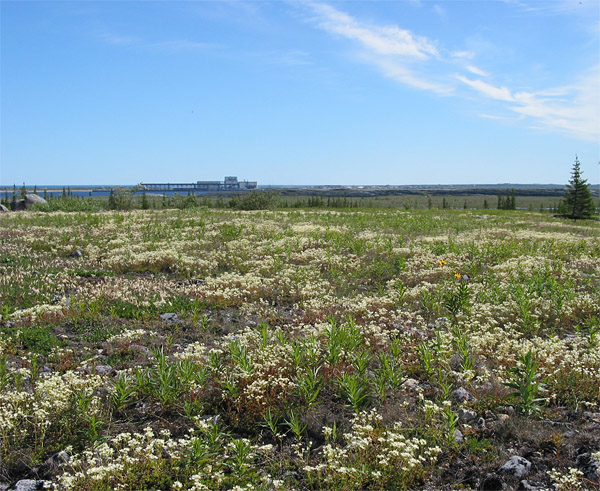
At the peak of summer, the Port of Churchill is viewed through a field of wildflowers on the east side of the Churchill River ...
We are headed to Churchill next week for the first time in several years, off to pay our respects to the blackflies, belugas, and yes, bears. From a respectful distance in the case of the latter, if at all possible.
With that in mind, and with hopes of adding many fresh images to the stock, here is a random sampling of photos from the early 2000s.

... and under a stormy sky from the tidal flats of Airport Cove.
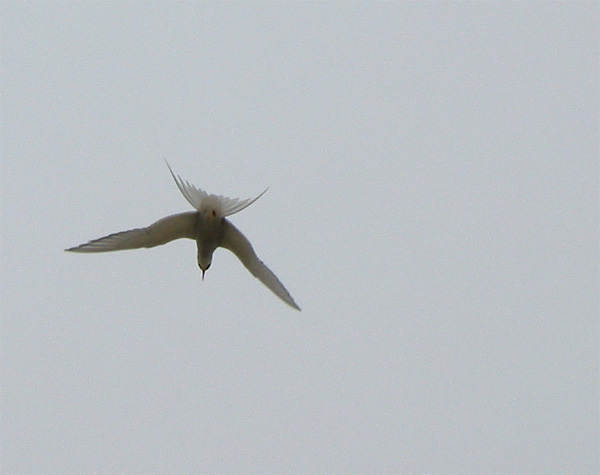
Look up! A divebombing tern screams just above my head.

The slab--sided hulk of MV Ithica, a fixture in Bird Cove for the past 50 years.
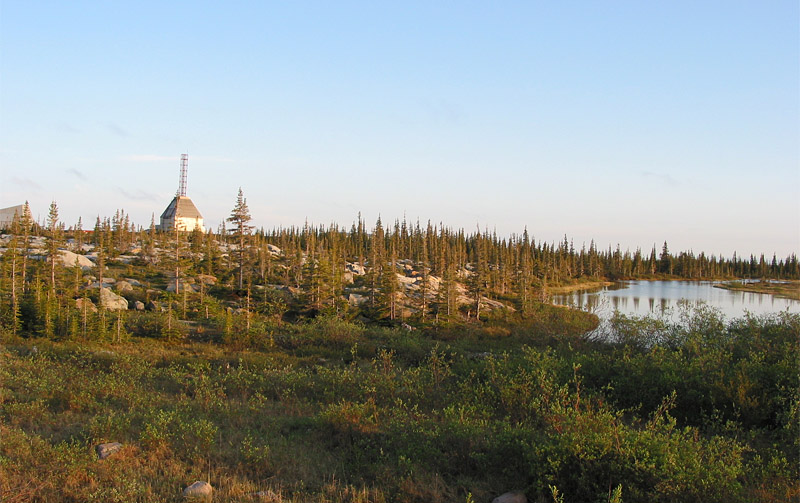
The old rocket launch facility stands above quartzite and spruce.
© Graham Young, 2011
Apples and Oranges?
The question about evolution posed to contestants at the recent Miss USA Pageant has generated a lot of discussion on the internet. Much of this has, of course, focused on the sad state of scientific education in schools, but perhaps more noticeably on the apparent ongoing clash between science and religion.
Yesterday, my friend Julius Csotonyi posted a link to an article about whether an acceptance of evolution should be described as “believing in evolution.” Julius stated eloquently that,
“there is a popular misconception that the thumbs-up that all serious scientists give the theory of evolution depends on a measure of blind faith in the same way that religious views depend on faith. It does not. If one were to examine the mountain of evidence that supports evolution …, I contend that they would find it impossible to conclude that there is any weakness in the theory as a whole, even though there is some disagreement over some of the fine details (as is the case with any healthily and actively researched field of science). Therefore, similar to how this article points out, I avoid the use of the ‘believe’ when talking about verifiable scientific theories such as evolution.”
The Kaali Craters
Island of Saaremaa, Estonia
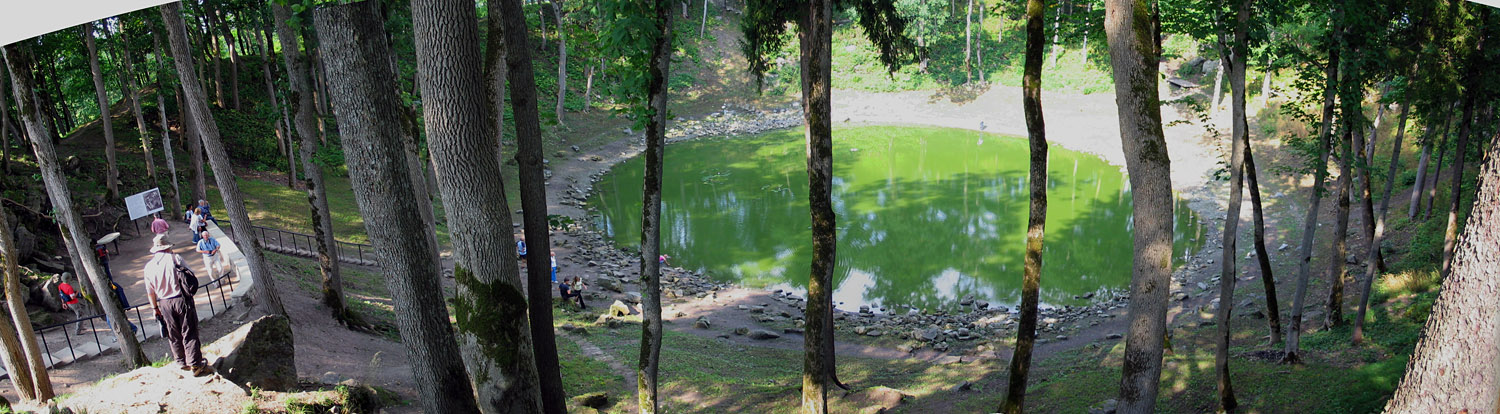
Panoramic photo composite of the main crater (click on the image for higher resolution)
This weekend I have been reading Mark Wilson’s posts about student fieldwork on the Island of Saaremaa. This reminded me that I have long been planning to post these photos, which have been sitting around gathering digital dust for the past three years.
The Kaali craters are shocking. They are some of the freshest meteorite impact structures that you could possibly experience, short of finding yourself in in the path of one of those “RV-sized” chunks that will pass the Earth tomorrow. These craters are a bit older than tomorrow, but geologically speaking they happened just yesterday. Age estimates seem to vary, from about 3000-7500 years old; the craters have seen little erosion and exhibit crisp rims of tilted dolostone.

Trees grip the stone of the crater rim
They were formed by the impact of quite a large iron meteorite, which at time of impact is estimated to have weighed 20-80 tonnes! There are actually nine craters within one square kilometre. These photos are of the main crater, about 100 metres across, which contains Kaali Lake.
As is appropriate for the pleasant, civilized Island of Saaremaa, the Kaali craters have become a modest and polite rural tourist attraction. Unlike the Niagara Fallses of this world, they do not trowel on the pancake makeup and oversell their wares. But then again, they have no need. They are the real deal: fresh structures that startle you with the immediacy of a catastrophic natural phenomenon.
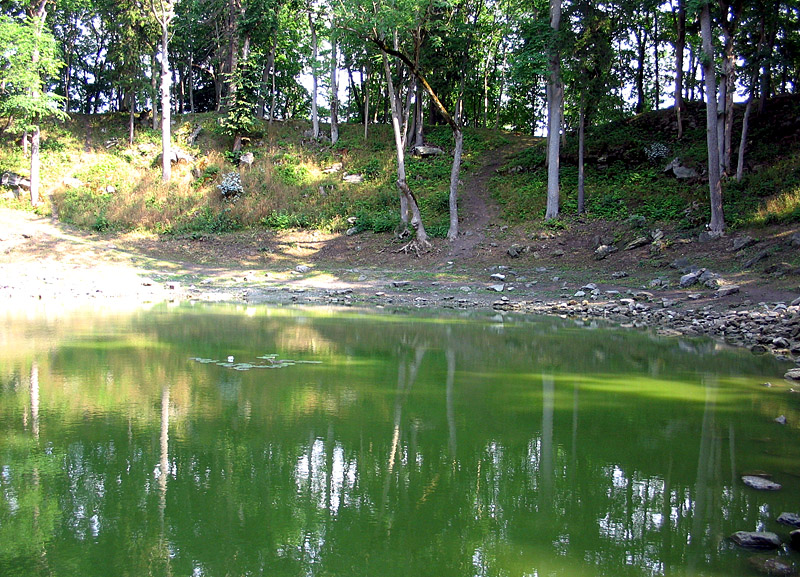
The surface of Kaali Lake
© Graham Young, 2011
Nine Things Noticed …
… at the Canadian Museum of Nature

Walking through the freshly renovated and re-opened Canadian Museum of Nature in Ottawa the other week, I was pleased to see the school groups and families enjoying the museum experience. There are some excellent new exhibits, and the visitors were busy with the obvious crowd favourites: the big dinosaurs, the blue whale skeleton, the splendid mineral cases.
I was enjoying the exhibits too, but as a museum person I tend to get distracted by technical details: word counts, case design, floor plans, materials, and lighting. Always lighting!
I also try to look for the good things that other visitors might not take in: the small details that give exhibits extra impact, and the less obvious fossils, building stones, and architectural details. The Victoria Museum building has just passed its centennial; its “Scottish baronial” architecture may lack the exuberance of some of its Beaux-Arts counterparts, but it still holds some interesting features. And of course there are all sorts of treasures hidden between the dinosaurs.
With that in mind, here in alphabetical order is a haphazard selection of features that some visitors might not notice:
1. Horsefly and McAbee Fossils
The Horsefly and McAbee are wonderful fossil-rich sites of Eocene age (a bit more than 50 million years old), in the interior of British Columbia. The fossils occur in sediment that had been deposited in basins between the mountains; they include life forms of forests, lakes, and swamps. As the small exhibit near the back end of the paleontology gallery demonstrates, these fossils are special, some of the best-preserved anywhere in the world.

Fossil fish Amyzon from the Horsefly fauna
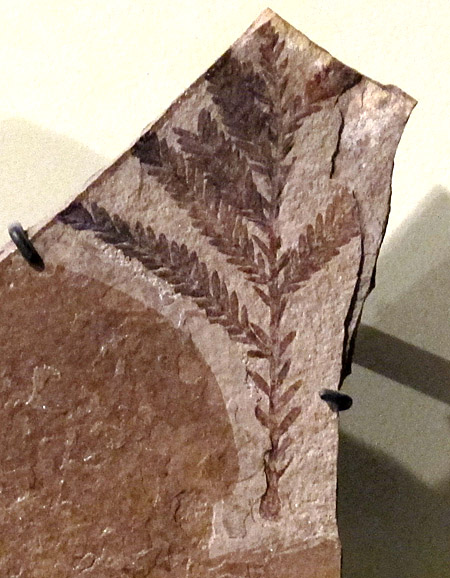
A twig of the "dawn redwood" Metasequoia, from the McAbee biota
Read more…
Peak Fossil
A little while back, my daughter jokingly asked me, “What will you do for a living when they start to run out of fossils to study?”
As is the case for any funny line, there was a grain of truth in that. Fossils can be considered as natural resources, as non-renewable as oil or nickel. Could they ever run out? Could we, in fact, reach peak fossil?
Thinking about this, I realized that peak fossil could refer to several different things. Most obvious is simply the total quantity of fossils in the world. Considered in that sense, there is no danger that we will ever pass peak fossil. Many limestones are composed largely of fossils; smack any random piece of limestone with a hammer, and you have a good chance of breaking a fossil. And there are so many other kinds of fossils: microfossils in deep-sea shales, trace fossils, bones of land vertebrates in sandstones … it is ludicrous to even contemplate that fossils, broadly defined, will never be tremendously plentiful.
Nothing but brachiopods: Ordovician limestone in the Cincinnati area
Swammerdam’s Mosquito

Swammerdam's depiction of the mosquito larva (left) and pupa (right)
As water covers the prairie landscape this week, I’m sure that Winnipeg will soon be engaged in its annual battle with mosquitoes. Long before there was a Manitoba, the mosquito, which some jokingly call our “national bird,” was already well understood scientifically.
This is thanks largely to the work of the great Dutch microscopist Jan Swammerdam (1637-1680), whose illustrations are shown here. Working with incredibly primitive microscopes, Swammerdam was among the first to document insect life cycles, and to carry out detailed studies of these creatures using dissections. What I find remarkable is how well his documentation stands up, more than 300 years later.

The adult mosquito, and details of mosquitoes' heads
As this work so abundantly shows, much careful observation had to be done before ideas about systematic classification could really develop. And much additional observation would be done, by many patient scientists, before a clear theory of evolution would be put forward. The edifice of natural science is constructed of many such building blocks.
Sadly, and perhaps ironically, Swammerdam did not live to see the publication of some of his most important work. This man, who had subjected so many deceased mosquitoes to such indignities, met up with an extant one that happened to carry the malaria protist within its salivary glands. He died from this last contact with the insects, at the age of 43.

The heads of insects and other features are depicted in exacting, almost painful detail. Even with a modern microscope it can be difficult to make out such features.
These illustrations are from the first English edition of Swammerdam’s work, published in London in 1758, about 80 years after his death. Many thanks to my mother, Mary Young, for kindly passing her copy of this edition on to me; she herself had received it as a gift in the 1950s. I thought it only fair that I should share it with others, and this seems the best way to do it!
Changing the Channel
How are political parties like cable television packages?
This blog is generally about science and related ephemera. This morning, in the wake of the Conservative Party’s victory in Canada, my thoughts were about how people make their voting decisions on the basis of a selective subset of what each party stands for. Which may not sound much like talking about science, but I assure you that it is related.
When people vote for a political party, they generally home in on the part of the platform that most interests them, whether it is taxation, health care, or a moral issue such as abortion. In so doing, they ignore (or may actually be ignorant of) the party’s stand on other issues. In this sense, choosing a party is much like purchasing cable TV. Cable companies often offer channels in “packages,” where to get what you want you also must receive a lot of other things. You know why you are buying the package, but you probably never even look at the parts of it that are at some remove from your areas of interest.
In voting for a Conservative government, it seems that Canadians have selected the package that has the family channels, sports, and economic news channels that they want, but unfortunately they have made this decision for all of us. Did we all really want that 24-hour channel of nonstop monster trucks and tractor pulls? Why does this package have no arts channels other than country music?
From my perspective, a real concern is that the scientific channels now seem to feature a mix of “intelligent design” justification, gee whiz pieces on new entertainment devices, and climate change denial advertisements funded by big oil.
Canadians have long been envied by scientists in some other countries because our government provided solid funding for both applied science and pure, inquiry-driven research. When the Conservatives had a minority, they indicated that they were only interested in the former, and that the latter far too often opposed the economic or religious beliefs of some of their bedrock supporters. Now that they have a majority, will this be a body blow to Canadian scientific research? I sincerely hope that I am wrong, and that our new cable package will still have room for the Discovery Channel and the CBC.
My Canada Includes …
I heard something in passing this morning about the maple leaf on our Canadian flag looking a lot like a dinosaur footprint. This seems so obvious that I assumed it must be out there in the common currency, but an extensive googling has turned up no imagery whatsoever. So how could I possibly resist the urge to take someone else’s idea and run with it?

(My friend has since pointed out to me that it was quote from the great Michael Flanders, that she had posted online this morning.)


 Ancient Shore