Currie Mountain: April 30th, 2010

Basaltic outcrop near the top of Currie Mountain
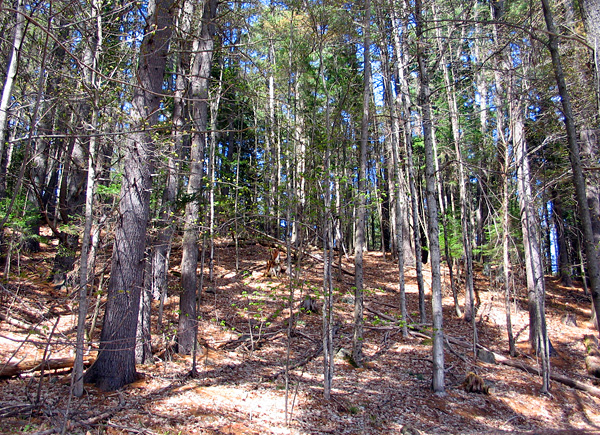
Old forest cloaks the lower slopes of Currie Mountain.
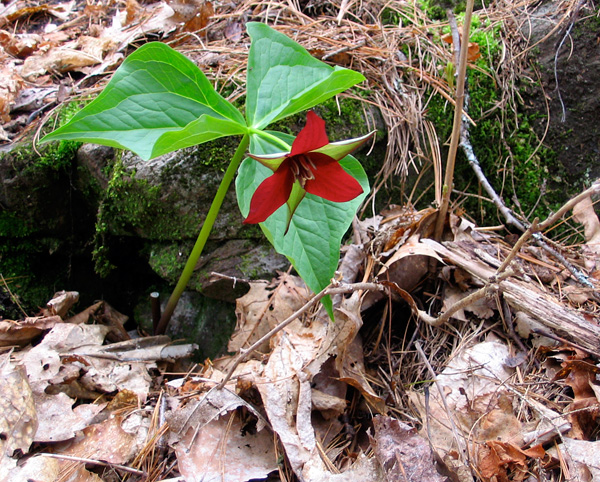
A solitary red trillium rises through the leaf litter.
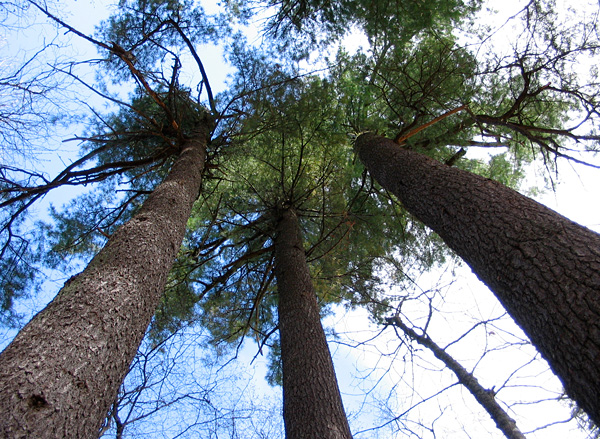
These white pines are old-timers. They may have lost their tops, but the branches don't even begin until fifty feet above the ground.

Chris stands on top of the "mountain."

The St. John River at Fredericton in the February dusk. Currie Mountain is the dark mound on the horizon.
Blogostratigraphy
This week, I was thinking about how to get back into the flow of blogging, after a long hiatus in which my time and energy were sapped by other projects. First, I considered writing a piece about the exhibit work largely responsible for the hiatus. (I will. Later.) But then I began thinking about that word, hiatus, which is also often used in geological conversations. And I realized that any blog is similar to a sedimentary succession, to such an extent that a new term may be required: blogostratigraphy.
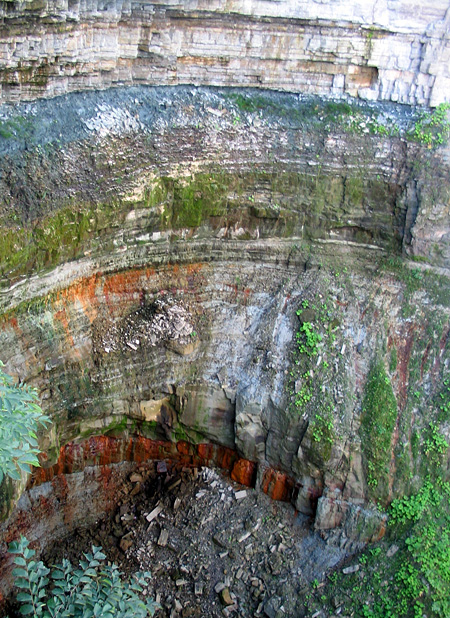
Colourful Paleozoic strata at Valaste waterfall, the highest waterfall in Estonia
Stratigraphy is the study of the arrangement and succession of strata. All sedimentary successions follow a few basic rules, our understanding of which has been gradually refined over the past four hundred years. According to the principle of original horizontality, sedimentary layers were originally horizontal, while the law of superposition states that “sedimentary layers are deposited in a time sequence, with the oldest on the bottom and the youngest on the top.” Similarly, the great majority of blogs are composed of horizontal posts, each of which is accreted above the previous one. This current post is like sediment being deposited on the Earth’s surface; if you drill down you will see that the layer below is dated February, underneath that are posts extending back into late 2009, and if you go to the very beginning of this blog you may find yourself somewhere in the Younger Dryas.

Ordovician carbonates in northern Kentucky
Strata are typically laid down in sedimentary basins, low areas in the Earth’s crust (such as Hudson Bay) where sediment is able to accumulate. For sediment to accumulate, it has to be generated, and some geologists like to talk about the “sediment factory.” Large amounts of sediment are typically produced under specific conditions, such as when corals and other organisms are growing great volumes of carbonate skeleton, or when actively-rising mountains are shedding vast quantities of freshly-eroded sand and silt.
When the sediment factory is switched off (as it is, for example, during some sea level changes), then sediments stop accreting in the basin. This hiatus may last years, decades, or millennia. The net effect is that the sedimentary record is not continuous: the record of time provided by sedimentary rocks is of fits and starts, feast or famine. In any one region the rocks may give a wonderful documentation for one period of geological time, but then for the next period there is no evidence whatsoever (we get a much more complete story when we compare several regions). Much modern stratigraphy is focused on recognizing and analyzing the hiatuses, because these can tell us so much about the geological history of basins and continents.
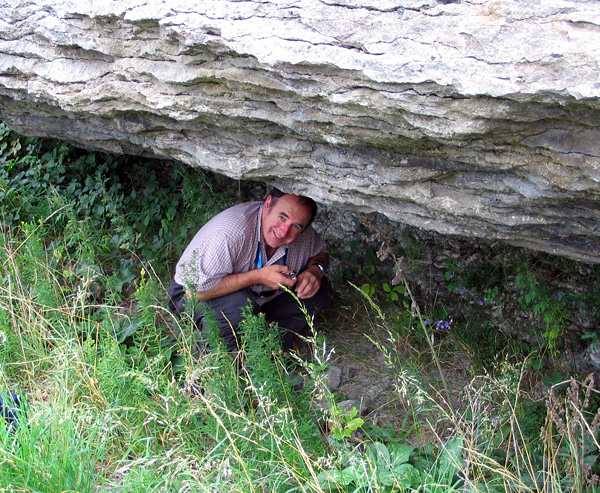
A simple-minded interpretation of the law of superposition might suggest that Steve Kershaw (Brunel University) is older than the Silurian carbonates he has burrowed beneath on the island of Saaremaa, Estonia. Some people will go to extreme lengths to find stromatoporoids!
Blogs are also produced in discrete intervals. No human being is capable of mechanically producing a volume of readable text every day, and a blog is thus a stratigraphic record of the individual’s life. Each post could be considered as a single depositional event. These blogging events are of interest, of course (at least to a few readers), but future blogostratigraphers may well be as interested in the relationship between event and hiatus. How was the blogger able to produce a continuous stream of quality pieces during this interval? What was responsible for this smattering of drivel? Was this gap related to a a traumatic event in the individual’s life, or did he just wander off and immerse himself in Facebook applications? I imagine a cadre of academic blogostratigraphers, each applying sequence stratigraphic methods to studying the bloglives of the obscure but interesting.
OK, now my idea factory has dried up. Time to think about something else.
© Graham Young, 2010
Next time, maybe I will tell you about my other new blog …
Forest Fire

May, 2008
It was an unusually dry spring in the Grand Rapids Uplands, 400-500 kilometres north of Winnipeg. As we crested the Pas Moraine and began our gentle descent toward Grand Rapids, we were surprised to see small cumulus clouds floating low in an otherwise clear sky. Driving closer, the cause became obvious: a huge forest fire was generating water vapour along with its smoke, and the vapour condensed as it rose.
Each day we drove past the burning area. Some mornings it smouldered gently with just a hint of smoke. Some afternoons the brown smoke billowed upward, yet the fire did not really appear to be migrating. Nevertheless, we were very lucky to finish our work when we did, as the fire monsters had awoken and were on the march. The smoke became so dense that the road was closed, and if we had been going south just an hour or two later our trip would have required a four- or five-hour detour (roads are far apart in the north)!
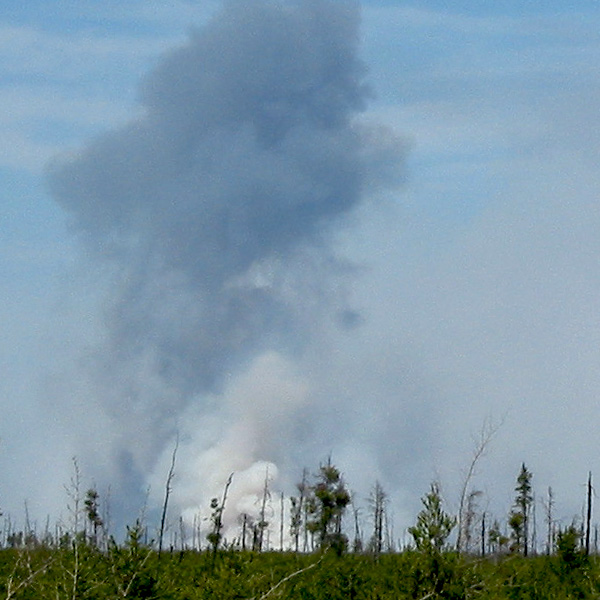
At dinner time, the restaurants in Grand Rapids were busy. Firefighting crews arrived for supplies, purchasing large quantities of burgers, sandwiches, french fries, bottled water, and all the other necessities of firefighting. There is little lumbering done in that part of the north, but forests are treasured, not least as the home of wild game, so fighting fires (or at least controlling them) is a serious business.
Other than the fires, it was a typical northern spring. The flowers and the blackflies had returned in profusion. On Saturday the breeze died down and the blackflies became unbearable; it is very hard to concentrate on work when you are inhaling flies, swallowing flies, feeling tiny flies crawling in your ears and eyes and, yes, occasionally being bitten.

___________
July, 2008
Toward Grand Rapids the sky is now behaving itself. No rogue clouds confuse our vista of high summer blue and heat haze. The fire was exciting and mercurial, and I have to say that I enjoyed the frisson created by its presence. This sky seems very dull and predictable, but it bodes well for our ability to get work done. And, I guess, that is why we are here.

Driving north from Grand Rapids on the first day, for a considerable distance we can see the dark signature of fire-burned trees out on the horizon, where the pale haze must reach its tendrils toward Moose Lake and Cormorant. Now the skeletal trees begin to approach Highway 6. Here are the remains of contorted jack pines and stark black spruce, with green grass already springing up beneath.
There are places where the fire had leapt across the road, where it torched aspen shrubs below the steel power towers. Did it damage the lines themselves? I don’t recall any issues with power in the south, but the sight generates talk of the fragility of our far-reaching hydro system. Civilization is a thin cloak that fits poorly on this land. We are just a wire’s width from feral, though most of the time we choose to forget this.
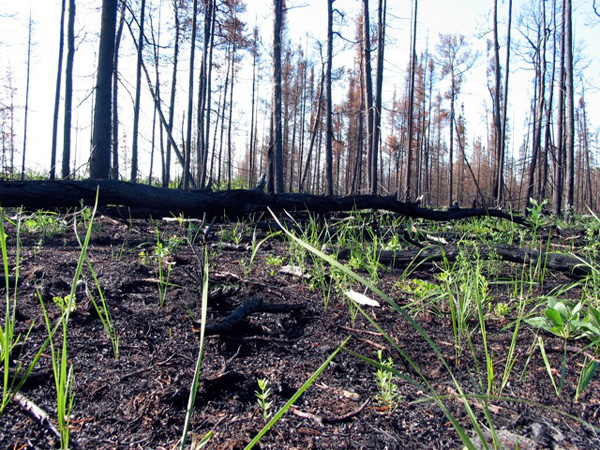
We can’t stop today for a close look at the awful beauty the fire has made. It is past lunchtime and there is rock to split, eurypterids sending us messages that they are there for the finding. We must rush onward to liberate them from their cool, stony resting places. But we will stop this week. Really. And we will try to get some photos that capture this strange place.
© Graham Young, 2010

Great Canadian Lagerstätten
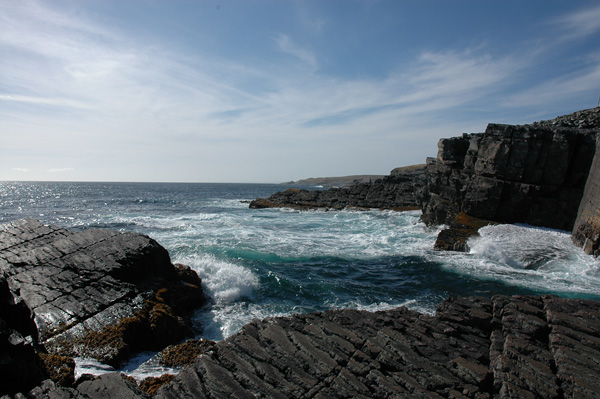
Mistaken Point, Newfoundland (photo © David Rudkin, Royal Ontario Museum)
In mid May, the huge GeoCanada 2010 conference will take place in Calgary. This is a once-every-decade meeting, and since Canada is home to some of the world’s most exciting fossil sites, it seemed like a very good opportunity to explain the sites and the research that is allowing us to better understand them.
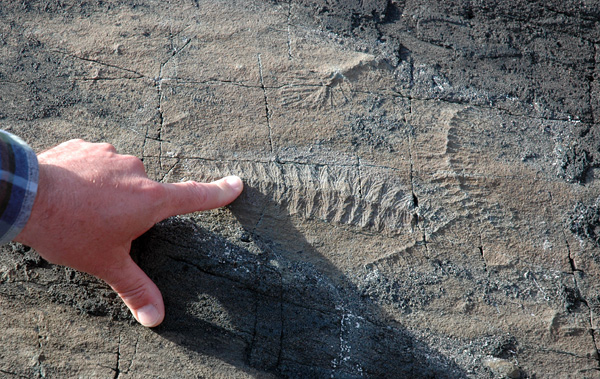
Ediacaran fossils at Mistaken Point: Fractofusus misrai and Bradgatia on the famous E surface (Guy Narbonne's index finger points to F. misrai). (photo © David Rudkin, Royal Ontario Museum)
Dave Rudkin and I have been organizing the Special Session Great Canadian Lagerstätten, which will explore the theme of exceptional fossil preservation in Canada. A lagerstätte is a deposit in which fossils are either exceptionally preserved or unusually abundant. Canada’s remarkable fossil record includes many recognized lagerstätten, each providing unique evidence of past life. Our most famous lagerstätten include the Ediacaran fossils at Mistaken Point, Newfoundland, the Cambrian wonders of the Burgess Shale, British Columbia, and the Cretaceous dinosaur bone beds of Alberta, but there are many other less well-known lagerstätten, in almost every province and territory.
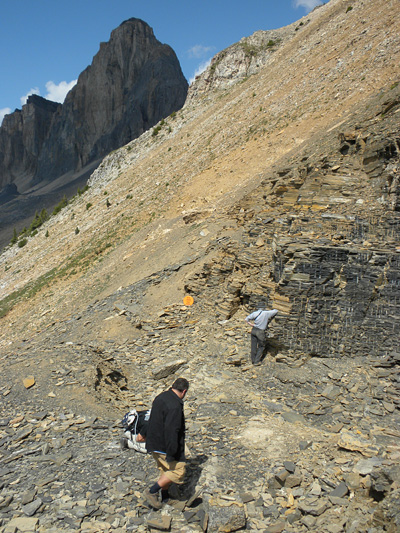
The Cambrian Burgess Shale: Walcott's Quarry (Greater Phyllopod Bed section), Fossil Ridge, Yoho National Park, BC (Wapta Mountain in background) (photo © David Rudkin, Royal Ontario Museum)
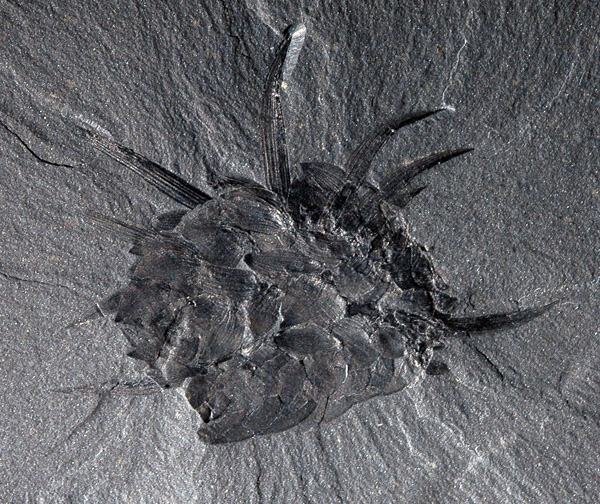
The Burgess Shale soft-bodied fossil Wiwaxia corrugata in reflected light (ROM 56950) (photo © David Rudkin, Royal Ontario Museum)
This session will provide a survey of these wonderful Canadian sites, with a focus on recent fossil discoveries. The tentative session schedule includes both lecture and poster presentations:
A. Lectures (20 minutes each; speaker indicated with a *)
1. Guy Narbonne* (Queen’s University)
When Life Got Big: The Mistaken Point Assemblage of Newfoundland (Ediacaran, 579-560 Ma)
2. Jean-Bernard Caron* (Royal Ontario Museum)
Discovery and significance of the Middle Cambrian Burgess Shale
3. David Rudkin* (Royal Ontario Museum)
Eurypterids and More – The Eramosa and Bertie Lagerstätten (Silurian), Southern Ontario
4. Richard Cloutier* (Université du Québec à Rimouski)
The Late Devonian biota of the Miguasha National Park UNESCO World Heritage Site
5. John Calder* (Nova Scotia Department of Natural Resources)
The Joggins Fossil Cliffs World Heritage Site: Coal Age Galápagos
6. Andrew Neuman* (Royal Tyrrell Museum) and Raoul Mutter
Wapiti Lake (BC): A Great Triassic Canadian Fossillagerstätte
7. Philip Currie* (University of Alberta)
Dinosaur Provincial Park, One Of The Greatest Outdoor Laboratories For Understanding Late Cretaceous Ecosystems
8. Mark Wilson* (University of Alberta)
Three Views of Eocene Life in British Columbia
B. Poster Presentations (presenter indicated with a *)
1. Thomas Harvey and Nicholas Butterfield* (Cambridge University)
An arthropod Lagerstätte from the early Cambrian Mount Cap Formation (Northwest Territories, Canada)
2. Nicholas Butterfield* (Cambridge University) and Maria Velez
A Burgess Shale-type micro-Lagerstätte from subsurface of SW Saskatchewan
3. Graham Young* (The Manitoba Museum), David Rudkin, Edward Dobrzanski, Sean Robson, Michael Cuggy, and Deborah Thompson
Late Ordovician Lagerstätten in Manitoba, Canada
4. Michael Cuggy* (University of Saskatchewan), David Rudkin, and Graham Young
A New Late Ordovician (Richmondian) Eurypterid from the William Lake Lagerstätte, Manitoba
5. S. Bruce Archibald* (Simon Fraser University), Rolf Mathewes, David Greenwood, Robin Smith, and James F. Basinger
Lagerstätten of the Okanagan Highlands (British Columbia and Washington): emergent communities in Early Eocene climates

Ordovician dolostone cliffs of the Red River Formation at Cat Head, Manitoba contain remarkable fossils.

Superbly preserved Ordovician eurypterid cuticle from Airport Cove, Manitoba; scale is in millimetres (specimen I-4063, © The Manitoba Museum)
If you are planning to attend the GeoCanada meeting, we strongly encourage you to take in this session. Or if you live in the Calgary area and are interested in unusual fossils, you might want to consider paying a one-day registration! We don’t yet know the date and time for this session; please check back here or on the conference website if you are interested.
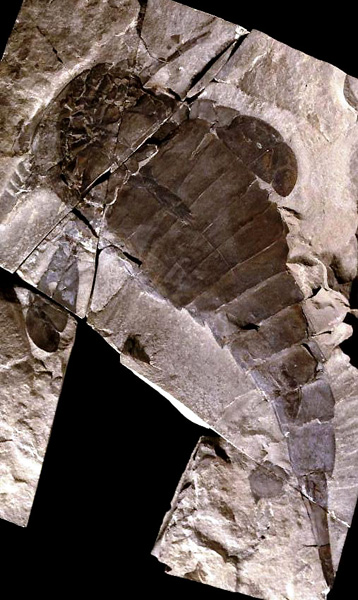
The Silurian eurypterid Eurypterus remipes, from the Bertie Formation near Ridgemount, Ontario (ROM 56889) (photo © David Rudkin, Royal Ontario Museum)
This session is sponsored by the Paleontology Division of the Geological Association of Canada.
Scenes from Northern Summers (2)
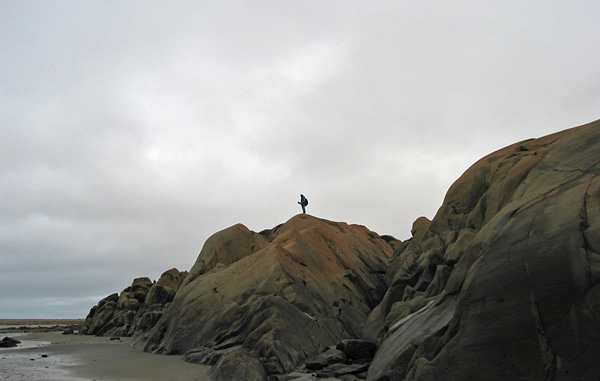
East of Halfway Point, Pete Fenton of the ROM keeps watch for bears.
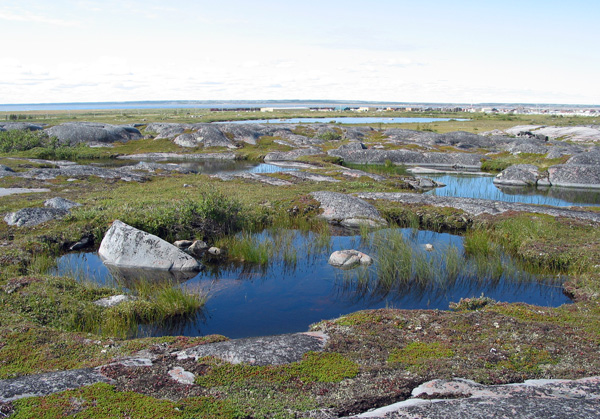
Ponds on the quartzite, with the town of Churchill in the distance
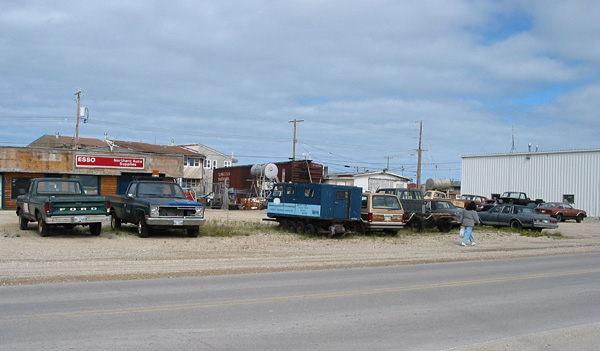
Street scene in Churchill a few years ago
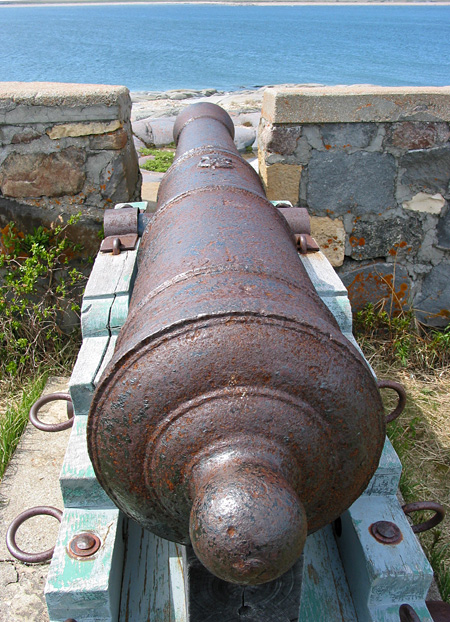
A cannon at the Cape Merry Battery, where the Hudson's Bay Company men waited, and watched, and waited for the French to come. But they weren't very happy when that finally happened.
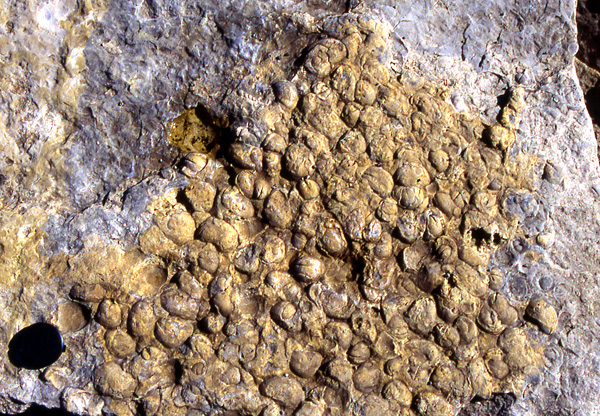
Fossils of the Silurian brachiopod (lamp shell), Virgiana decussata, cover the surface of a block on the shore east of Halfway Point.
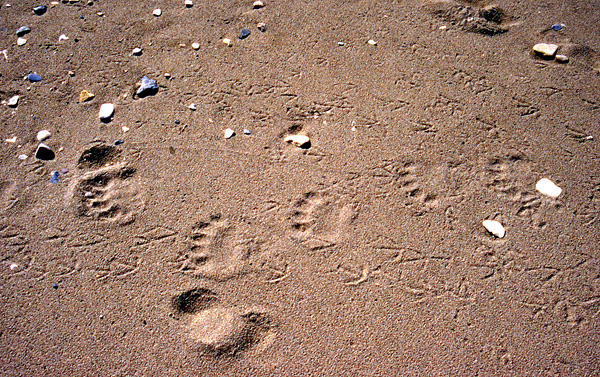
Sand on the shore east of Churchill shows fresh prints of gull, overlain by Homo sapiens, overlain by Ursus maritimus. Bears like to place things in such a way that you will know who really owns the territory.
The Beatles and the Cambrian Explosion
Among the items I received for Christmas was the newly remastered CD of the Beatles’ Magical Mystery Tour. Listening through headphones the other evening, I began to think about the Beatles as a “type specimen” of group genius, and about the synergies that can allow groups of people to achieve feats far beyond the abilities of any individual group member.
People who study such things like to make comparisons between human groups and groups in the natural world. So we hear about corporations, youth gangs, or crews of Arctic explorers being compared to packs of wolves, bands of gorillas, or colonies of ants or naked mole rats. I don’t know enough about most kinds of human groups to comment on such analogies, but I have spent (or wasted?) enough time playing in bands that I think I can make a stab at considering how they work and develop.
As I listened, and the mediocre depths of Flying and Blue Jay Way gave way to the sublime heights of I am the Walrus and Strawberry Fields Forever, I wondered how the Beatles had managed to travel from Love Me Do to all of this in only five short years.
Then it struck me. There is a good natural analogue for the Beatles’ story, but it is not in within-species groups. Rather, the closest similarity I can see is in the development of communities and ecosystems, in particular in the burst of evolutionary activity about 530 million years ago known as the Cambrian Explosion, and the events that followed, culminating in the first mass extinction of complex life at the end of the Ordovician Period about 444 million years ago.
Test Pattern
If you visit this site periodically and are beginning to wonder about the absence of new posts, don’t worry. I am not ill, and rumours of my death have been greatly exaggerated. I’m just busy.
I have been working on several new pieces for this page, but life keeps getting in the way. We are assembling the exhibits that will accompany the Ancient Seas video, and that has involved a lot of toil and pain. Not to mention blood.
Anyway, I will be back soon, and you will again wish that I didn’t post so much. Meanwhile, wander around, take a look at anything here that you haven’t read yet, or check out some of the links. I particularly recommend my friend and colleague Sean Robson’s new page, Lore Deposits.
See you.
The End of an Era. Literally.
As promised quite a while ago, here is a follow-up to my post about Eastend and the Cypress Hills. I travelled to that area in late September, 2008, with museum artists Betsy Thorsteinson and Debbie Thompson, and cameraman Bruce Claydon. We planned to collect a sample of the Cretaceous-Paleogene boundary for the Manitoba Museum. The K-Pg (formerly called the K-T) is the stratigraphic horizon that defines the end of the “age of dinosaurs,” and is characterized by a distinctive clay that was probably produced by the impact of a huge asteroid.
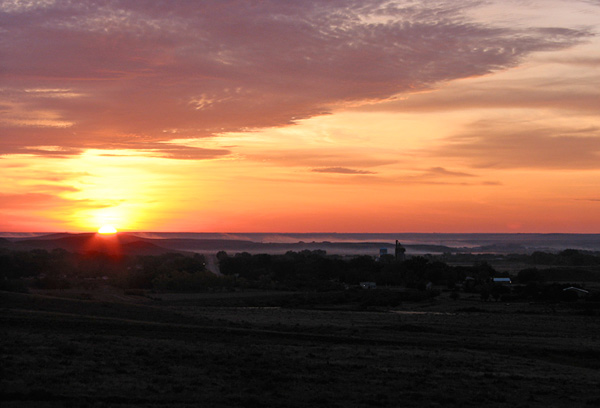
Saturday morning. Sunrise.
We arrived in Eastend at dusk on Friday. It is a longish run, and to make it in one day we left Winnipeg in the early morning light. Last night the light was dim and we couldn’t really appreciate Eastend’s setting, but we are able to drink it in this morning. I am immediately reminded that this is an utterly splendid piece of the world; quite the antithesis of the “boring flat prairie” that so many people seem to mention when the subject of Saskatchewan is brought up.

The Frenchman Valley
Tim Tokaryk of the Royal Saskatchewan Museum has kindly offered to show us the K-Pg boundary site. After breakfast we meet Tim at the T. rex Centre, then follow him cross-country to the site, which is on the wall of the Frenchman Valley south of Shaunavon. Travelling at speed on the loose gravel, raising our own clouds from the dust-dry section roads, it begins to feel-like an adventure, and more than once the pebbles flying from other vehicles’ tires make me fear for our windshield (which will, fortunately, survive the trip only slightly scathed). There is a very good reason why many trucks in rural Saskatchewan sport chrome running boards and sloganned mudflaps. Contrary to the opinions of trendy urbanites, these are not just unfathomable redneck fashion statements.

Layered Cretaceous rocks in the Frenchman Valley. (photo © The Manitoba Museum)
The site is much as I had remembered it. The advantage of this place is that the exposure is good, and there is little vegetation to get in the way. The disadvantage is that the hill is much bigger and steeper than I had recalled. It will turn out to be rather a challenge to move the 5 gallon water carriers and 50 lb bags of plaster to the boundary level, which is, of course, near the top of the slope. But it will be very easy to bring down a several hundred pound sample of the sediment layers. So perhaps it is for the better that the site is up slope from parking, rather than the other way around.

This is the slope as seen from road level. The white rectangle toward the top is our first field-jacketed sediment sample. (photo by Betsy Thorsteinson, © The Manitoba Museum)
Tim explains where we will find the boundary horizon if we dig down (yes, this will take quite a bit of digging), then we get back into the vehicles so that he can show us the area where they collected the T. rex nicknamed Scotty. We drive to a beautiful place a few kilometres away, up the Frenchman Valley, and Tim generously consents to let Bruce get some film footage of him explaining the T. rex excavation. We head back to the boundary site, thank Tim for his help, and settle down to work.
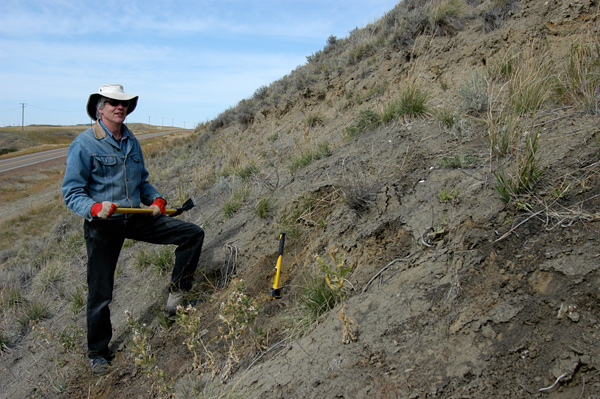
I am ready to start digging. The hat may look ridiculous, but it is essential. (photo by Betsy Thorsteinson, © The Manitoba Museum)
We haul our digging gear up the slope and start making test pits to try to determine where to extract our sample. Betsy and Debbie are both very hard workers, and I really have to apply myself so that I don’t appear to be a slacker. Bruce is always on the move, up to the top of the slope, down below us, hovering around us, always shooting, asking questions. I need to give him coherent answers and explain what we are doing, but in the heat of the work I find that I am tongue-tied and stumble over the words, or say “um” far too often. There’s a reason why, on the old Wild Kingdom TV show, Marlon Perkins did the talking while he sent Jim to capture the wildebeest or zebra. It wasn’t just that Marlon preferred to have Jim do the more dangerous job (although I certainly would, given the choice!). It is genuinely impossible to do hard focused work and clearly explain what you are doing at the same time.

The slope may not look steep from this perspective, but it is always a challenge for Bruce to film us! (photo © The Manitoba Museum)
We work until the sun begins to go down, clear a possible site, and begin to cut a vertical surface. I am not really satisfied, however, that we have found the part of the succession that we came to collect. I am not dispirited by this, just uncertain and questioning. I will have to sleep on it, and will reconsider in the morning.
The next morning, after breakfast, we go back to the T. rex Centre to look at a sediment sample that Tim had collected from the same site a few years ago. We examine it closely, imprinting a search image of the precise tones, textures, and layering of the various sediments, then drive to the site for another go.
Working laterally along the scarp, we start to clean back the overburden in a couple of new places, digging larger pits to examine the succession of sediments. By lunchtime we have decided to concentrate on one place where the boundary clay can be clearly seen (it is not a continuous layer). We begin to “develop” the surface into a pillar so that it can be extracted, then take a break. After lunch, up on the scarp, I have another look, compare the succession to the publications about this area, then decide that this still needs further confirmation.
This is one of those times when I realize that technology has changed fieldwork irrevocably. Pulling out my cellphone, I call Dr. Art Sweet at his home in Calgary (this is Sunday afternoon). Art is an expert on these rocks, and he has given me his number in case I need to “call a friend” for the answer. I carefully describe the succession of sediments to him, and its location on the slope. He assures me that all is good. So it is a go. Time to really settle down to work.
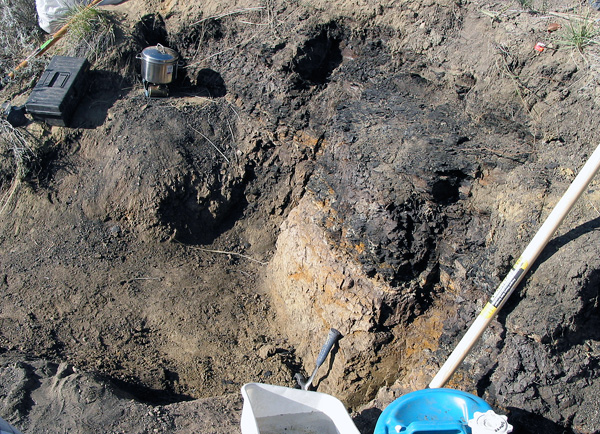
Pale-coloured Cretaceous sediments of the Frenchman Formation are overlain by the darker Paleogene coals and coaly shales of the Ravenscrag Formation (Photo © The Manitoba Museum)
The interval between lunchtime Sunday and lunchtime Tuesday includes so much backbreaking effort, so many setbacks and minor disasters, so many supplies to be found, and so many bags of plaster to be hauled up the slope, that the events merge into one seamless, slightly pulsating mass. You can be grateful that, since the sequence is far from clear in my mind, I won’t be describing it in detail or order.
We cut back around the sample with mattocks, switching to hammer and chisel where the sediment becomes harder. Every few minutes we have to take a break to rest weary muscles, then shovel the loosened sediment out of the way so that we can continue to cut the pillar. Once it is exposed on three sides we need to make a jacket, or rather, Betsy and Debbie will make the jacket. I will try to keep them supplied with materials; the jacket will be made of burlap and wood (which are light), glued together with plaster and water (which are far from light). I will be very weary by the end of each day here, but I will be feeling tremendously fit by the time we go home.

Betsy and Debbie assembling the field jacket. (photo © The Manitoba Museum)
While Betsy and Debbie are jacketing, Bruce and I can go and shoot additional video that will be needed for our gallery exhibits. First, we take the van and drive north toward Shaunavon, so that I can narrate an overview of the project while being filmed driving down the highway to the site. It is a very good thing that we don’t meet any other traffic, given my multitasking abilities.
Back on foot, we do a slow traverse of the slope leading up to the site. This is much more pleasant. First we look at the beautiful river-channel sandstones of the Cretaceous Frenchman Formation, which are overlain by clayey floodplain deposits as we move up toward the boundary. The boundary clay above is not particularly thick, but it is very distinctive in colour and texture, particularly when it is damp in the bright sunlight.
I dig out the boundary clay, examine it closely, rub it between my fingers, and yes, taste it (so I am probably now an iridium anomaly). The clay is beautiful – very smooth, soft, soapy, cleaves conchoidally, and has a colour almost the same as that of the flesh-coloured crayons we used to use in Grade 5. Standing at that level on the scarp, I imagine a landscape covered with this stuff, all the last T. rex and Triceratops smothered by a pastel-coloured nightmare world.
We cannot, of course, see the iridium anomaly in the field, nor can we readily observe the fine-scale succession of sediments at the boundary that has been recognized by Art Sweet and others. But we will have to assume that what we are collecting contains all of those colourfully named intervals and features: the ejecta layer, the fireball layer, the fern-spore anomaly.
Above the boundary, the character of the sediment changes with the beginning of the Paleogene Epoch. First, dark coaly shales suggest a stagnant, swampy plain rich in tree growth. These are overlain by beds of true coal, and above those the modern plants and soil cover the upper part of the slope. Bruce and I continue upward, taking a break on the very top of the scarp.
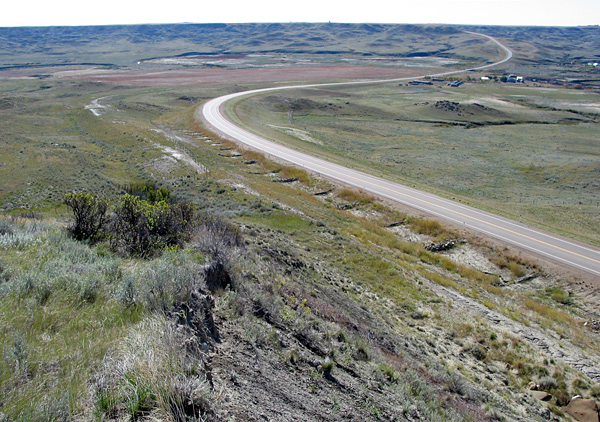
The Frenchman Valley, as seen from the site.
High on the slope, this place feels a lot like an English moorland. Looking across the valley so far below, with the cold and remarkably clear breeze contrasting with the warm sun, hearing a few birds singing, I might be sitting on the Whin Sill west of Newcastle upon Tyne. Except that there are cacti here (so I had to be careful where I sat!) and I don’t think I have ever seen such a dry day on the Whin Sill.
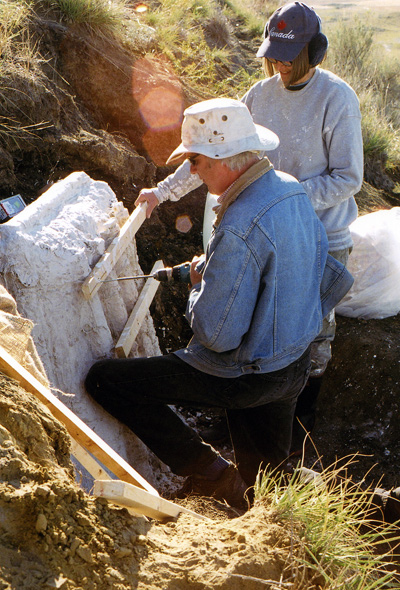
Constructing the field jacket. (photo by Debbie Thompson, © The Manitoba Museum)
The front, sides, and top of the field jacket have been constructed, and the plaster has hardened. Now we have to cut down through the tough coal at the top of our pillar of sediment, while keeping in position the part we want to collect. Fortunately, I had been given some very good advice about this by Art Sweet. For the first time in my life, we have brought a handsaw on a geological field expedition. It is very odd to be sawing through a sediment layer, but the coal is really a pressure-toughened woody amalgam. You can’t extract it cleanly with hammer and chisel. The saw is very slow, but it does the job.
We try to finish chiselling through the clay at the bottom, but it is tenuous and resists our efforts. We eventually manage to lever out the package, but I fear that I have displaced the sediment layers with one of the final pushes. The back of the package is plastered on, and it is left to dry thoroughly before we can move it.
Though we work late, time passes very quickly since there is so much to be done, and we are so very weary when we make the final descent to the vehicles. The sun is setting, the valley is already dim, and some way off to the west we hear a coyote yipping. It is answered by another nearby. It is time to leave.

As we load the van, Betsy's appearance speaks volumes about the hard work that was done today. (photo © The Manitoba Museum)
Back at the cafe in Eastend, we settle into our now-customary booth, appreciating once more the enveloping primitivist historic mural that covers the walls. By this point I don’t really mind what I eat, and pizza sounds good. Betsy has a somewhat more difficult time; it is always “interesting” to travel around the rural west with a vegan. Fortunately, she is also not that particular about what she eats, as long as it is within her dietary requirements. But I suspect that she will be very tired of toast by the end of this trip.
It is a beautiful evening for the end of September. Betsy and Debbie have wisely headed for sleep, but Bruce and I decide to wander over to the hotel in the centre of town for a beer. The bar, a more modern addition to the old hotel, is graced by a display of the varied cattle brands of the ranches that surround Eastend. The Pilsner is cold. The world is a good place.

The jacket dries, awaiting extraction (photo © The Manitoba Museum)
On Tuesday morning the package is ready to move to the van, and Betsy is working on a small second package that can act as a back-up in case there are issues with the big sample. Lee Gilbert from the Eastend T. rex Centre has volunteered to assist us, as the big package is very heavy. We wrap the package in a tarp and attach ropes and straps.
The first part is very easy. We tug on the straps to get the weight shifted from the sediment platform on which it rests, but then it begins to plow down the hill of its own accord, gathering speed and floating boat-like toward the bottom. We have to restrain it, but only with modest force; the steepness and texture of the slope are quite perfect. Of course this condition will not persist all the way to the road.
The lower slope is rutted and cobbled down to the ditch, which rises to the road. We lash the package to a hand cart, but it is still tough going, and Bruce has to place his camera on a tripod so that he can assist Lee, Debbie, and me. With considerable toil, sweat, and swearing, the package is dragged to the road surface behind the van. Lee has brought straw bales from the farm, and we manage to raise the package in stages and slide it into the back of the van. In hindsight the process has been remarkably smooth. Still, I don’t plan to move anything that is about the same weight as a dead grizzly bear again in the near future. A live grizzly, perhaps, as it would be easier to move, if harder to direct.
After the big package, the little one seems like nothing, and all that is left is to somehow wedge the gear back into the vehicles, then start on the eastward road home. But it is still just mid afternoon, and we have not yet driven west from Eastend to take a good look at the hills. There is still time …
© Graham Young & The Manitoba Museum, 2009

Jellyfish Story
One of the policies I have for this page is that I generate my own content; I don’t follow a lot of other science blogs in re-posting whatever is appearing in the news or on other web pages. However, I will make an exception for a story that appeared in the Winnipeg Free Press today, since it is about some of the work we are doing:
“THE proliferation of jellyfish blooms around the world has ocean scientists worried, as massive numbers of very simple creatures are floating around what used to be more complex ecosystems.
But a discovery in northern Manitoba suggests jellyfish blooms may not be just a recent phenomenon. A team of paleontologists has found the fossil remains of large numbers of jellies at a dig site that date back 445 million years, to a time when a shallow sea known as the Williston Basin covered what’s now boreal forest north of Grand Rapids. …
… As fish and seafood species continue to disappear from the oceans at the hands of overfishing, human beings may be returning the oceans to a state that existed before the evolution of bony fishes: a world where simple creatures like jellyfish dominate the seas.
“We’re getting rid of the top of the food chain,” Young said. “We’re making conditions better for jellyfish.” ”
You can read the entire story here.

Monday Museum #6: Box Jelly
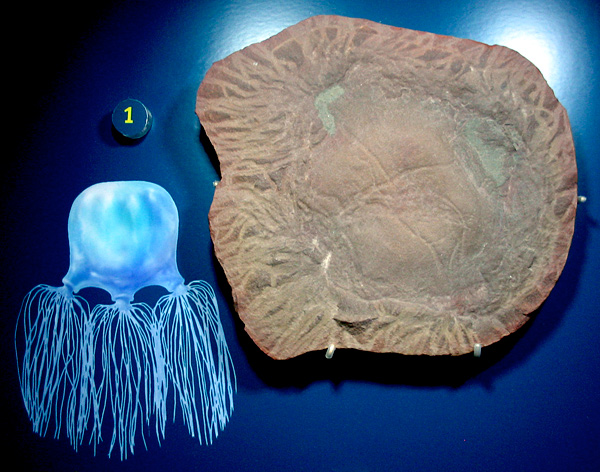
One of the functions of museums is to serve as treasure houses, showing the visitors fabulous objects that they cannot view anywhere else. Sometimes those treasures are known globally, such as the Elgin Marbles or Tyrannosaurus Sue. Other treasures are obscure, and may be well-known only to a few professionals. In the latter instances, it is gratifying when a museum takes the trouble to exhibit its best material, when perhaps less valuable and sensitive “pretty good” pieces might suffice for 99% of the visitors.
This fossil cubozoan (box jellyfish) in the Mazon Creek exhibits of the Chicago Field Museum’s splendid Evolving Planet gallery is just such a treasure. I have studied the fossil jellyfish collections at various museums, and I think that this exhibited specimen is not only the best Mazon Creek cubozoan, but that it may actually be the best fossil cubozoan “in captivity.”
Mazon Creek fossils occur in iron carbonate concretions in the Carboniferous Francis Creek Shale Formation of Illinois; for many years they have been collected in large numbers from the spoil heaps of open-pit coal mines. Many were studied scientifically and published in the 1960s to 1990s and several hundred species are known. The Field Museum has one of the finest collections of these fossils. In a windowless storeroom, secreted in the space formerly occupied by a fresh air shaft, row upon row of cabinets hold many thousands of Mazon Creek fossils that have been assigned to hundreds of species: worms, plants, jellyfish, shrimps, centipedes, scorpions, and many other groups including the wonderfully named and enigmatic Tully monsters (Tullimonstrum).
The cubozoan Anthracomedusa turnbulli is relatively rare in comparison with some of the other Mazon Creek jellyfish, but to my eye it is the most beautiful and interesting species. Mazon Creek jellies are preserved as external impressions in the siderite concretions: you can see the shape of the animal, the tentacles and the bell (“umbrella”), but there is usually almost no evidence of internal features. What makes this particular specimen unusual is that it not only has superb external preservation (or superb for a dead, squashed jellyfish, anyway), but it also shows a pyritized (“fool’s gold”) structure in each corner of the body. I have never seen pyritic structures in other Mazon Creek jellies, and I have looked at hundreds of them. I am not an expert on cubozoans, so I am not absolutely certain what these structures are, but they could possibly be evidence of the fleshy pads called pedalia.
In modern seas and oceans, cubozoans are a widespread, fascinating, and somewhat bizarre group of animals. They include some of the most poisonous creatures on the planet, such as the Australian box jellyfish Chironex fleckeri, and show some unusual adaptations such as highly evolved eyes. For many years, Anthracomedusa was the only known fossil cubozoan, but in recent years much younger ones have turned up in the Jurassic of France, and possibly in the Cambrian of Utah. Still, this Field Museum fossil stands out as a remarkable piece: a specimen worthy of detailed study, and a wonderful exhibit to share with the museum-visiting public.
Addendum (Nov. 18): After I posted this last night, the link to this new paper on cubozoan evolution showed up in my inbox this morning. If you are interested in this subject, there is a lot of good research going on.


 Ancient Shore