Turning the Tables on Overfishing?
In recent years, the media have been paying considerable attention to jellyfish blooms or swarms, phenomena in which huge numbers of jellyfish occur within a limited area of the sea, sometimes clogging harbours or wrecking fishing nets. It has been suggested that these blooms may be becoming more frequent, as our overfishing of other creatures may be opening up ecologic niches for these opportunistic animals. It has also been proposed that, if other sea animals become sufficiently rare, we humans may end up eating a lot more jellyfish than we currently do.
Those of you who have read other pieces in this blog will know that I have an enduring interest in jellyfish. For several years I have been studying fossil jellies in extreme (possibly excessive) detail, I have travelled to other cities to study modern examples in museum collections, and whenever I have the opportunity I examine and photograph modern beached medusae. I have also been unpleasantly stung by jellies in the past, but until last night I had never had a relationship with them that could be described as “trophic.”

A few weeks ago, I bought these preserved jellyfish on a whim. We were at the local Chinese grocery store, and I was intrigued that there were a lot of packages of jellies in the “impulse buy” location beside the checkout. They came in two different flavours, so we decided to get the less spicy ones. Once purchased, they resided in the fridge for several weeks, since actually eating them was clearly less appealing in the concrete than it had been in the abstract.
Last night we were cooking Chinese food, and since we planned on making calamari with garlic, we thought we’d might as well go all-out on the “creatures with tentacles” theme and try the packaged jellies. The jellies that are sold in the food trade are the bodies of the big, “meaty” rhizostomes. Rhopilema esculentum is the species used in Chinese food (according to Wikipedia), though of course I was unable to confirm that identification from the bits we purchased. As with some squid rings, you aren’t actually eating the tentacular part of the animals. Rather, trained jellyfish experts have stripped out the umbrella (bell) and the oral arms, treated them with salt and other substances, and preserved them so that they don’t need refrigeration.
We opened the package to find that it contained stringy, translucent strands. These were rinsed thoroughly, and then we added the oil and chili sauce that came in a small separate packet. Maybe we should have washed the jelly bits more; we followed the instructions on the package, but some sources suggest that they should be washed for far longer, and left overnight to remove the salt. Anyway, the saltiness did not seem particularly at issue when we came to eat them.

When picked up with chopsticks, the jelly pieces had a slithery but fresh texture, with a nice light crunch when you bit into them. My dinner companions were less enamoured of this physical part of the experience than I was; the jellies were described by one daughter as “crunchy yet gelatinous,” and by the other as “interesting.” Unfortunately, the taste was less interesting than the texture. They had about as much flavour as the least-flavourful seaweed I have ever eaten. The jellies could be described as slightly marine, mildly plant-like, but with a trace of a gag-inducing edge. The least pleasant part of the experience, for me, was that this “edge” remained, several hours later, as a metallic memory near the back of my mouth.
The jellyfish could well have been better if soaked in fresh water for longer, or if mixed in a salad (as was suggested on one page I looked at). But I ate them as little bits mixed in with my rice and greens, and they still stood out as a remarkably unappetizing foodstuff.
If we continue to work our way down the marine food chain, will we reach a stage where jellyfish are the only marine animals that ordinary people can afford to eat? Based on last night’s experience, I would probably renounce seafood entirely at that point.
© Graham Young, 2009
Lake Winnipeg Beaches: Why is There so Much Sand?
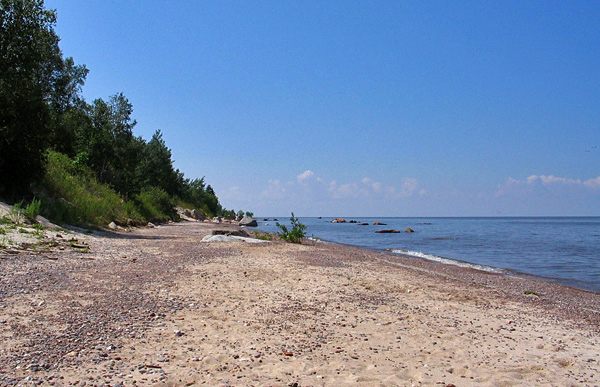
The shore at Victoria Beach
When summer finally arrived here in late August this year, we took advantage of the remarkable weather and spent time relaxing at Victoria Beach, on the eastern side of Lake Winnipeg’s south basin. As I lay stretched on that beautiful beach, below sandy scarps and dunes, I started to wonder how all the quartz grains had arrived there, on the shore of a lake in the middle of North America. Victoria Beach is not just a small patch of sand; it is part of a very substantial deposit that also includes the famous perfect shores of Grand Beach.
I assumed that, given the number of people who vacation along the margins of Lake Winnipeg, there would be clear answers to this question readily available on the internet. Sure enough, I was able to find out several things quite quickly. A Manitoba Parks website and other references explained that Grand Beach is part of the Belair Moraine, a deposit 100 kilometres in length that rises 30-50 metres above the lake. This deposit was formed as high energy outwash water moved sediment from the glaciers, perhaps 11,000 years ago. The sediment was subsequently reworked by glacial Lake Agassiz, which was for a time the largest lake in the world.
The Belair Moraine includes a lot of other material besides sand. My friend Jim Teller of the University of Manitoba has had his students study the composition of the sediment in this area, and he tells me that in some of the beaches, much of the material consists of larger fragments of igneous or metamorphic rock. But even in those places, a considerable portion is well-rounded quartz sand. Other Quaternary deposits in eastern Manitoba, such as in the pits at Beausejour that once served a glassworks, consist almost entirely of beautifully sorted and rounded quartz.
From all of this, my long-view geological mind just had to ask: if there was that much sand to be shifted here, where did the glaciers and the lake find the sand? At this point I begin to move into the realm of speculation, since I have not been able to find a definitive reference on the sediment source, and I would be grateful if anyone reading this wishes to correct any errors or inaccuracies.
There is no question that a large glacier can produce great quantities of sediment as its weight grinds and pulverizes the surface of the bedrock below. But in the case of the Lake Winnipeg area, there is also a remarkable ready-made source of sand that I think must have been a major contributor to the beautiful beaches: the Winnipeg Formation. And if some of the beach sand was derived from the Winnipeg Formation, then that makes it a physical material of wondrous antiquity. If the Winnipeg Formation is the source, then the beach that we often take for granted includes grains that could have been sand for anything from 500 million to more than a billion years. Some of those grains may have been part of a sandy beach or dune before there was any complex animal life on this planet.
Before I travel further into hyperbole and reverie, perhaps I had better give a bit of background to this suggestion. The geology of Manitoba is defined by the Canadian Shield, which forms a broadly-domed turtle back that is gently blanketed toward its edges by near-horizontal younger sediments. The Shield rocks are of deep antiquity (though they keep a lot of this information to themselves); the rocks of the Superior Craton on the east side of Lake Winnipeg were formed during times of tectonic turmoil about 2.5 to 3 billion years ago.
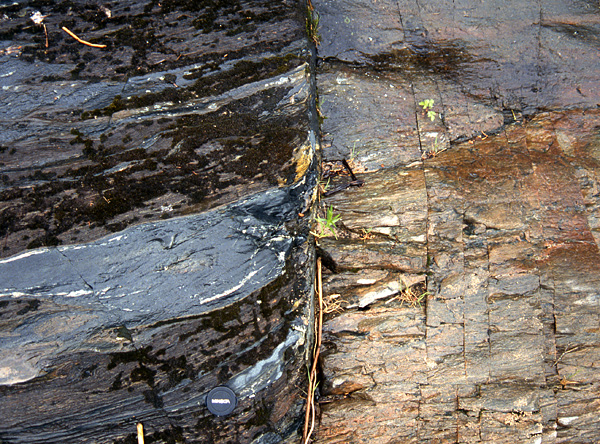
A fault cuts through layered Precambrian rocks near Seymourville, on the east side of Lake Winnipeg
We have little evidence for events in this region over the two billion years or so following the formation of the Shield rocks, but it is clear that there were immense periods in which the land was subject to erosion. Much of the Shield terrain must have been tall and mountainous in the early years, but over the endless millennia it was ground down, bit by bit and grain by grain, to a shape close to that of the low-lying terrain with which visitors to northern and eastern Manitoba are so familiar.

The Winnipeg Formation is exposed in the large silica sand pits on Black Island (photo taken in the early 1990s)
As the mountains were ground lower, those grains of sediment would have accumulated in vast bodies along their flanks. Finally, about 460 million years ago in the Late Ordovician Period, the sea intruded into the middle of what was then the ancient continent of Laurentia. The waves and currents played with the immense store of sediment, shaping it and laying it down into sandstones and shales. These would become the Winnipeg Formation, which blankets the eroded surfaces of the ancient Shield. Along the lake these rocks are not very thick, generally about 10 metres in total thickness, but they form very distinct deposits. They have been lightly touched by the forces of diagenesis, so lightly that you often do not need a hammer to collect them, but can scoop out the sand with a shovel or with your bare hands.

A geological field party examines layers of the Winnipeg Formation in the pits on Black Island
The Winnipeg Formation is variable stuff. In places it is an ugly, grey, muddy shale. In other locations, such as in parts of the silica sand pits on Black Island, it is a sparkling golden yellow sandstone. Much of the Winnipeg yields little to no evidence of ancient life, but elsewhere there are lamp shells, or conodonts, or evidence of animal burrows. Even though it is such a soft material, easily rendered to mushy soil and covered with vegetation, the Winnipeg can still be seen in several places around the lake for which it is named. In addition to the superb exposures on Black Island, it can also be observed near Seymourville and Hollow Water, at Grindstone Point, and at the north end of Hecla Island, among other locations.
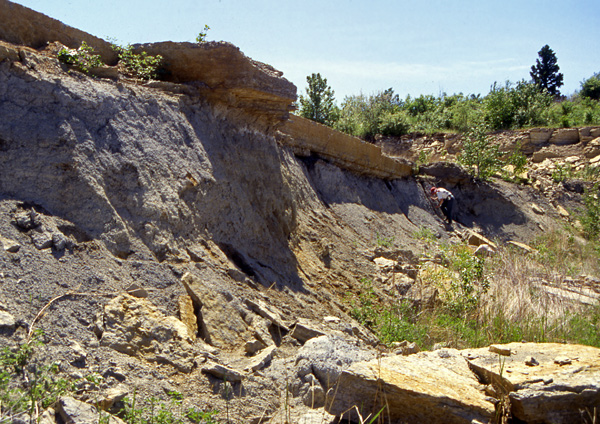
Near the north end of Hecla Island, the grey Winnipeg Formation is capped by hard dolostones of the Dog Head Member, Red River Formation. This photo was taken in the mid 1990s; I understand that this slope has slumped since then.
The Winnipeg Formation sediments are so soft and friable that they are almost never exposed except in places where they are capped with a much harder rock, the mottled Dog Head Member of the Red River Formation. Often, this cap is thin, only a few metres thick, but don’t be fooled by appearances! For this snippet of the Dog Head is itself just the introductory paragraph to the novel-length story of Ordovician limestone seas that was to follow. Along the lakeshore the overlying parts of the Dog Head have been eroded away, but in other places it has not been eroded, and in the subsurface (under ground) it is in the range of 30 metres (100 feet) thick. The Dog Head is itself overlain by three subsequent members of the Red River Formation, including the famously fossil-rich Selkirk Member (Tyndall Stone). Above these, the four members of the Stony Mountain Formation and the lower part of the Stonewall Formation were also deposited before the Ordovician story was complete. But the Winnipeg Formation is older than any of these, and its sandstones were already in place even before the Tyndall Stone cephalopods and Churchill horseshoe crabs were alive.

Ordovician stratigraphy in the vicinity of Winnipeg. The Winnipeg Formation sits on an unconformity above the much older Precambrian rocks. CHAT. = Chatfieldian Stage; G. = Gamachian Stage (after Elias, 1981, fig. 2).
A few years ago, a detailed scientific study of Lake Winnipeg was carried out, and some remarkable discoveries were made. One of the most significant (from my perspective) is that there is virtually no Ordovician bedrock under the eastern part of the lake. Rather, the lake bed in that area consists of the ancient Precambrian rock, with Lake Agassiz sediments above it. If the Winnipeg Formation has been almost completely stripped out of the eastern part of the lakebed (where it almost certainly occurred in the distant past), then an utterly mammoth quantity of sand, silt, and clay has been shifted by the combined efforts of water and ice.
The total area of Lake Winnipeg is 24,514 square kilometers. Even if we assume that the Winnipeg has been removed from only 10% of that area (and I’m sure it would have been more than that), and if the formation is about 10 metres thick (as it is along parts of the lake), then that is still about 25 cubic kilometres of sediment. Since quartz is remarkably durable stuff, the sand grains have tended to outlast the clay and silt, and the overlying carbonates.
This conversion of the antique Winnipeg Formation sand into modern sandy beaches is almost certainly happening still, because the Winnipeg is very close to the beach level in the eastern beaches area. Just east of the pump house at Victoria Beach, blocks of Dog Head rest high on the beach, but on a day when conditions are right, you can find bits of greenish, clayey sandstone exposed at mid beach level. On a really lucky day, you will find beautiful little Ordovician fossils in that sand: brachiopods (lamp shells), bryozoans (“moss animals”), crinoids (“sea lilies”), even trilobite components. That greenish sand is part of a thin layer, called the Hecla Beds, lying horizontally between the Winnipeg Formation and the Dog Head. So the Winnipeg itself is just below your feet. Along the shore, where pelicans glide above the windsurfers, grains of Winnipeg sand are gently washing out into the lake, beginning the next phase of their billion-year progress through the sediment cycle.

Victoria Beach
Even though this is far from being a scientific treatment of this matter, I ended up consulting quite a few references as I compiled the above piece. Some of these include:
Bannatyne, B.B. 1988. Dolomite resources of southern Manitoba. Manitoba Energy and Mines, Economic Geology Report ER85-1, 39 p.
Burt, A.K., T.A. Brennand, G.L.D. Matile, G. Keller, and H.L. Thorleifson. 2002. Reinterpretation of the Belair Moraine, southeastern Manitoba, Canada, based on a regional digital elevation model and new geological data. Geological Society of America, North-Central and Southeastern sections Joint Annual Meeting, Abstracts, Paper 29-0.
Elias, R.J. 1981. Solitary rugose corals of the Selkirk Member, Red River Formation (late Middle or Upper Ordovician), southern Manitoba. Geological Survey of Canada, Bulletin 344, 53 p.
McCabe, H.R. 1971. Stratigraphy of Manitoba, an introduction and review. In Turnock, A.C. (ed.), Geoscience Studies in Manitoba: p. 167-187. Geological Association of Canada, Special Paper 9.
Young, G.A., R.J. Elias, S. Wong, and E.P. Dobrzanski. 2008. Upper Ordovician Rocks and Fossils in Southern Manitoba. Canadian Paleontology Conference Field Trip Guidebook No. 13, Geological Association of Canada – Paleontology Division and The Manitoba Museum, 97 p.
Crab Haul at Wawa
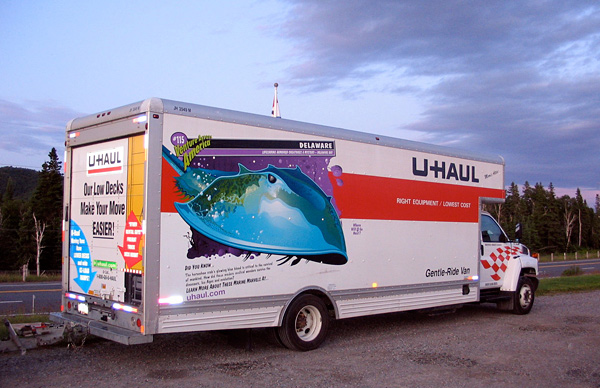
Driving across Canada this summer, I was surprised to encounter this colourfully decorated U-Haul in northern Ontario. It is wonderful to see a corporation using its advertising space to talk about relatively obscure (if very impressive) invertebrates.
Perhaps U-Haul aren’t being entirely accurate when they say that horseshoe crabs “survived” evolution, but I’m sure that the company was trying not to offend the sensibilities of some of the customers who might have ended up driving around with this informative blurb on the side of their vehicle (there are also a few minor inaccuracies in the web explanation that accompanies it, but I still give U-Haul full marks for including this in their Supergraphics series).
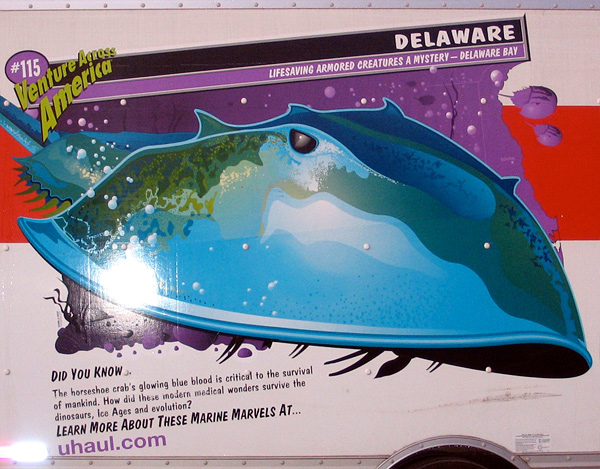
Horseshoe crabs (or xiphosurids) did, of course, survive the dinosaurs. Doubly so, since the oldest horseshoe crabs are about twice as old as the oldest dinosaurs (the Ice Ages were just yesterday geologically speaking, so I won’t even try to make that comparison). And horseshoe crabs have evolved, but they have done so slowly. Creatures evolve as much as they need to, in response to selection pressures, and horseshoe crabs have long been superbly adapted to shoreline and nearshore environments. Modern Limulus is not immensely different from Lunataspis and other Ordovician horseshoe crabs, but it is nonetheless different. Those ancient creatures do possess some characters, such as the segmentation between their thorax and telson (tail), that place them closer to the stem-group arthropods than any of their living relatives.
If you want to read more about this subject, Dave Rudkin and I have just published a general review of the evolution of xiphosurids in this new book. I haven’t seen the volume yet, but I am really looking forward to getting a copy!
Bernard Palissy
It seems that personal webpages go in one of two possible directions. A few are systematic and disciplined explorations of particular topics, but many more are collections of bright and shiny baubles, evidence of the human tendency toward a “magpie mind.” The following piece could demonstrate that this page is moving in the latter direction. I was looking through some trip photos today, and just couldn’t resist posting some of these …

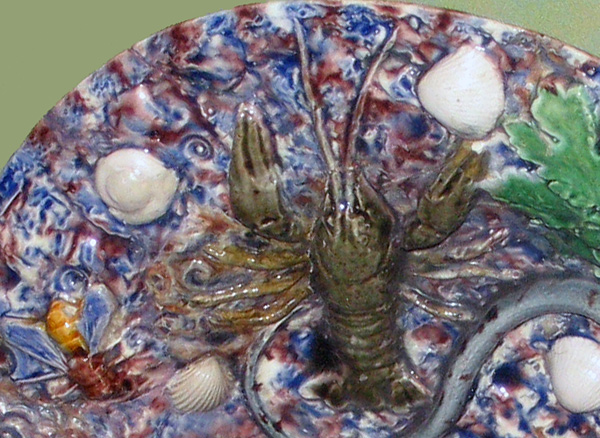
Two years ago, I had an opportunity to visit the Hermitage Museum in St. Petersburg, Russia. Among the endless treasures there, I was particularly struck by some items in a case of ceramics attributed to Bernard Palissy (c. 1510-1589) and his assistants. I was not previously aware of Palissy’s work, but I was instantly converted when I saw these wonderful platters on natural history themes.
Palissy was true Renaissance man, accomplished in the arts and in natural sciences. This is evidenced by his fine attention to detail, and the non-judgemental depiction of all manner of “creepy crawlies” on these marvellous dishes.
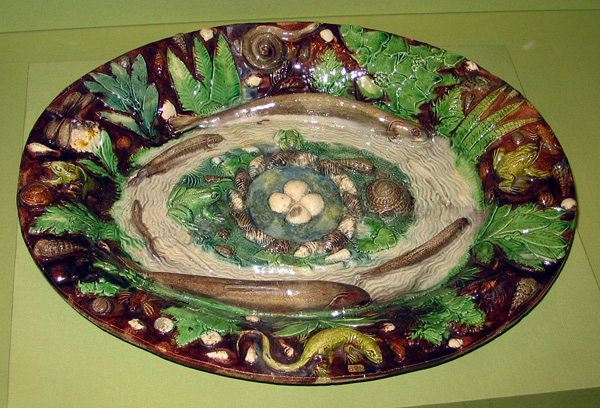

from Wikipedia: “Bernard Palissy (c. 1510 – c. 1589) was a French potter and craftsman, famous for having struggled for 16 years to imitate Chinese porcelain. … Around 1563, under royal protection, he was allowed to establish a fresh pottery works in Paris in the vicinity of the royal palace of the Louvre. The site of his kilns indeed became afterwards a portion of the gardens of the Tuileries. For about twenty-five years from this date Palissy lived and worked in Paris. He appears to have been a personal favorite of Catherine de’ Medici’s, and of her sons’, in spite of his profession of the reformed religion. … His ideas of springs and underground waters were far in advance of the general knowledge of his time, and he was one of the first Europeans to enunciate the correct theory of the origin of fossils.”
Addendum: I was just looking up information about Bernard Palissy on the internet, and found some wonderful material, including the subtitle “Snakes on a Plate.” I wish I’d thought of that.

Statistics are no Substitute for Judgement
When I started this page about seven months back, I didn’t anticipate that I might get interested in the mechanics of blogging. But early on I discovered that WordPress provides comprehensive statistics on visitorship, and as time has gone by I have found myself tempted to visit my “Blog Stats” page on a daily basis.
How many people have looked at my page today? How did they chance upon it? Which parts did they find interesting? How are visits influenced by the frequency, subject, or quality of my posts? Since I launched this site, it has had just over 4,000 visits. Maybe this isn’t a big number, but I am pleased that I am not writing purely for my own amusement, as I had feared at the start of this process.
This seems like a good time to examine what people are actually looking at. The following is a compilation of the “all-time” top 20 search topics that led people here as of August 28th (I have grouped similar searches):
|
Search |
Views |
| siberia | 51 |
| eurypterid/sea scorpion | 36 |
| ordovician animals/fossils | 21 |
| samuel hearne | 21 |
| ancient shore / ancient shore wordpress | 16 |
| plesiosaur / plesiosaur skeleton | 13 |
| ancient seas | 12 |
| 40000 feet | 10 |
| aequorea | 8 |
| tabulate rugose / rugose corals | 8 |
| mv ithaca / mv ithica | 7 |
| summer end | 7 |
| clearwater lake manitoba | 6 |
| octagonal shed | 5 |
| “norman aime” | 5 |
| ordovician cephalopods | 5 |
| bird gravel | 5 |
| small ponds | 5 |
| ship scrapping | 4 |
| museum exhibits | 4 |
It is intriguing that fully half of these topics (such as bird gravel and ship scrapping) are at best marginal to the subject of this page. I get hits for “Siberia” and “40000 feet” only because I posted a single photo of Siberia from the air. Obviously, it is worthwhile to include a diversity of material if you want to attract visits; I just hope that a few of those who came looking for information on octagonal sheds (for example) took a bit of time to read some of the other material on offer here.
The paleontological search topics are a mixed bag, but I am surprised by the level of interest in eurypterids, which appears to be far greater than that for any other Ordovician group. Are there more people who collect eurypterids than cephalopods, for instance?
Considering visits to specific posts, the most popular by far is The Churchill Quartzite. Fair enough. I like that one myself. But I am at least as proud of some pieces that have attracted only 10% of that attention.
How much should I be thinking about what attracts people to one piece, rather than to another? This is the point at which attention to statistics can become dangerous. As long as they are just a matter of interest or fun, like baseball statistics or lottery numbers, then that is fine, since they cannot be modified by passive observation. (If I am in a position to modify baseball statistics or lottery numbers, I am not telling you about it here, and you will be hard-pressed to locate me in my new tax haven somewhere in the Caribbean.)
But as the generator of content on this page, there may be a danger that I will begin to modify that content. I might begin to write what I think will attract visitors, rather than writing whatever I find interesting on a given day. I do like to see an increase in the number of hits, and most months they have increased, but when will they reach saturation? If I “sell out,” might visits continue to go up, or would this just annoy those people who come back regularly to follow what I might have to say?
The truth is that I have no plans to sell out, at least in any conscious way. I have a long-term agenda for this page, and anyway, I am too contrary (or pig-headed?) to be strongly swayed by whether I am attracting a large audience. There is, however, a plan to add more items that might make the site useful. In particular, I am currently working on separate pages about Tyndall Stone fossils, and more technical pages about my research. But these have turned out to be big projects, so don’t expect to see either of them next week!
Statistics are no substitute for judgement, but they can provide untold hours of idle amusement.
The Uplands, 2009

(photo © Norman Aime)
As promised a couple of weeks ago, the following is an update on our recent fieldwork in the Grand Rapids Uplands of north-central Manitoba. Since the internet service there turned out to be at the weak end of the “chancy to nonexistent” scale, you have been spared from what might have been almost daily descriptions of our progress. This is probably a very good thing; what might have seemed interesting to me at the time would probably have turned out to be dull and repetitive for you. Paleontological fieldwork often consists of similar days that merge into a single memory, punctuated only by weather conditions, number and ferocity of biting insects, and the very occasional discovery of an unusual specimen. Instead of that recounting of daily travails, I am now able to describe a “typical” day, which will almost certainly include most of the highlights of our time there …

The beginning of a day in the field: Debbie Thompson's safety glasses reflect (L-R) Sean Robson, me, and Michael Cuggy.
I am awoken at 6 am by the pleasant sounds and smells of brewing coffee. I am sharing a room with Norman Aime this week, and I am grateful that he is an early riser, because the coffee is always ready long before I get out of bed at 6:40-ish. By that time, Norm is dressed and has headed out to the front step of the motel with his coffee, where he will chat with Debbie Thompson. Perhaps Debbie will tell him her joke (the long one that we haven’t allowed her to repeat to the rest of us), or they will look to see whether the little brown bat has returned to sleep by the step this morning.
Up and showered by 7-ish, and fortified by my first cup of coffee, I run into Ed Dobrzanski in the hallway. Even though Ed retired from the weather office long ago, meteorology is as much a calling as an occupation, and he gives me a thorough and accurate forecast for the day. Today will be warm and slightly cloudy, but at least it will be a bit cooler than yesterday. That afternoon it hit about 32 Celsius, hot enough that we must have each consumed several litres of water on the dry and dusty outcrop. By 7:30 Sean Robson and Michael Cuggy have also emerged, and we are ready for breakfast.
Every morning we eat at the Pelican Landing, a short drive across the mist-shrouded bridge over the Saskatchewan River (anywhere in Grand Rapids is just a short drive away!). Over our eggs, bacon, bannock toast, or pancakes, we map out the day ahead. Today, Ed and Norman will scout for new fossil sites north of Grand Rapids, while the rest of us continue to split rock at the William Lake site, a place that has become very familiar over the past several years.
The road northward is quiet this morning, even by northern standards: we meet perhaps five cars (most of which are, of course, pickup trucks) in the course of an hour or so. There is little wildlife other than the ubiquitous ravens, but at one point we come across a pair of sandhill cranes searching for their morning snack in the broad ditch. Arriving at the site, we unload the packs, tools, and water pails, and retrieve the shovel and broom that had been safely stowed under a fallen tree. The cooler and water bottles are placed in the shade against the front bumper. Even though it will not be as hot as it was yesterday, the sun’s rays are direct and piercing this morning, and heat is rising from the surface of the rock.

For a brief instant, it looks as though we are performing some sort of free-form dance as we scrape rubble from the surface. L-R are me, Sean Robson, and Debbie Thompson. (photo © Michael Cuggy)
Those rays are still at a low enough angle that it would be tempting to put the shadows to use in the search for small and obscure fossils, but right now there is other more pressing work. Yesterday we finished off the bedrock horizon (level) from which we were collecting, and the next uncollected level above is hidden and secret, resting beneath a well-cemented mass of loose rock, gravel, and clay. All four of us work away at this through the morning. First we lift and throw all the larger stone slabs; this is the fun part, because some of them land with a sound like breaking crockery. We follow up with shovels and broom, and finally wash the surface with water.

Debbie saves and befriends one of the many butterflies attracted by our water pails. (photo © Michael Cuggy)
In North Korea, convicts are sentenced to this sort of work. Here, people do it voluntarily, and seem to enjoy it, even though we do complain and swear quite often (field conversation is much less polite than office conversation). Our big advantage is that we are much better fed than those people in North Korea. Speaking of which, it is already lunchtime. Yesterday, Debbie sat on the outcrop in that numbing heat while, I am almost embarrassed to say, the rest of us turned on the truck’s engine and air conditioning. Today is a bit cooler, so we all sit outside on the rocks to eat our sandwiches. Or at least, this is the story I’m telling you here.

Searching for fossils, Sean Robson extracts a small block of dolostone. (photo © Norman Aime)
After lunch, the rock surface we cleaned is now reasonably dry, and we set to with hammers and chisels, splitting the beds apart in our search for fossils. The layer we examined yesterday gave us very few fossils (just one ostracode, as I recall), and today is sadly not much different. I brush the dirt from each slab and turn it in the light, using a hand lens to examine each little feature. On the surfaces I can see salt crystal moulds, algal crusts, or small ripples, indicators of a shallow, hot, salty, and barren environment. There is no evidence of complex life. I hurl the slab onto the growing heap of detritus, then lever out the next piece of bedrock. The toil seems endless and, even worse, completely unrewarding. I remove my hat and wipe the dust, sweat, and sunscreen from my face.
The rock we are examining was deposited in the Late Ordovician Period (about 445 million years ago), in an interval during which the sea was becoming progressively shallower. Here in the centre of the ancient continent of Laurentia, conditions were becoming hostile for life as the shrinking sea retreated toward the middle of the Williston Basin (in what is now North Dakota and Saskatchewan). The area we are working in has given us wonderful fossils in previous years: jellyfish, eurypterids (“sea scorpions”), and horseshoe crabs, along with more typical fossils such as corals and brachiopods (lamp shells). But the interval we have reached this year is the “dead zone” of the marine regression, and our attempts to collect fossils here are beginning to depress us.
We give up trying to find fossils in these beds, and begin to prepare a block that will be extracted as a lithologic (sediment) sample. We want to get a vertical sample through each interval in its entirety, but the beds are often thin and brittle, so this is a tricky business. I have wrecked several such samples already this week, so I slowly cut out a pedestal of rock. As it is gently tipped away from the bed, Sean straps it with tape. Debbie bags and labels the sample, ready for return to the lab in Winnipeg.
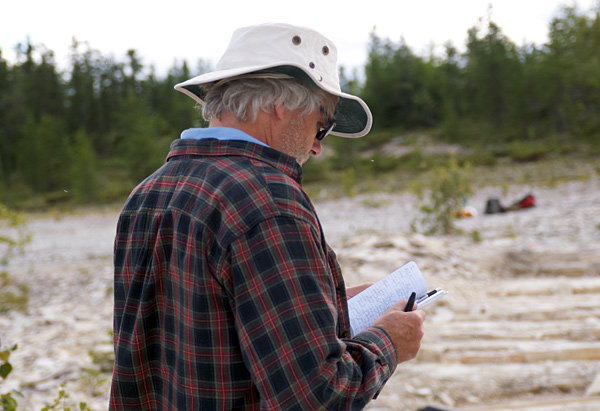
A scruffy paleontologist fills in his field notebook. The two shirts are not some sort of ill-planned fashion statement; I was cold that day! (photo © Michael Cuggy)
As we finish this sample, Norm and Ed drive up to give a report on their scouting progress. They have visited many sites, but most of those have turned out to be full of Silurian stromatolites – algal or bacterial mounds that are of little interest to most of us.
Ed: “I don’t care if I never see another stromatolite.”
Norm: “We saw some great stromatolites!”
Norm is almost always positive and enthusiastic, regardless of conditions, and why should stromatolites be any different? He often reminds us of the whistling guy in this Far Side cartoon.
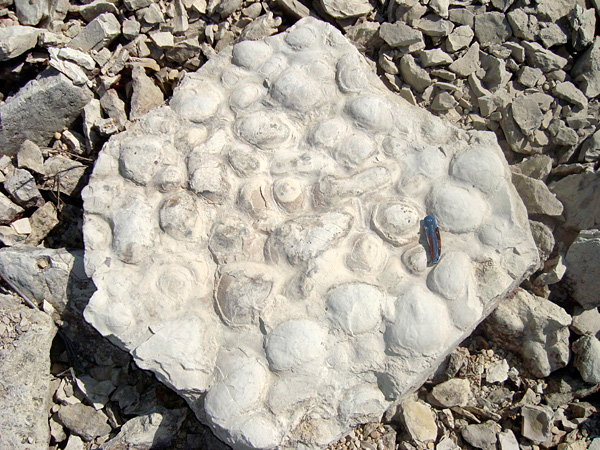
Silurian stromatolites in the Grand Rapids Uplands (photo © Norman Aime)
Ed and Norm head off to look at a few more sites, while the rest of us get onto some serious fossil collecting. We are tired of shifting masses of unfossiliferous rock, so we move to a lower interval, one that we already know to contain some wonderful fossils. The fossils are still rare here, and it takes a while to find them, but every few minutes a hopeful sound emanates from one or another of us. After an hour or so, Michael has found some nice arthropod bits. This makes him much happier.
Michael is an expert on eurypterids and other ancient arthropods, and he is with us because he needs more material for a proper description of the eurypterids from this site. As it turns out, we will not find many useful examples this week, but we will collect one that will show the entire segmentation of their jointed bodies. So Michael’s time is not wasted.
Sean and Debbie have collected some very fine jellyfish, and we have also seen and set aside many odd bits that will only be identified once they have been carefully washed at the museum. Sean is hoping to find some well-preserved linguloid brachiopods (lamp shells). His quest will not be as successful as Michael’s: we can find thousands of brachiopods, but none of them are sufficiently complete for the sort of detailed work that Sean wants to carry out.
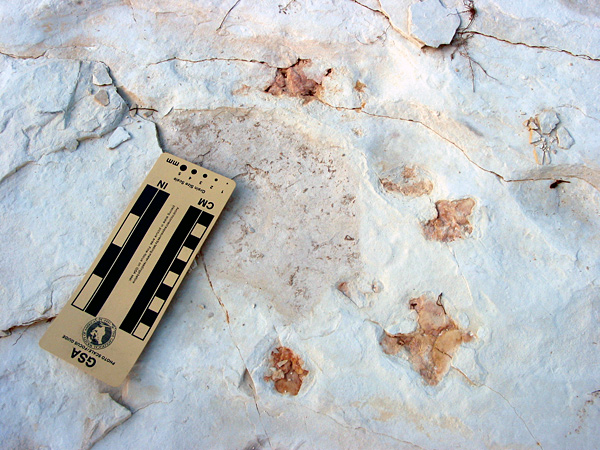
Several fossil jellyfish are exposed on a bedding plane surface.
Now the mood is far more cheerful and relaxed; sometimes the human dynamic in the field reminds me of a sports team. When we are not finding fossils (i.e., losing), then nothing seems to work and every action seems like an effort, but when we find fossils we are completely cheerful and positive. Though some of us do still grumble about the pain in our knees, of course.
This afternoon, Sean, Michael, and I engage in endless juvenile banter. I occasionally wonder how Debbie manages to put up with us …

Poorly preserved linguloid brachiopods are incredibly abundant in some intervals.
The sun is getting low. The shadows make for fine fossil-finding, but they are also a reminder that we really should pack it in for the day. This decision is made slightly easier by the fact that the slight breath of wind has diminished, and the blackflies have decided to make plain their painful presence. Reluctantly, we begin to label our “catch,” then pad it into bins in the back of the Explorer. The fossil surfaces are easily damaged, so every piece must be protected before it is transported. The gear is re-stowed, the shovel and broom are hidden, and we pile into the vehicle and ease back to the road.
In the golden light, the east-pointing tree shadows are at right angles to the north-south line of asphalt, creating what Dave Rudkin sometimes calls a “bar code road.” We miss Dave this year; we could really use his good humour and his fossil-finding skills, but he has been too busy with other matters. Next year, perhaps?

Over the past few years we have extracted a lot of dolostone, giving the "quarry" this stepped appearance (photo © Norman Aime)
We drive back past rocky outcrops on the gently undulating crest of the uplands, past the trees blackened by last year’s forest fire, past the huge beaver lodge in Eating Point Creek, past the remarkably unspoiled lakes. We reach the curves that herald the approach of Grand Rapids, then coast down the gentle slope and into town. Grand Rapids is small, but it always feels as though it is really “somewhere” when you realize that it takes the better part of two hours to drive to the next place, either northward or southward.
There are more dinner choices this year, as a Chinese restaurant has opened right across the road from our motel. After a quick wash, it is very pleasant to walk there through the gathering dusk. There are still rocks to be unloaded from the truck after dinner, and field notes to be completed, but there is relaxation time too. Time to consider what tomorrow might bring, and what unknown fossils may remain hidden somewhere in the immense and enigmatic uplands.

Pelicans below the hydro dam at Grand Rapids (photo © Norman Aime)
North
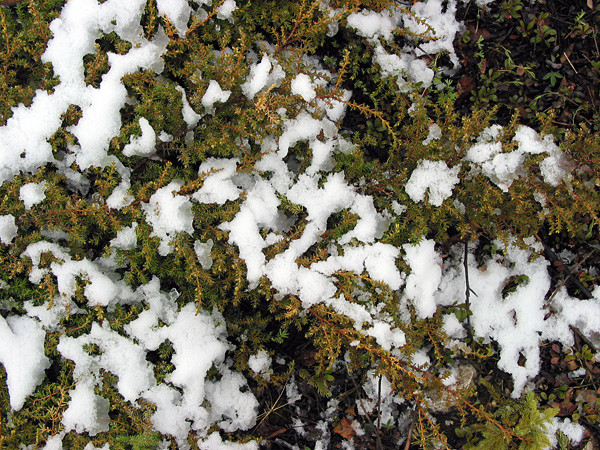
I’m headed north, off to commune with the bears and blackflies, black spruce and moose. I’m going to the Grand Rapids Uplands to do fieldwork with a wonderful group of people. We will be searching for Late Ordovician shoreline creatures and are hoping to find more horseshoe crabs, jellyfish, eurypterids, and perhaps some unexpected treasures. We will also be scouting a large area of north-central Manitoba to see if any new and interesting sites can be located.
If I can get an internet connection, I will try to post some “live from the field” material while I am there. But we will see; the connection is often chancy to nonexistent.
The above photo shows what the ground looked like one day in late May a couple of years ago. I don’t expect to see snow this time, but you can never predict northern weather!
Transitions

Sea urchin on the beach: Whale Cove, Grand Manan Island. New Brunswick
It has been said that every spot on the Earth’s surface is an ecologic zone of transition, for at least one life form or one physical factor. If you walk 10 metres across the middle of a prairie wheat field, with flat grain extending almost to the horizon, it is hard to see what is changing, but you can be sure that there are transitions. On a shoreline on the other hand, the transitions are dramatic, often abrupt, and sometimes violent.

Norman Aime (R) and me at the Churchill rocky shoreline site, summer of 2005 (photo © David Rudkin, Royal Ontario Museum)
When I traverse the modern shore of Hudson Bay and take a step from the cold hard quartzite into the even colder seawater, I am crossing the most elemental and complete kind of boundary on this planet. Salt water and dry land are arguably the two most different environments you can find in immediate proximity to one another. Fish and other sea animals live in a world where their body chemistry is very similar to that of the surrounding water; they breathe water and are buoyed up by it so that they are free of gravity. In my land world, I must carry my seawater-like chemistry around in a tough (though not always thick) skin, I breathe air, and each step of my hiking boot must counteract 190 lbs of gravity.
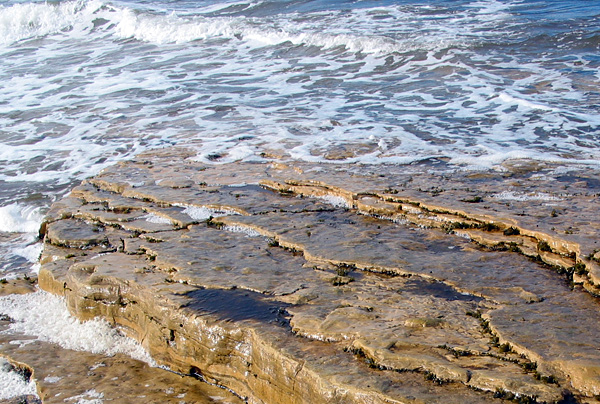
The transition from sea to land was a major evolutionary step for our fishy ancestors to undertake, and they hadn’t yet made this step when the ancient Churchill shore was being formed. So there were no amphibians, reptiles, or mammals on the scarp above that shore. The ancestors of insects had probably also not yet moved onto land, so no mosquitoes flew above the land surface, nor were there land snails. If snails had tried to move onto land before this time they would have found it a very inhospitable place, since there would have been no land plants for them to graze on, though there might have been lichens and algal scum on the bare rocks. The snails would have been quite happy to stay in the sea, though. There, they were surrounded by corals, sponges, seaweeds, trilobites, and squid-like cephalopods. Although none of these diverse animals belonged to the same species as those around today, together they make up an assemblage that we can easily recognize as a shallow-water, tropical biota.

This diorama at the Manitoba Museum depicts an Ordovician seafloor in southern Manitoba (photo © The Manitoba Museum)
Since there was so little life on land at the end of the Ordovician Period, the transition zone represented by the ancient shoreline would have been extreme, in ways that we can only imagine. If I envision myself diving there, approaching the shore from the seaward side I can see silty sediment ploughed by worms and trilobites, then zones of dense, colourful corals extending upward into the intertidal zone. Lifting my head above water as I reach the shore, I can see … almost nothing. A sweltering Mars-like landscape of dark forbidding cliffs, with nearly no visible life. Sitting on the shoreline today considering this, I have to say that I prefer the modern Churchill land, even on a July day with a blasting northeast wind carrying cold sleet.
I wrote this piece a few years ago. Sadly I won’t be getting to Churchill this year, though I will at least be doing some northern fieldwork before the end of the summer.
On the Level

Paleontological field party on a beach ridge (an ancient beach) east of Churchill, Manitoba (photo © David Rudkin, Royal Ontario Museum)
I am often struck by the shock with which many in the media seem to greet the news that global sea level may be rising. No, I am not a global warming denier. We are using up the Earth’s precious carbon resources in a hasty, thoughtless manner, and this is bound to have negative outcomes. Climate change is just one of these, and sea level rise is obviously a likely outcome of climatic warming.
What I find somewhat surprising is the static view of the world that seems to be so deeply ingrained in so many people. The media in general remind me of a bunch of oldtimers sitting on the porch of the general store, talking about “young people these days” and “whatever will they think of next.” Note to the media: constant change is one of the basic truths that underlie the geological record. If the sea isn’t rising, it is falling. And if the world isn’t getting warmer, then it is getting colder.
One of the most interesting aspects of sea level change is that it is a local phenomenon, as well as a global one. On a local scale, the sea can be rising in one place while it becomes lower elsewhere. This is because sea level is relative: it is linked to both the rise and fall of the ocean’s surface, and the rise or fall of the shore on which we happen to be standing (the world’s landmasses are in both horizontal and vertical motion, though at rates that we cannot usually perceive directly).
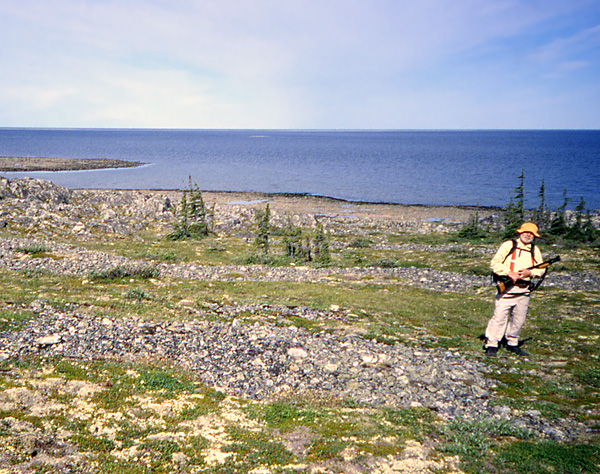
Ed Dobrzanski stands beside ancient beach ridges at Button Bay, Hudson Bay. Beach ridges extend inland from Button Bay, providing abundant and often graphic evidence that the land has been steadily rising (and local relative sea level falling) as a result of post-glacial rebound.
I thought of this last week, as my family was visiting old haunts near the mouth of the Bay of Fundy, New Brunswick (for those of you who have read my other posts: yes, I did look for jellyfish the whole time, but unfortunately I didn’t find any). What I did see was a fabulous geological story that I had not previously been aware of.
One day we took the ferry from Grand Manan Island to Whitehead Island, then wandered to the beach near the Whitehead lighthouse. As we walked along the beach near the water line, I began to notice wood sticking out of the gravel. At first, I thought that this was random driftwood. But then I began to notice that most of the pieces of wood were oriented near-vertical. Each of them rose out of the gravel into the air in exactly the way that floated-in pieces of driftwood do not. When I saw tree stumps sticking out of the beach in places, I developed an inkling of the true story: the wood represents the remnants of an old forest that is gradually disappearing beneath the sea, suggesting that the relative sea level is rising on this shore of Whitehead Island.
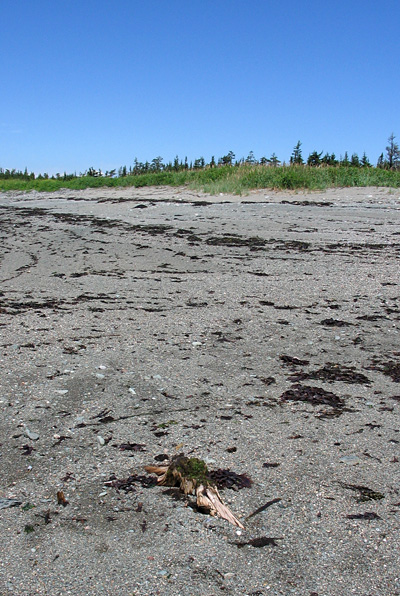
Tree stump buried in the beach on Whitehead Island
Later, I saw information describing a much better-preserved “drowned forest” and peat layer along the shore in front of Castalia Marsh, on Grand Manan itself. The wood, which has been carbon dated to more than three thousand years old, consists of stumps, roots, and other wood from conifers such as hemlock or spruce. These are embedded within the thick peat, which is itself composed of an immense quantity of compressed plant fibre. My friend Dick Grant, a retired geologist, kindly offered to show us the deposit at Castalia. So my family met up with Dick and his daughter Hannah, with dogs in tow (or, more realistically, the dogs were towing us).

Dick Grant with Noni at the beach beside Castalia Marsh, Grand Manan Island
The peat layer is only exposed when the sea is several feet below the high tide mark. Tree stumps and roots are visible within the peat, and when one sees the entire assemblage it is remarkably easy to imagine the ancient community. The wood is wonderfully preserved and unmineralized. When you hold a piece of it, it is very difficult to appreciate that it comes from trees that grew long before the time of the Roman Empire. The dogs were not burdened by these thoughts, and the two labs occupied themselves with pulling wood out of the peat and tearing it to bits with their teeth. It clearly had a superb vintage bouquet.
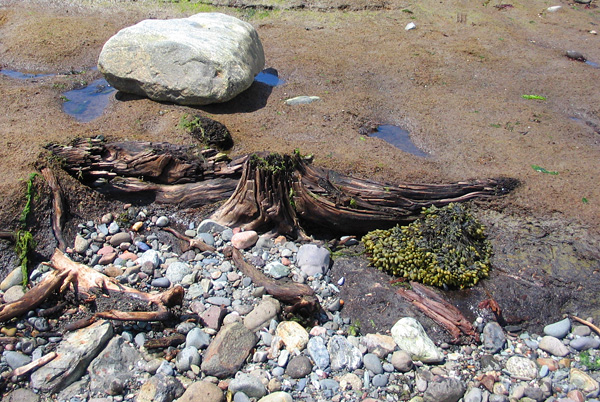
One of the stumps that Dick and Noni were examining
This deposit appears to be part of a fascinating, continuing geological story. The peat in front of the modern beach ridge may have been deposited in a low-lying wood, and perhaps also under saltmarsh conditions. If sea level is rising in this area, then the beach is moving landward over the peat, and the peat to seaward is continuously eroding away.
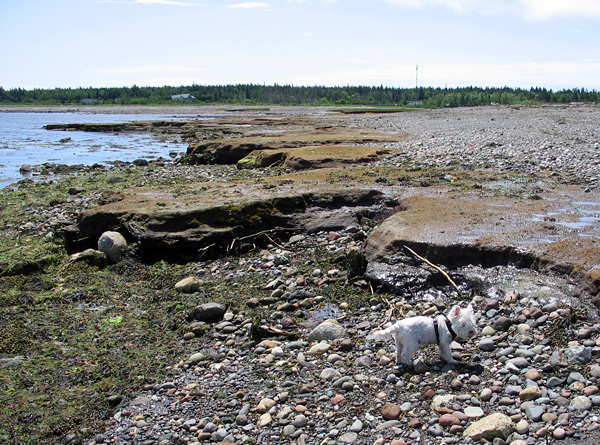
The peat horizon is being rapidly eroded by the sea (Keita for scale)

A large quantity of wood is embedded in the peat
Behind the beach is a semi-enclosed embayment, and behind that is saltmarsh and low coniferous trees. The seaward edge of the saltmarsh also exhibits a thick, eroded peat deposit. Meanwhile, trees along the front of the low-lying wood are now dead, possibly killed by increasingly salty conditions. All of these features appear to be consistent with a gradual sea level rise; the wood-salt marsh-embayment-beach could be considered as a conveyor belt that is being gradually fed into the sea.
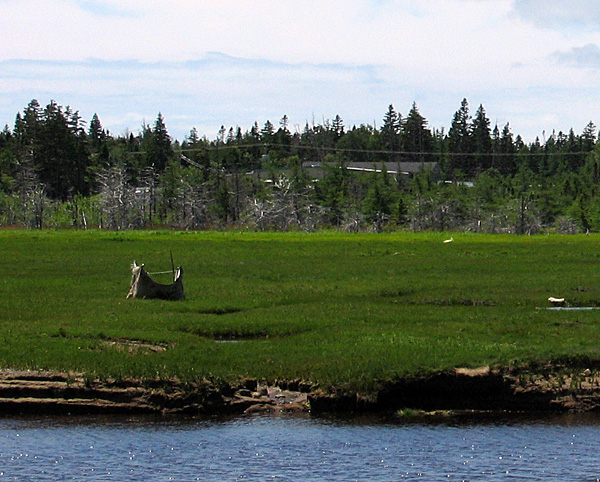
Dead trees at the back of the saltmarsh may have been killed by an ongoing sea level rise.
Anyway, it seems to make a nice story, at least to my eye. But much detailed scientific work would need to be done to determine if such an interpretation is, in fact, correct. As Dick and I discussed all of this, the sea was beginning to rise over the peat. The dogs were engaged with their own concerns, as important to the grand scheme of things as any of our scientific considerations:

I hadn’t really considered dogs as agents of erosion, but seeing how they worked on the wood in this deposit, I have had to modify this opinion (I will try to add a video clip after I get home).
© Graham Young, 2009
(For general information on Castalia Marsh and the geology of Grand Manan, I referred to J. Gregory McHone’s Grand Manan Geology: Excursions in Natural History, which was kindly provided by the author.)
The Glamorous Life of the Jet-Setting Paleontologist
If you come to this page looking for scientific content, you might want to just skip over this entry … this one is largely a travelogue.

Cincinnati in the morning
What is your mind’s eye image of the travelling paleontologist? For many people outside the profession, it seems to be somewhere between Roy Chapman Andrews, Indiana Jones, and the characters from Jurassic Park. Certainly this is the impression that I get when I tell people that I am off on a trip. Almost invariably, those who don’t have experience of this life seem to assume that, if I am going to the field, it will be an exciting adventure. Uplifting scientific discoveries will alternate with encounters with dangerous animals, animated intellectual discourse, dramatic landscapes, perhaps some interesting local people, and food served up on white linen and fine bone china at a luxurious field camp staffed by trained international chefs.
Yeah, of course there is some of that, other than the trained international chefs. But the great majority of fieldwork seems to consist of endless hours of tedious, repetitive labour, far too many biting bugs, bad weather (too hot, too cold, too wet, too snowy, too many tornadoes, …), uncomfortable beds, and barely passable food. It is often fun, but this fun is achieved despite the conditions, not because of them. I enjoy going to the field, but I generally enjoy returning home even more.
The same goes for travel to conferences or committee meetings. When I say that I am off to a meeting in another city, I often seem to get the response, “You’re lucky!” And there is a grain of truth to this. I like to see the world from above, I enjoy seeing strange cities, I love going anywhere that has a seacoast, and who wouldn’t appreciate it when they are given the chance to see things on the other side of the world? But it is also often true that my favourite view of some places is in the rearview mirror (Russia, anyone?), with home the next visible point on the horizon.
The germ of these thoughts was forming as I sat in Winnipeg Airport’s international departure lounge late one morning last month, on my way to the North American Paleontological Convention in Cincinnati. After a “lunch” consisting of a diabolical watery pap-filled microwaved wrap, I spent most of the remainder of the day being bumped around on United Express’ commuter cattle-car flights, punctuated by a wander through much of the length of O’Hare Airport in Chicago (actually, this part was rather pleasant; the Field Museum has added a shop with an immense Brachiosaurus replica, almost worth the price of a plane ticket to see).
Arriving at Cincinnati/Northern Kentucky International Airport was a revelation. The terminal was small, smaller than Thunder Bay Airport, and the heat and humidity were so shocking as to be confrontational, but the people were friendly and genuine. I reached the university residence towards evening and met my roommate, John Handley. John is a fascinating guy, a mild-mannered industry mathematician by day who spends his spare time helping paleontologists make their statistics make sense. I discovered from John that the campus food services would not be open for several days prior to the start of the conference itself (we had arrived early to take part in pre-conference field trips). As the breakfast restaurants within reach seemed to consist of Arby’s, Arby’s, or Arby’s, I deposited my bags and headed out to scope the environs before darkness set in.
I really should have taken some time to think about this, as I realized several agonizing blocks later. I had not changed from my travel clothes of black blazer, black jeans, and black boots (my wardrobe is nothing if not imaginative), and was now discovering that, even though we were well into the evening, the heat of the sun and air packed a tremendous wallop. It began to feel as if I had entered a sauna dressed for a formal occasion, and the friendly greetings of the lightly-dressed people I met just made me feel even hotter, more uncomfortable, and more foreign. Nevertheless, a mile or so from campus I found a restaurant and shopping district and had dinner.
After dinner (Thai Noodles!) I made the rounds of the IGA, picking up all those glamorous international paleontologist breakfast supplies: bagels, cream cheese, instant coffee, and yogourt, but was defeated in my attempts to find a microwave-proof coffee cup. Again, the remarkably friendly people of Cincinnati came to my aid, as various store staff left their posts to assist this strangely-accented and dressed foreigner with his quest. The young man from the bakery section asked if I was an artist (the black jacket, I guess!), while the lady from the deli kindly helped me locate a glass measuring cup in which I would be able to heat the morning Maxwell House. Then it was back up the hill to the university, hauling grocery bags through the stifling heat as I continued to be greeted by the friendly locals.

Frankfort, Kentucky

A roadside sight in Rabbit Hash, Kentucky (yes, that is the actual name of the place; you could look it up!)
After this literally pedestrian introduction to Cincinnati, the field trips on the subsequent days were another revelation. Here in Manitoba we have fantastic Ordovician marine fossils (some of the best in the world, in my humble opinion), but these are generally located in quarries and outcrops that have little vertical extent. We can find a lot of fossils at a given site, but they all come out of just a few beds. In the Cincinnati area, by comparison, there are also abundant Ordovician fossils, but they are located in roadcuts that may expose a thickness of many metres or tens of metres of rock, along stretches of a kilometre or more of road.

One of the many large Upper Ordovician roadcuts in northern Kentucky
We were led on the Ordovician field trips by Carl Brett, Pat McLaughin, Steve Holland, and Mark Patzkowsky, scientists who have put together a remarkable three-dimensional view of how the environments and organisms in that region changed through time. Seeing the vertical sections they have been studying, I could begin to appreciate how they have been able to apply sequence stratigraphic principles related to sea level change. I could also appreciate the immense amount of work that has been done by them, and their colleagues and students, and marvel at the creative way in which this picture has been assembled.
These field trips really made the conference worthwhile for me. Even though I had been reading their papers for years, having the rocks explained by these people really opened my eyes to their ideas, and gave me inklings of how I could apply some of the same principles to our ongoing work here (more on this later, perhaps). As has occurred elsewhere, I was also inspired by the knowledge and dedication of some of the amateur paleontologists who took part in the field trips. Members of the Cincinnati Dry Dredgers, such as Steve Felton, carry a depth and breadth of field knowledge that must be envied by every professional paleontologist with whom they come into contact.

Large trilobite Isotelus maximus from the Cincinnati area (specimen on exhibit in the Cincinnati Museum Center)

A mess of brachiopods on a Richmondian (Upper Ordovician) bedding plane surface
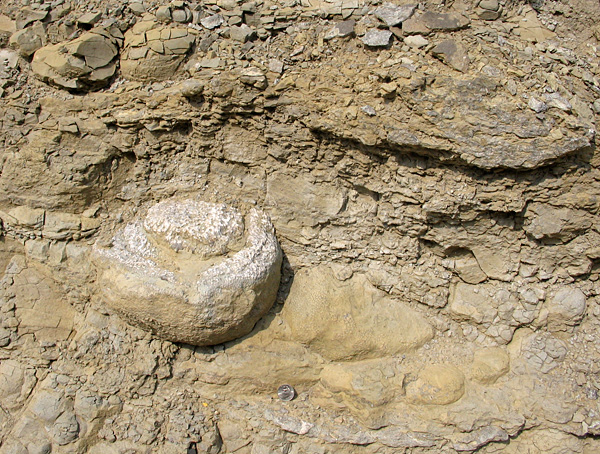
This colony of the colonial rugose coral Cyathophylloides is in the large Richmondian roadcut near Madison, Indiana (see The Coral Hut, below)
But the rest of the conference was also superb. Arnie Miller and his entire team at Cincinnati put on what has to be one of the best-organized meetings I have ever attended. Meeting rooms were well planned, the equipment worked, the refreshment breaks were perfect, and there were always people available to answer any question one might have. Each evening, after the scientific sessions were over, groups of scientists reconvened in the restaurants and beer gardens near campus to continue their discussions (sometimes in a more and more animated manner, I admit). Even the heat began to seem benign, as it was relatively pleasant to sit outdoors in the long warm evenings. If one had a cool beverage to hand, and didn’t actually have to get up and go anywhere, it was just fine.

Modern buildings at the University of Cincinnati
Still, it was a long time to be away (so long that the conference was beginning to feel like a job), and we were living in a dorm and not a hotel. I really felt I could take no more of the heat by the time I boarded the plane for home. This time around, O’Hare took on a less pleasant quality. The Winnipeg flight was supposed to depart from the same commuter-plane gates as at least six other flights, the space was full of very grumpy people waiting for a long overdue departure to Charlotte (NC), the airline staff were apathetic, there were no audible announcements of any sort, and I was almost out of US money. It was very good to finally be back on the ground in quiet, cool Winnipeg.
Back with my unwashed laundry. Back to all the unanswered e-mails, reports to be written, monthly forms to be filed. Work life. Travel is often necessary. It is sometimes exciting. But I can foresee a time when I will travel very little. And I really won’t mind.

The Cincinnati Museum Center occupies the former train station, a wonderful Art Deco building.


 Ancient Shore