The Coral Hut
I have had a hiatus from blogging as I was attending the North American Paleontological Convention in Cincinnati last week. I learned many things that would be worth adding to this page, but we were kept so busy at the meeting that there was little time (and even less energy) for writing. I will try to get some of the conference items posted in the next week or two.

While I was in Cincinnati, my friend Bob mentioned that the new book A Sea Without Fish has a piece about this octagonal shed in Madison, Indiana, that has its walls constructed entirely of Ordovician fossil corals. This seemed so intriguing that we took a morning away from the presentations so that we could look at the hut, and at the fabulous Richmondian (Late Ordovician) coral beds along the roadcut leading into Madison.
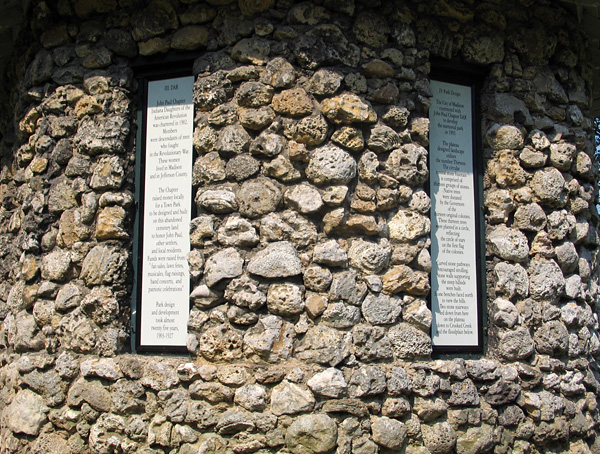
The shed is in a corner of John Paul Park, which was founded more than 100 years ago. It was built as a tool shed; the panels describe the history of the town and the park (but, interestingly, they don't seem to mention the corals).
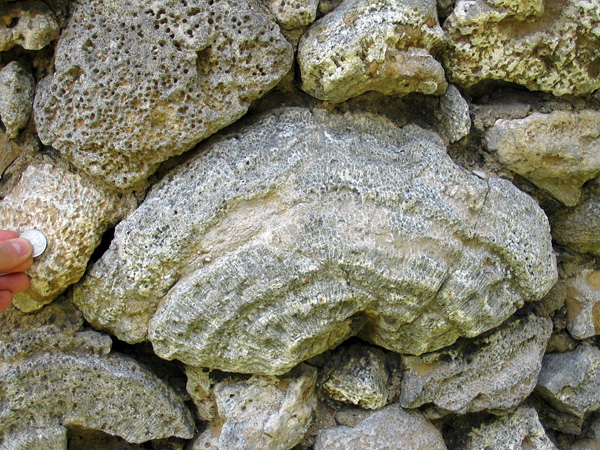
The walls are made of coral colonies mortared together. Every one that we could identify seems to belong to the rugose coral genus Cyathophylloides. Even though other corals can be found in the coral beds, the masons must have been selective when choosing stones. This dome-shaped colony is in its growth orientation, but many others have been fitted in every which way.
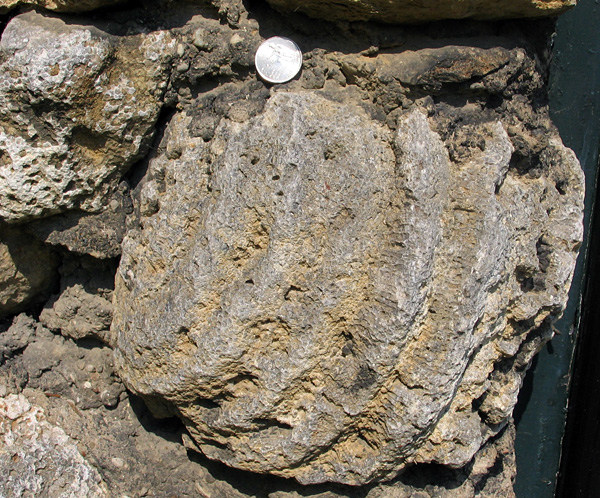
This colony is turned sideways. The repeated subparallel bands in its skeleton may represent annual growth cycles (similar to tree rings).

Although the shed was the highlight of our trip to Madison, the town has many other interesting sights.
Under Cormorant Hill
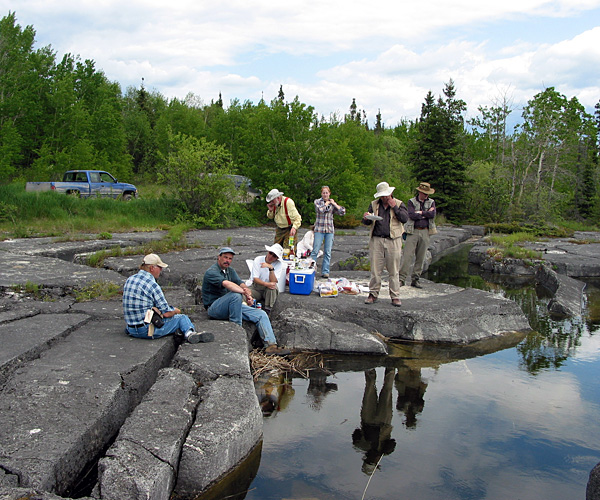
Geological field party eating lunch on the shore of Cormorant Lake (June, 2006)
I am spending a couple of days at Cormorant Lake in northeast Manitoba, looking at the Ordovician – Silurian boundary with Bob Elias of the University of Manitoba and our student, Matt.
Cormorant is a beautiful place, almost the end of the (dirt) road. When you get there, there is not a lot of “there there,” if you are looking for the busy human world. But the peaceful natural world more than compensates for this.

The famed Hudson Bay Railway passes through Cormorant.

Saxifrages on the shore of Cormorant Lake in June, 2006. This year the weather has been much colder, and the flowers are not yet in bloom.
The modern veneer is a landscape of boreal spruce and aspen forest, with low hills and wide clear lakes. Hidden not far beneath the surface of Cormorant Hill is a very different ancient place. Here, layer upon layer of dolostone bedrock tells us the story of tropical environments that changed as the Ordovician world disappeared while giving birth to its Silurian successor.
It was not an easy birth. All the rocks we are looking at were deposited on the floors of salt seas. In older Ordovician rocks in Manitoba, we find amazing fossils such as the giant trilobite and abundant corals at Churchill. But here at Cormorant, the Ordovician rocks are almost devoid of fossils, and features such as salt crystal lattices suggest a hot, dry, and hostile place.
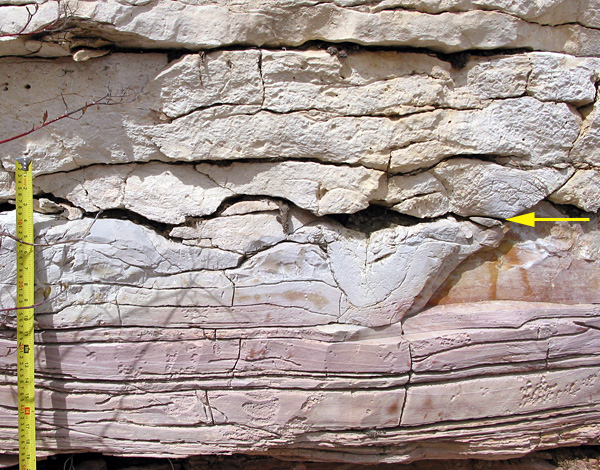
This is a vertical quarry face near Cormorant. The yellow arrow indicates the contact between the Ordovician Stony Mountain Formation (below) and the Stonewall Formation. This is a very irregular surface which is indented by channel-like features. It suggests a period during which sediment was not being deposited, and the surface may have been above sea level for a while.
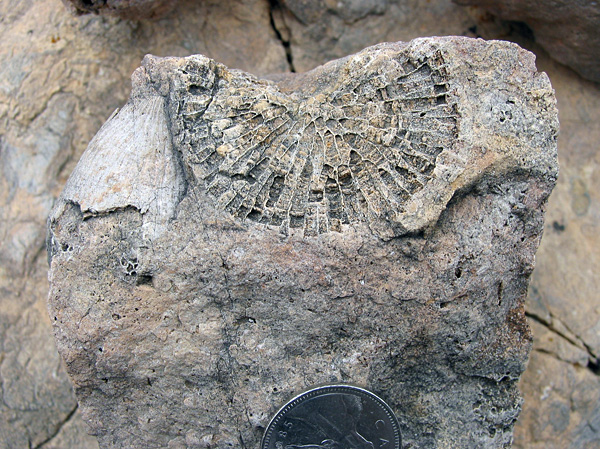
These Silurian corals are from the Fisher Branch Formation near Cormorant. An overturned horn coral (solitary rugose coral) is on the left, with a favositid tabulate to its right. The coin is 23 mm across.
After the Ordovician gave way to the Silurian, conditions here were still far from pleasant: a hot, muddy, almost lifeless place. But then things improved, as they always will given time. As we got higher into Silurian rocks this afternoon, we reached a formation where fossils are quite common. It was very pleasing to spend the latter part of the afternoon finding nice specimens of a variety of corals and brachiopods (lamp shells).
Our perspective also improved, and it was cheered immensely by the numbers of red squirrels who kept visiting us, popping up out of the crevices in the rocks. Though, as I said to Matt and Bob, the behaviour of the squirrels, jumping attentively onto boulders very close to us, was disconcertingly similar to that of the group of cute little Compsognathus in one of those Jurassic Park movies.

Moss on a quarry floor near Cormorant
On the way back to The Pas, we stopped to check another quarry, and got out to take a look at the pair of ospreys nesting at the top of a pole beside the Hudson Bay Railway. The ospreys, of course, took note of our presence and commented on it with a high pitched “craawk craaawk craaawk craaawk …”

The power line had been re-routed around the osprey nest.
Short conversation between two paleontologists:
“They make sort of wimpy sounds for such big birds.”
“Do you plan to go down there and tell them that?”
“Hmmm. Not really.”
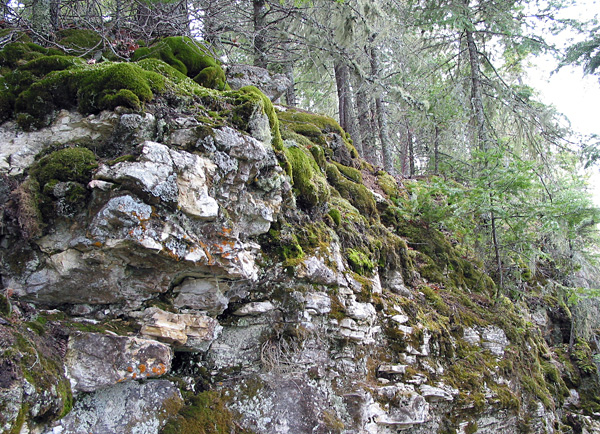
A cliff face beside Clearwater Lake

Snow can still be seen in the deep crevices beside Clearwater Lake.

Gallery Milestones …
If you visit this site periodically and have been expecting updates, I apologize for the lack of change. Things seem to have been spinning very quickly in the past couple of weeks. There’s a lot that I could easily write about, but it has been hard to find the time and energy to grab any one story and give it shape.
As you may know from some previous posts, for the past few months we have been busy with exhibit development at the Manitoba Museum. Quite a lot of this work has been on a revitalization of the somewhat “fossilized” Earth History Gallery. Most immediately we are renovating all of the exhibits dealing with the Cretaceous Period; within the next year, we also plan to install a multi-screen animation of an Ordovician shoreline.
Last week, the final installation of the terrestrial parts of Cretaceous Life was under way. Unfortunately I had to be in Toronto for much of the week, as I was already committed to attending a conference, and the meetings of the Canadian Geological Foundation. It was a busy week, between conference sessions and trying to get paleontological research done at the ROM with, I admit, a bit of social time tacked on. We wrapped up the foundation’s grant review meetings early Thursday afternoon, and Thursday evening I was winging home in the opulent luxury that is always associated with a middle-of-the-row seat on a packed Westjet flight.
Friday morning saw me back at the museum and dressed in full monkey-suit for the opening. I received a bit of good-natured ribbing for the way in which I had made myself absent for the mass of work that had happened in the intervening days, but they had done a really fabulous job, and some of the exhibit staff may well have been happier that I hadn’t been wandering around looming over them. The opening went smoothly, the media interviews were done, and we are now onto planning the next phases. I will try to post some photos of the new exhibits, once things begin to spin a bit more slowly.
But in the meantime, of course, all of the usual seasonal work also has to happen. It is finally gorgeous early summer in Manitoba, time for natural history staff to load up SUVs and head for the boonies (the remoter the better). My colleagues have already been out a good bit, looking at plants or examining the mating habits of frogs in northern Manitoba. Now it is my turn; we are off to the north in a couple of days, if I can only manage to sort out my claims from the Toronto trip by then …
Master of My Own Domain
This evening, I took what felt like a major step: I registered ancientshore.com as its own domain. I know that this could easily seem pretentious, but one of my objectives with this page has been to gradually grow it from a blog into a more wide-reaching (and probably more useful) site. The plan is that this will spur me to gradually post other sorts of content: lists of publications, maybe pdfs of papers and professional posters, and hopefully identification information for some of the fossils people find around here. So stay tuned. Maybe this won’t always be just a collection of (?self-indulgent?) meanderings …
Lake Winnipeg
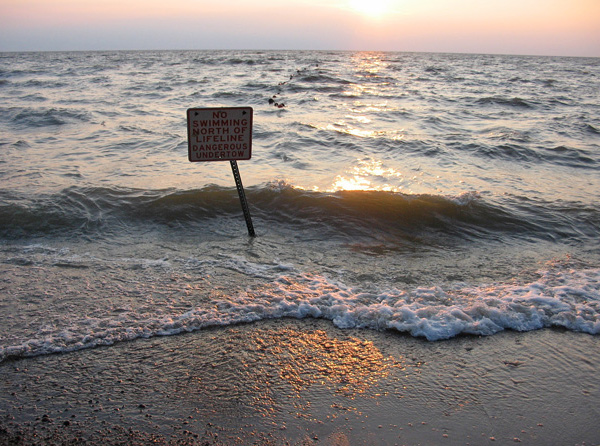
Lake Winnipeg is a strange place. Sometimes it seems like it is taken from a painting like Monet, but at other times it is definitely more JMW Turner, or even Hieronymus Bosch. Most Winnipeggers know Lake Winnipeg as a beach and cottage place, a place of pleasant endless sands with gentle lapping waves,a place where we take our children for an enjoyable summer experience. But this huge lake is much more than that; it is a fierce, independent, unpredictable force of nature, a body of water that can charm you with its beauty one minute, and soak and scare you utterly s***less the next. Its north basin is an immense, trackless waste. If you get lost there, you are really lost. Permanently lost. Utterly and sadly lost, though there is nothing really tragic about it. Just a silent grey curtain pulled across the end of your story.
In comparison with Lake Winnipeg, the other prairie lakes are shallow, immature muddy sloughs. They are babies, incapable of thoughts of their own. They may sometimes have weather, or even waves, but those are little baby waves. Lake Winnipeg has intense moods and tantrums. It can be an angry giant teenager, yelling, stamping its way upstairs and slamming all the doors in the house. Lake Winnipeg is like the sea in miniature, but I would never dare tell it to its face that it is a small copy of anything else. On second thought, I take that back. Lake Winnipeg is nothing like the sea.
The lake’s surface is a work of art, and it is its own medium. It pushes water around between the basins as caprice takes it, sculpting mounds of fluid here, creating liquid synclines over there. You may tell me that these variations are the result of outflow from rivers, or seiche waves, or Manitoba Hydro’s attempts to control the lake’s level at its outflow. But I know better. Lake Winnipeg is a sneaky, evil bastard (or at the very least, an elemental force), and it decides where its water will go. If lakes were animals, Lake Winnipeg would be a big cat. It walks by itself, and it knows its own mind. But this is not a mind that we can ever fathom. This mind is full of dark embayments, uncounted small islands, the flotsam and jetsam of a thousand wrecked boats, the Archean secrets hidden in gneissic crevices of its eastern shore. You might call it shallow, but you would be fooling yourself.
Lake Winnipeg is a place of powerful images that are forever imprinted on my inner eye. The Namao steams past our shore through some very heavy weather, looking not at all like a boat on a freshwater lake. A tent, caught by a black squall, still floats as it disappears over the horizon. In the channel off Seymourville, the wind-compressed waves fling our small fishing boat upward before instantly dropping us into the trough with a buttock-bruising bang. Huge wind tides that make the perfect sand beaches of the south basin disappear for days on end … leaning out onto the bow of the zodiac to keep it down as we head into a rapidly stiffening storm … standing on the causeway at Hecla, transfixed by the approach of swirling waterspouts …
But after each intense episode the calm returns, and you would never guess that this polite place was prone to wild and unseemly outbursts. A sailboat materializes out of the moonlit silence of an empty lake. Purple flowers tenaciously cling to the limestone cliffs at Cat Head. Pelicans land in the misty stillness of an endless hot afternoon. Foot-deep windrows of ripely rotting fishflies clog a tourist shore. Teeming spiders in the wonderful damp cool beneath a north-facing cliff, when the air above is a stifling +35 … brown-green tendrils of a late-summer algal bloom on the north basin, visible from the window of our Otter as we make our stately way north from Matheson toward Jackhead … and of course, the Goldfield sailing into magic-hour evening light at McBeth Point.
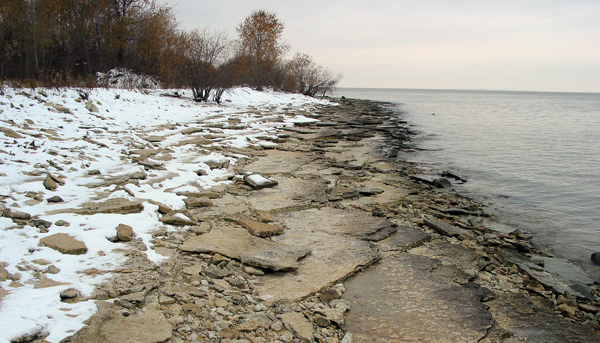
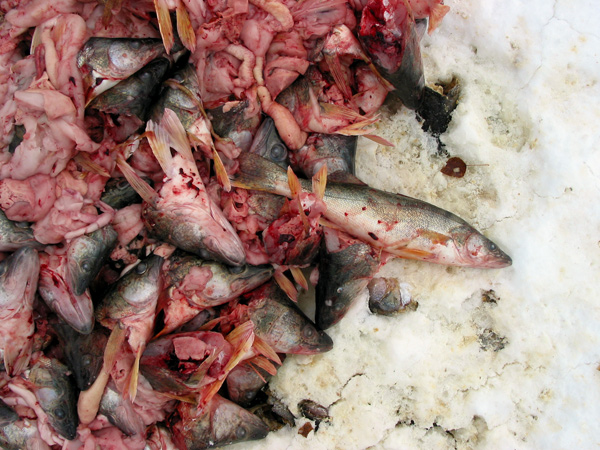
The photos below show Lake Winnipeg at peace, in the cold season. Why did I include that horrible fish picture? Well, that is yet another aspect of our relationship with lakes, isn’t it?
(all posts © Graham Young, 2009)

The Ancient Seas Video
When I think about my job, one thing that can safely be said is that it is never dull. I am occasionally driven to distraction by conflicting deadlines, but most of the projects are challenging, fascinating, and rewarding.
Almost two years ago, it came to the attention of some of the people at our museum that the Field Museum in Chicago was using an exciting new video animation, which brought to life the varied creatures of the Cambrian Burgess Shale of British Columbia. It was suggested that we should have a similar exhibit at the Manitoba Museum. While we don’t have a Burgess Shale in our backyard, we do have some fabulous fossils in our Ordovician rocks, many of which represent forms unknown anywhere else.
And so our “Ancient Seas” exhibit was born. We were fortunate to receive capital funding from the provincial government, and extremely fortunate that Phlesch Bubble, the company that produced the Field Museum video, was available to work on this project.
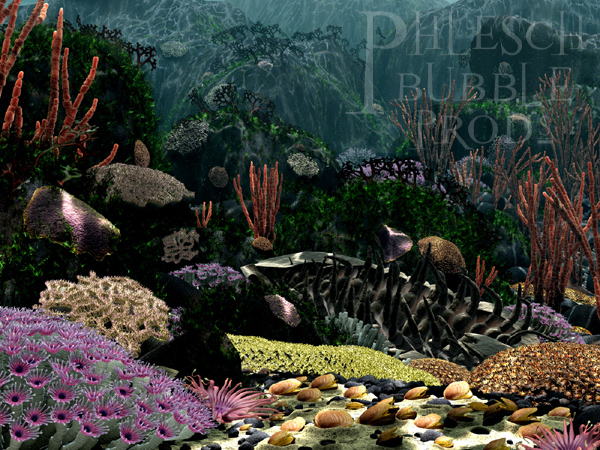
Part of the reconstructed community just in front of the boulder field. Visible organisms include corals, brachiopods (lamp shells), algae, and a dead giant trilobite.

A fossil coral lies between cobbles in front of the boulder field at Churchill (photo © David Rudkin, Royal Ontario Museum).
The finished exhibit will be a digital animation on three huge adjacent projection panels, giving the visitor a view into the underwater tropical paradise that existed 445 million years ago on an equatorial shoreline. You will see it as though you are in a submersible beside the rocky shore. A boulder field is covered with and surrounded by algae and corals. In front of the boulders, a more open seafloor is interspersed with patches of sponges and sea lilies. Giant trilobites plough through the seafloor mud, while sea scorpions, fish-like conodont animals, and huge fierce predatory cephalopods swim above. Near the water surface, immense numbers of small jellyfish float past.
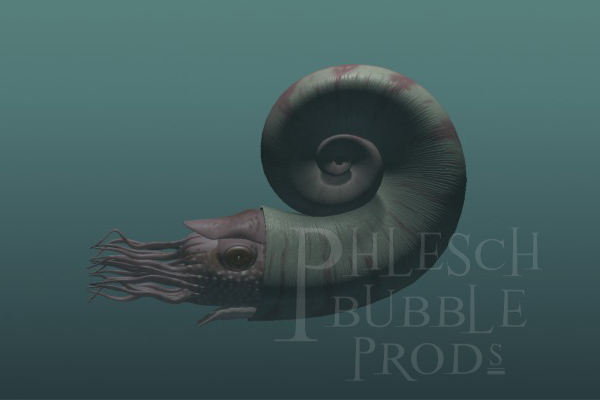
This coiled cephalopod (related to the modern pearly nautilus) is based on the fossil genus Charactoceras.
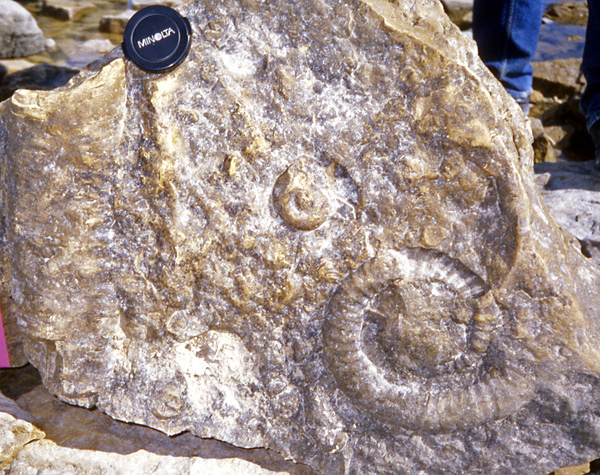
This fossil-rich slab from Airport Cove, near Churchill, includes a large coiled cephalopod. We collected this slab, and plan to include it in a gallery exhibit next year.
This is going to be an amazing exhibit, unlike anything at this museum or elsewhere in the city. But for me, the best part is that it is largely based on knowledge we have developed here. The place that is being depicted is the Ordovician rocky shoreline near Churchill (see posts below). I have been studying this site for more than a decade with several other scientists, including Bob Elias (University of Manitoba), Dave Rudkin (Royal Ontario Museum), and Godfrey Nowlan (Geological Survey of Canada). The animals and plants are all from fossils that we know to occur in northern and central Manitoba. The “in-place” hard elements, such as corals and sponges, are the same as the specimens we have collected from the Churchill rocky shoreline. We have added some free-moving creatures we know from other places (such as the sea scorpions and jellyfish), and the algae are based on the famous fossil seaweeds of the Cat Head – McBeth Point area along Lake Winnipeg.
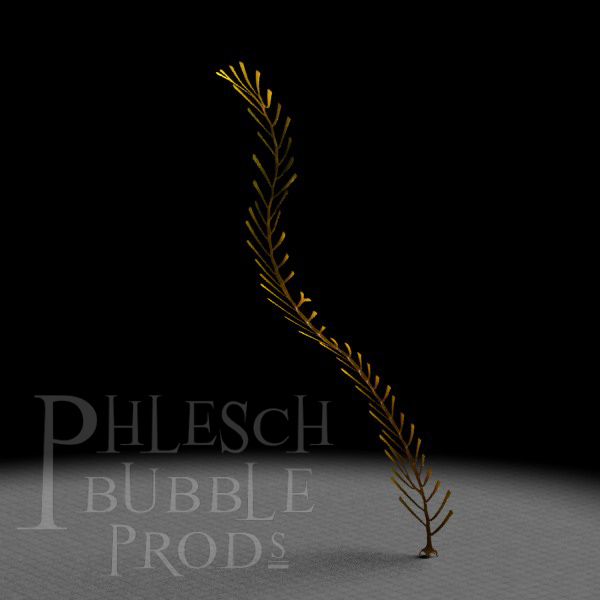
This seaweed reconstruction is based on the Ordovician genus Winnipegia.
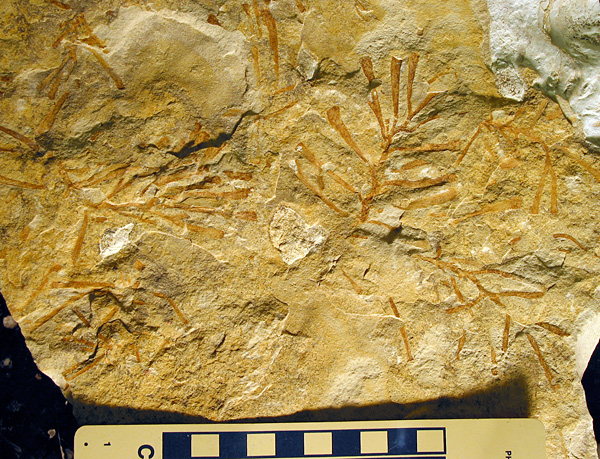
This fossil of Winnipegia is from the Cat Head - McBeth Point area, Lake Winnipeg (Manitoba Museum specimen).
The really intensive work on this exhibit started about a year ago, when I began to compile a package of detailed materials that described and illustrated all of the organisms to be represented. Phlesch is located in southern Australia, so this package (and all subsequent materials) had to be sent halfway around the world. The “long-distance” collaboration has been one of the most interesting parts of the project – I had done remote research collaborations before, but have never worked on an exhibit with someone located at some distance. I have not actually met Phlesch’s Jilli and Lars in person, but we have spent so much time in e-mail discussions that I feel as though I know them quite well. They sometimes lose patience with me, and I occasionally feel a bit annoyed by something that they do, but overall this way of working together has turned out brilliantly. This project has also turned into a global scientific collaboration; I will talk about that aspect in a future post.
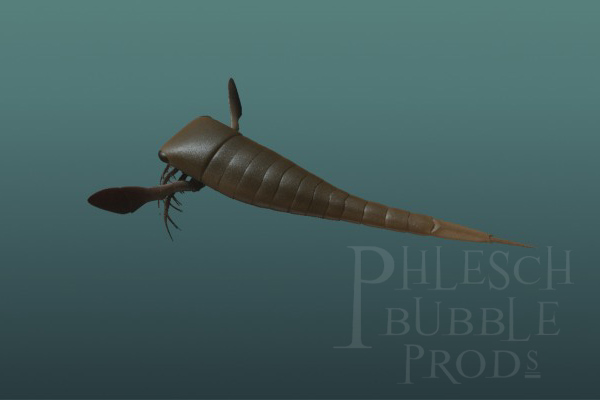
This eurypterid ("sea scorpion") is based on fossils we found in central Manitoba.
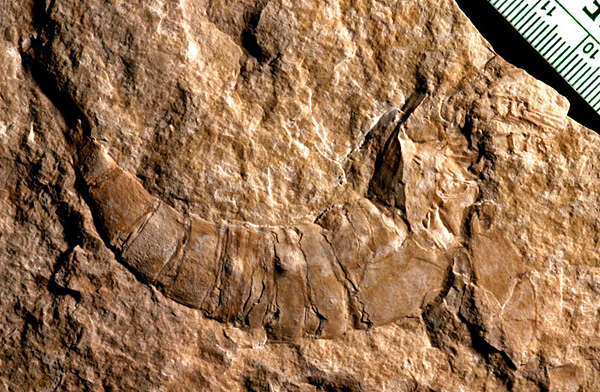
A eurypterid from the Grand Rapids Uplands (Manitoba Museum specimen)
Over the past several months, Phlesch have developed the “environment” in which the animals will move. For each animal or plant, they first made digital models of it, then developed those into three-dimensional versions that could be rotated, and then gave life and movement to those three-dimensional critters (each of which exists only inside computers, of course). At each stage in the process, I have had opportunities to give feedback, or been required to find additional information. Can we make this seaweed taller? Which way would sea lilies face relative to the current? How would the branching corals vary with depth? What colour should this cephalopod be? When artists work to depict an ancient lost world, there are so many questions, many of them not expected by the scientific mind.
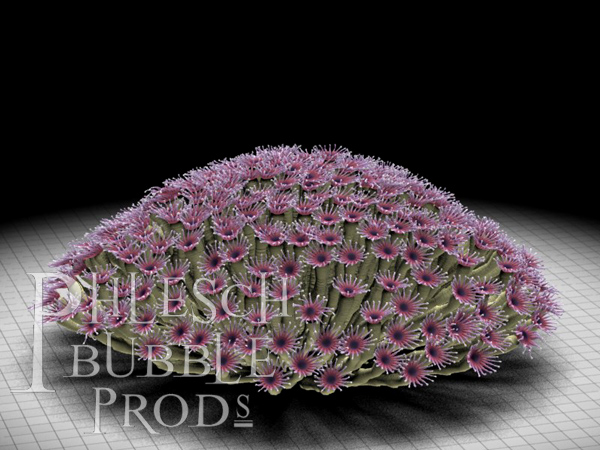
Of all the wonderful models produced by Phlesch, this colonial coral (Palaeophyllum) is my favourite.
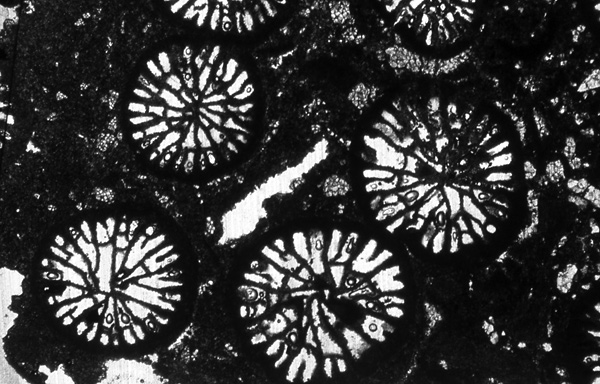
Thin section (microscope slide) of fossil Palaeophyllum from the Churchill rocky shoreline.
We have now reached the point where the various pieces are being assembled, and I am really looking forward to the next couple of weeks. We will see feeding corals, seaweeds being pushed by the waves and currents, a school of conodont animals swimming across the foreground, a trilobite being …
It will be like Christmas, and I really can’t wait!
On My Island
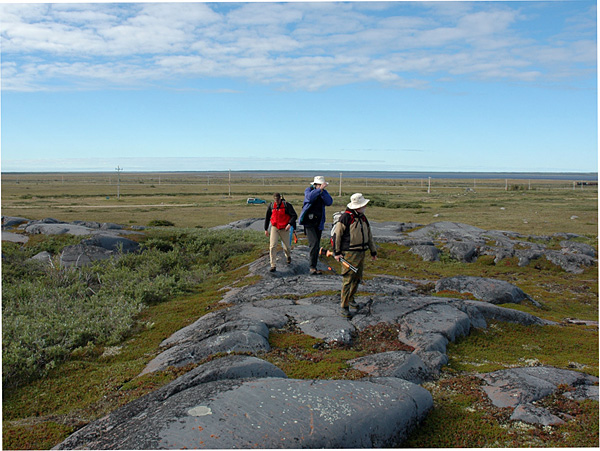
Striding across one of the quartzite ridges that formed islands in the Ordovician sea: L-R are Norm Aime, me, and Ed Dobrzanski. (photo © David Rudkin, Royal Ontario Museum)
Sometimes, standing on top of the quartzite ridge, even with the arctic lichens and stunted spruce all around, I can easily imagine that I am at the pinnacle of a tall, narrow island, a few hundred metres across and a couple of kilometers long – because that is where I am in my time machine. Facing north, where I can see the icy waters of Hudson Bay, it is easy to imagine a warm sea, although it is often harder to picture a hot equatorial sun directly overhead. Behind me to the south, the low landscape of railway, muskeg, estuary, and boreal forest stretching to the horizon is a continuation of that broad sea.
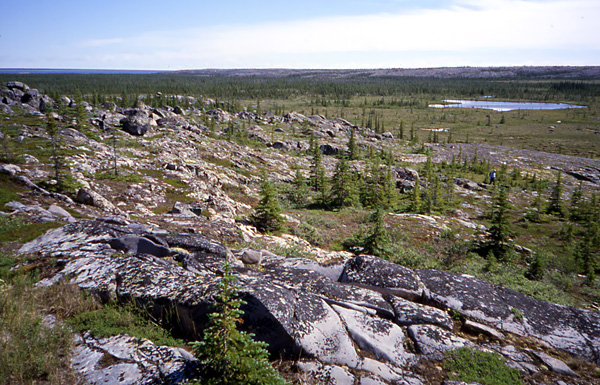
West of the Churchill River, one can stand on top of one quartzite ridge and look across to the next ridge. In the Late Ordovician Period, this low area was a channel between tropical islands.
The quartzite ridges extending past the giant grain elevator on my left, and on my right all the way to the old rocket range far past the airport, are a sinuous archipelago of small islands like my own, the only land standing above the sea surface for hundreds of kilometres in any direction.
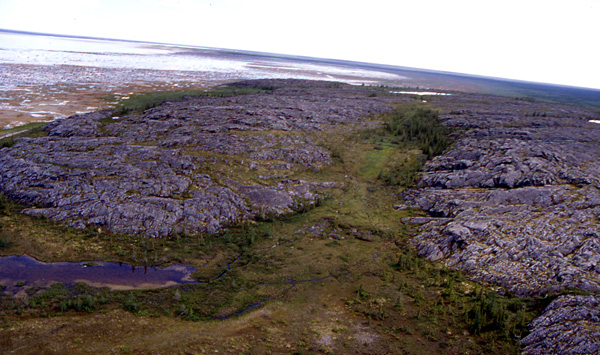
From a helicopter it is easy to see the outlines of islands that existed here 445 million years ago.
Churchill may be a unique, lonely place today, but on my Ordovician island it is far lonelier – for it is silent except for the waves lapping on the shore. The silence is occasionally disturbed by tropical thunder, and rarely by giant hurricanes driving monstrous waves and huge boulders against the shore. There are no gull cries, but the smells may not be all that different – no doubt there is rotting seaweed on the Ordovician shores, too.
And what about tastes? There are no fish to catch in the Churchill area, no land animals on the shore, but giant trilobite probably tastes a lot like lobster. Every time machine should be stocked with nutcrackers, bibs, and a supply of melted butter.

... tastes like ...
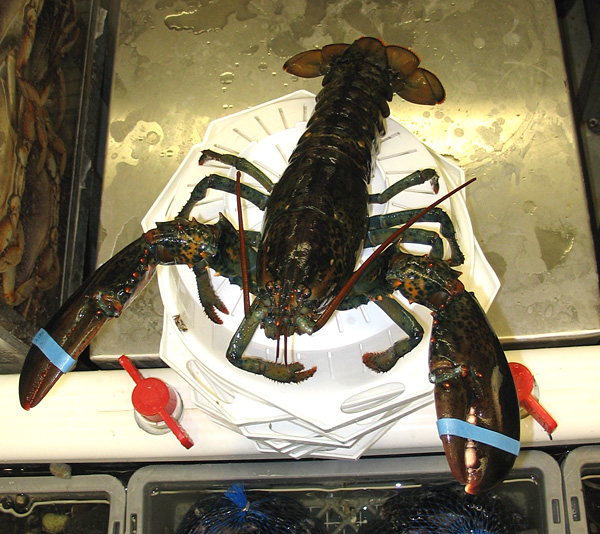
... perhaps?
The Goldfield
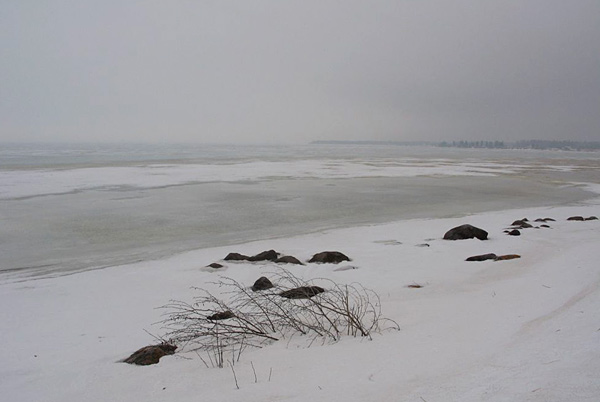
Shore and ice, Lake Winnipeg
We have just spent a couple of days on a family trip to Hecla Island, on Lake Winnipeg’s south basin. It is the “in between” season now. The ice on the lake is still thick, but it is becoming soft enough that all the ice fishing huts have been removed. On the land, the snow is not sufficiently continuous for skiing or snowshoeing, but deep enough in places that you can sink up to your knee and get a bootful of granular frostbite. Sadly it is not a season to wander around looking for fossils, but there are enough other sights to keep things interesting.
Yesterday was a soft, grey day, with a stiff damp breeze; a Scottish day, you might say. Hecla Village was empty of any evidence of human activity, but immediately south of the village there was plenty of action; we were able to watch a flock of six bald eagles clustered in the trees along the shore. Nowhere near the numbers that can be viewed farther up the lake in the fall, but still wonderful to see.
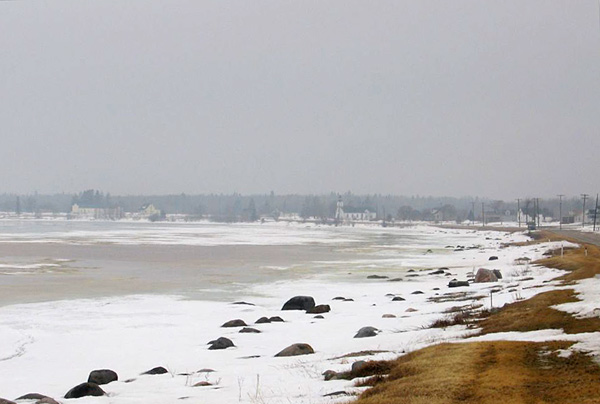
Hecla Village yesterday
Just north of Riverton, more interesting sights. We could see a small ship, the Mukutawa, familiarly resting on the shore where it has been for several years, but what was the other vessel hunkered down nearby, barely visible from the road? Leaving the car outside the padlocked gate, we tramped a few hundred metres to the little harbour. A large brownish fox scampered away across the field, but there was no other animal or human life. Nevertheless, the ship lodged at an angle in the ice was worth the walk, because it was the vessel I had guessed: the Goldfield.
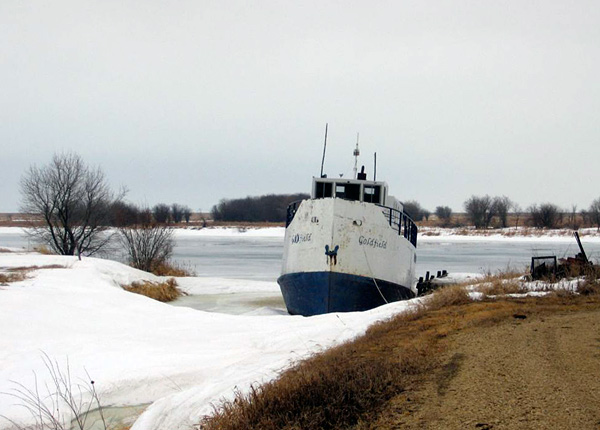
I first encountered this blunt-ended boat in 1997, on a golden June evening far from here. We were camped at McBeth Point on the north basin, doing reconnaissance work on the remarkable fossil sites in that area. We were surprised and impressed to see a ship pull into the harbour; it seemed very large and purposeful beside the outboard-powered fishing boats. The people at the fishing station told us that this was the Goldfield, which was used by the Freshwater Fish Marketing Corporation to transport the catch from the various fishing stations to Matheson Island. We discussed the idea of travelling by boat the next time we went to McBeth Point (we had flown in), but otherwise I thought no more about the ship.
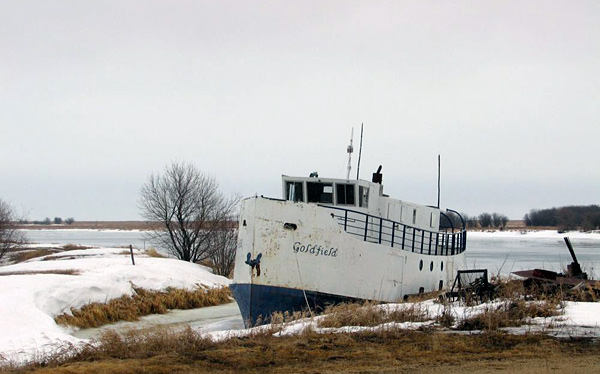
A couple of years later at the local museum in the town of Gimli, in a mini-diorama of Gimli harbour in the 1930s I noticed a ship that was labelled as the Goldfield. There were several photos in the museum of the same ship, showing it moored in the harbour or towing the antiquated sail-powered boats out to their fishing grounds. I didn’t think this was likely to be the ship we had seen at McBeth, but spending time in the library I was shocked to discover that it was not only the same, but that it had been launched in about 1912, rebuilt in the 1950s, abandoned in about 1970, and then brought back into service again.
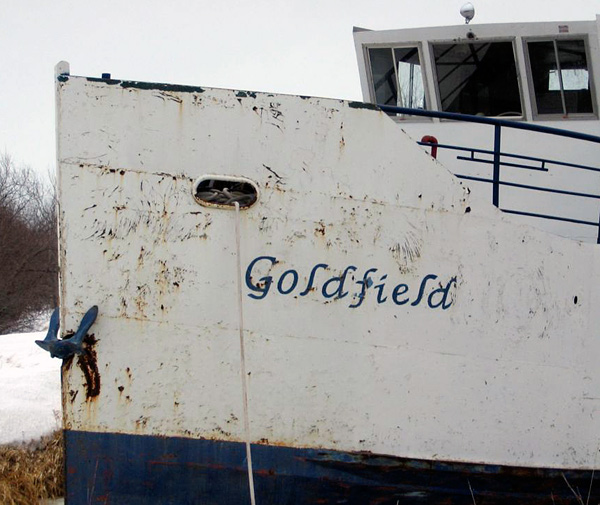
But that still wasn’t the entire story. According to a variety of sources, the 1912 version of the Goldfield was apparently a rebuild of an even earlier wooden hull, dating back as far as 1886! That rebuild was as a supply ship for the new gold mines on the east side of Lake Winnipeg, hence the name it still bears. In its 123 years or so on Lake Winnipeg, this ship has hauled freight, passengers, and fish to every remote harbour on this immense body of water. It is, in short, the embodiment of the economic history of this region. This ship may not be beautiful, and the square utilitarian superstructure is clearly far newer than the more elegant hull, but every part of it is relevant to that story of settlement and industrial development.
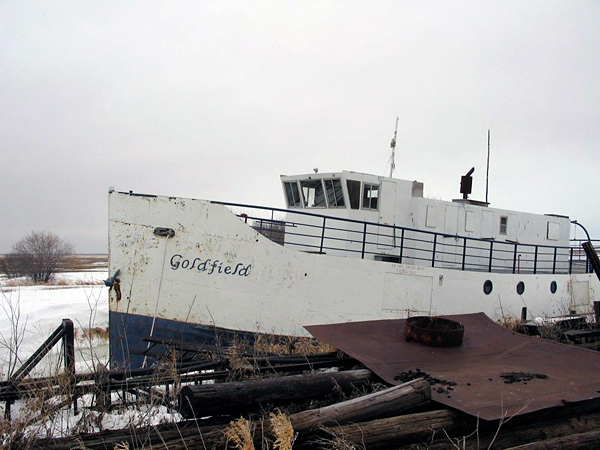
But what does the future hold? The Goldfield was apparently damaged in a minor accident a couple of years ago, and also failed its safety certification, so it has been taken out of service. I had heard that it was destined for the Marine Museum of Manitoba in Selkirk, and I hope that the resources can be found to get it there soon. After such a remarkably long and productive life, it deserves to take on a new role as the “senior ship” at a museum. We often hear that there is little history to be found in western Canada; that view is negated by such hidden treasures as the Goldfield.
Yesterday was not a day to hang around paying our respects, however. The wind was becoming bitter and the dog was complaining about the cold. I had to satisfy myself with a few quick snapshots, then turned the car once more toward Winnipeg and home.
The Churchill Quartzite

Along the cove beside the airport, the quartzite seems to go on forever.
This land has bones that are deep and old, bones that give it shape and substance. To the north is the blue water of Hudson Bay, to the south an endless low expanse of muskeg and black spruce, but here at Churchill the sculptured quartzite makes a landscape that might have been imagined by Henry Moore. This hard, resistant stone forms ridges that parallel the bay shore for kilometres east of town, abut the river mouth, and shape the west side of the river for some distance upstream. The dark, sensual Churchill quartzite is omnipresent here, but is not seen anywhere else in northern Manitoba.

Variable patterns of weathering along a quartzite scarp
Many early visitors to the Churchill River remarked on the stone, and it was first described and named by the pioneering geologist Robert Bell in 1880. Although it has been known for such a long time, it has apparently never received the detailed scientific description that would permit formal formation status. We can talk about the “Churchill quartzite” and every geologist who has visited the region will know what we mean, but we can’t use “Churchill Quartzite” as a proper name.

Quartzite spine of the shore just east of Churchill
Scientifically speaking, the term “Churchill quartzite” is also somewhat of a misnomer, since the rock is apparently closer to being a metagreywacke. A quartzite is a sandstone composed of quartz grains, while a greywacke can be considered a dirty sandstone, its quartz content diluted by rock fragments and minerals such as mica. The “meta-” part of the name simply means that it has been modified by heat and pressure deep within the Earth. Regardless of accuracy, “Churchill quartzite” is what it is generally called, and “Churchill metagreywacke” is not the sort of term that slips comfortably from my mouth during casual conversation.

Many quartzite surfaces exhibit a fine natural polish. Note the angled cross beds in the foreground.
Churchill quartzite was initially formed as a sedimentary rock during the Proterozoic Eon, some 1.8 billion years ago, back when this area was covered by large rivers that flowed from mountains. The cross beds that can be seen in the quartzite in some places are evidence of sediment deposition by flowing water. The sediment became hard rock, which in time was buried deep beneath overlying strata. There, it was subjected to the heat and pressure that welded the grains together, endowing it with an almost superlithic toughness. And again time passed, such an immense amount of time that the nearby mountains were eroded flat by water, wind, and glacial ice. Those mountains now lie beneath muskeg, while the more resistant quartzite remains as the only bedrock relief for kilometres around.
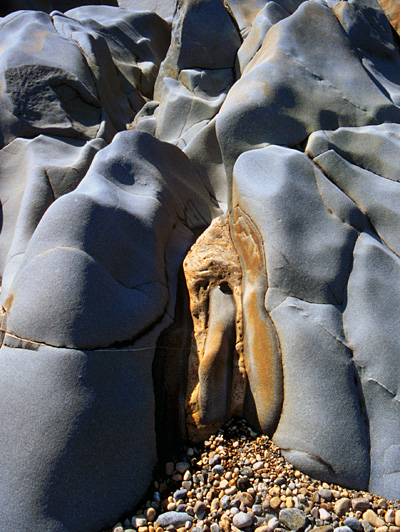
In a few places, pale brown Ordovician carbonate sits directly against the quartzite
Although the quartzite is so obvious here, it is not the only bedrock in the Churchill area. Around the edges of the quartzite ridges, one can see patches of fossil-rich Ordovician and Silurian rock. These sedimentary rocks, at about 435-445 million years old, could be considered relatively recent additions to the landscape of this area. In a few places they sit immediately adjacent to the quartzite, resting gently against surfaces that had already been exposed to erosion for thousands of millennia.

Water collects in low places across the impermeable bedrock, forming small ponds that are home to a variety of plants and animals.
Walking over the quartzite is like passing across the surface of an ever-changing sculpture. The stone may be smooth and regular, but there can be unexpected turns. Here, a vein of white quartz blazes across a vertical rock face in the sunlight. There, you discover a hidden crevice too deep and wide to cross, and must retrace your steps. Deep in the bottom of that crevice is the last surviving bit of shade-protected snow, even though it is late June. Beside the snow lies a patch of bones and feathers, the remnants of someone’s meal (but whose?). The old quartzite surfaces are covered with a Rorschach test of lichens: grey, green, black, yellow, and most wonderfully, orange. On this dry day they may crunch under your feet if you are not careful, but beware if it should start to rain or mist. You will no longer be able to gaze across the landscape, but must place each foot with the utmost caution or the greased lichen will pull that foot from under you, and you will find yourself landing on your pack (if you are lucky) on the hardest rock you have ever had the misfortune to encounter.

Samuel Hearne's 18th century signature is one of the pieces of historic graffiti decorating the quartzite at Sloop Cove, across the river from Churchill.
(to make this piece reasonably accurate, I was glad that I could refer to L.A. Dredge’s (1992) Field Guide to the Churchill Region, Manitoba : Glaciations, Sea Level Changes, Permafrost Landforms, and Archaeology of the Churchill and Gillam Areas)
Gastroliths
A couple of years ago I was working on an exhibit about jaws and teeth, in collaboration with my colleague Randy Mooi. One of the key purposes of this exhibit was to demonstrate how different kinds of vertebrates process their food. We were exhibiting a lot of different kinds of skulls and teeth, so the space for explanatory text was limited, and we had to try to find creative ways to get the information across to museum visitors. Since some animals are very familiar to us, it is relatively easy to explain eating in many mammals and birds, but other less familiar animals turned out to be quite tricky.
One of our exhibit cases explained dinosaur teeth and jaws. Many dinosaurs apparently swallowed pebbles or cobbles that assisted with grinding their food; the stones were held in a muscular gizzard. We have examples of dinosaur gizzard stones (or gastroliths) in our collection, which were found associated with dinosaur skeletons in the western United States. They are interesting objects, but if they are put in an exhibit case without much explanation, they will just look like a “bunch of rocks.”
Modern birds also have gizzards, and people who keep birds such as budgies or chickens know that they need to be provided with gravel if they are to remain healthy. We thought we would have fun with this comparison, so we bought some budgie gravel and played with what the packaging would be like if people had to buy stones for their pet dinosaurs:
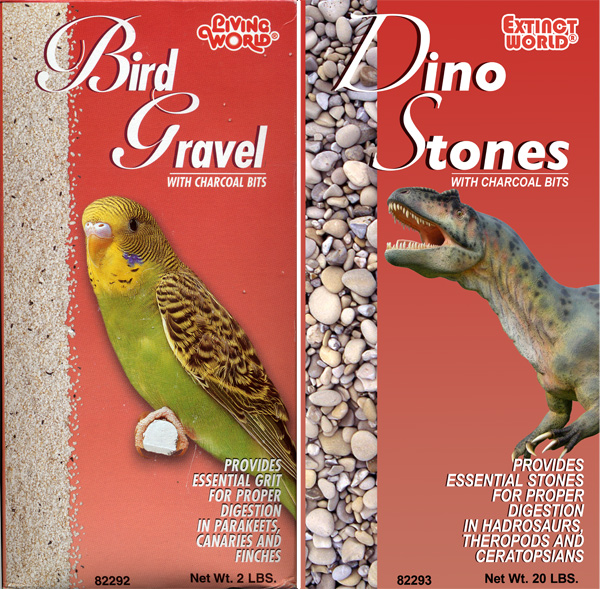
Bird gravel and dino stones (note that I was probably incorrect to list some of these groups of dinosaurs, as only some kinds are known to have had gastroliths)
We were very pleased with this, and we put a fake “dino stones” box in the display case beside a genuine bird gravel box (to fit it in the space, they were unfortunately the same size). In hindsight, though, I suspect that the fake was too subtle to make the intended point. There was no explanation of the boxes and we never received comments about them from anyone who saw the exhibit. I hope no one thought that Dino Stones were an actual product …


 Ancient Shore