Saint’s Rest
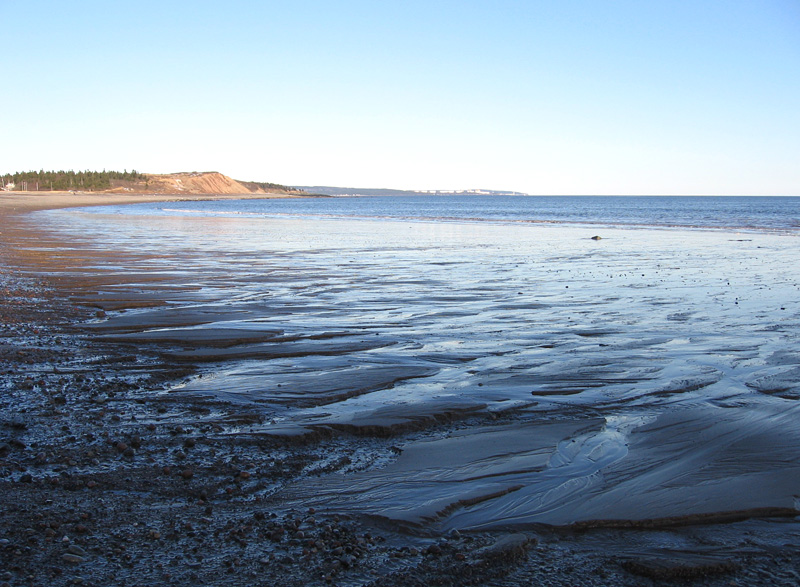
Saint’s Rest Beach
What could possibly be more pleasant than a February afternoon by the Bay of Fundy? There may be some February days that possess a pleasantness exceeded by the average tonsillectomy or root canal, but Tuesday was not one of those. Under a warm and gentle sun the temperature was an unseasonal +6, the sea was a bright transparent blue, and the air was as clear and sweet as I have ever experienced.
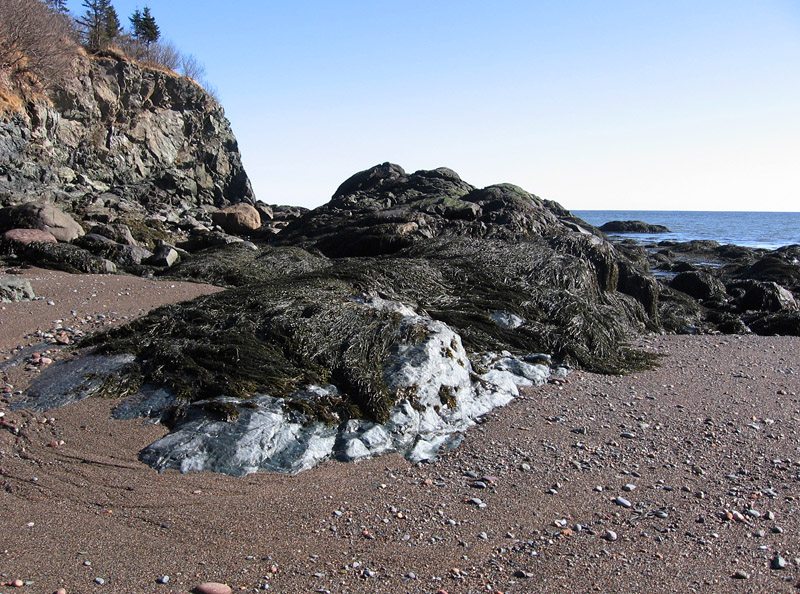
Rocky shore at Sheldon Point
The Irving Nature Park is a tremendously diverse sample of shoreline within the City of Saint John. Rocky shore, cliff, shingle beach, sand beach, salt marsh, coastal mixed forest: all of these can be found between Taylors Island, Saint’s Rest Beach, and Sheldon Point. The geology is also of interest: Neoproterozoic or Cambrian bedrock (which looked like metavolcanics to me) is overlain by glacial sediment, and the beach contains a wonderful variety of boulders and cobbles. With such varied geology, it is little wonder that the Saint John area has become North America’s first Global Geopark.
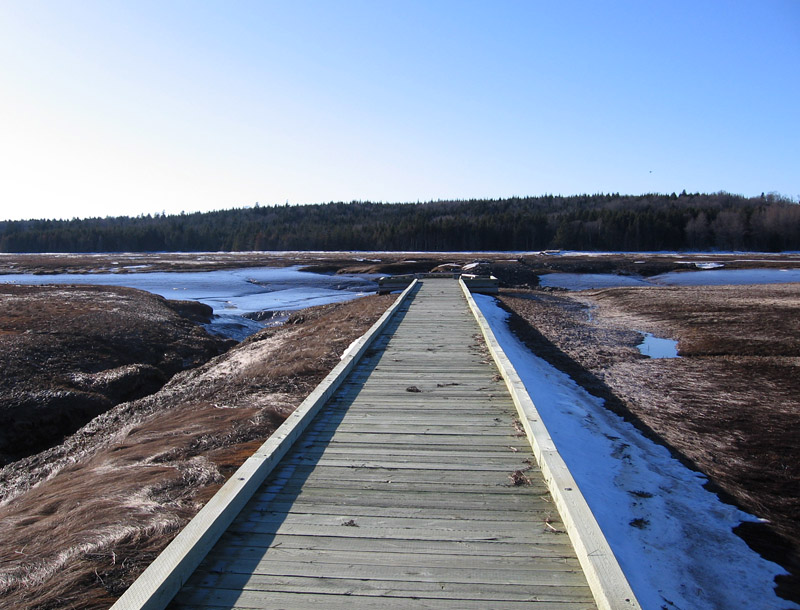
The salt marsh boardwalk
Late Ordovician Konservat-Lagerstätten in Manitoba

Fossils from the Airport Cove site, part 1: spectacular examples of dasycladalean green algae on bedding plane surfaces (The Manitoba Museum, MM B-339, B-340).
Canada is remarkably rich in Konservat-Lagerstätten, sites at which unusual fossils are preserved. For the past while, Dave Rudkin and I have been co-editing a series for Geoscience Canada called Great Canadian Lagerstätten, which compiles reviews of these sites, covering many intervals from the geological record. The third paper in the series is based on our own research, describing the fossils from three unusual localities in central and northern Manitoba. Together with our co-authors, we have had a lot of fun putting this together: it was interesting to have the chance to assess the state of our “art”, to see where we really are with our research. We have learned a lot about these fossils, but still miles to go before we put this project to bed.

Fossils from the Airport Cove site, part 2: (c) Articulated scolecodont apparatus (jaws of a polychaete worm)(MM I-4062). (d) Large phosphatic or chitinophosphatic tubes of uncertain affinity (MM I-4061). (e) Finely preserved organic eurypterid cuticle (MM I-4063).
The abstract of the paper follows below. If you are interested in downloading a pdf of the entire paper, it can be found here.
Konservat-Lagerstätten, deposits in which soft-bodied or lightly sclerotized fossils are preserved, are very rare in Ordovician strata. Three significant sites are known from Upper Ordovician rocks in Manitoba: at Cat Head – McBeth Point, William Lake, and Airport Cove. These sites are in two distinct sedimentary basins: the former two are in the Williston Basin, while the latter is in the Hudson Bay Basin. All three sites contain marine fossils, but each has a different assemblage that contributes a distinct piece of the diversity picture. Important groups represented at one or more of the sites include seaweeds (algae), sponges, cnidarian medusae (jellyfish), conulariids, trilobites, eurypterids, xiphosurids (horseshoe crabs), and pycnogonids (‘sea spiders’). The different biotas reflect depositional conditions at each site. Many of the fossils are unknown elsewhere in the Ordovician at the family level or higher. The province of Manitoba therefore makes a significant contribution to knowledge of Late Ordovician biodiversity.
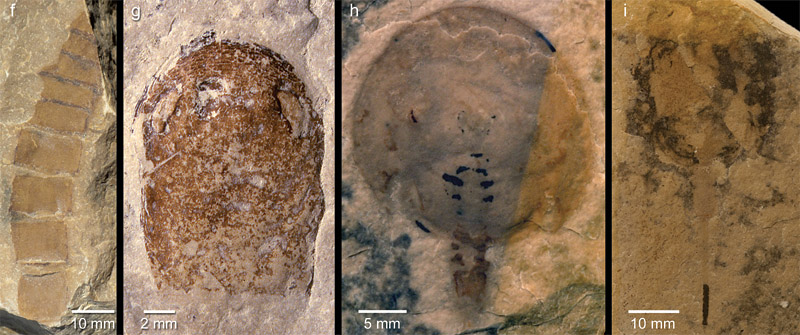
Fossils from the Airport Cove site, part 3: (f) Partial eurypterid abdomen (MM I-4586). g. ‘Head’ region of eurypterid-like arthropod (MM I-4064A). (h) The holotype specimen of the xiphosurid (horseshoe crab) Lunataspis aurora; note the preserved eye and dark-stained areas (MM I-4000). (i) This degraded example of L. aurora is surrounded by a halo of dark staining, possibly the result of postmortem decomposition of soft tissue and leakage of body fluids (MM I-4585).
Murmuration

South of Greenland in the middle of the day (this image and those below are from http://flightaware.com/live/)
In late morning the huge birds take flight. One after another they lumber into the air like pelicans, and like pelicans they spiral upward, forming long lines as they soar across the water. As a flock they fly westward over the ocean through the middle of the day, headed for the next large land. At night they return, following trackless courses through the blind dark, sensing one another’s presence even though they cannot hear or smell.
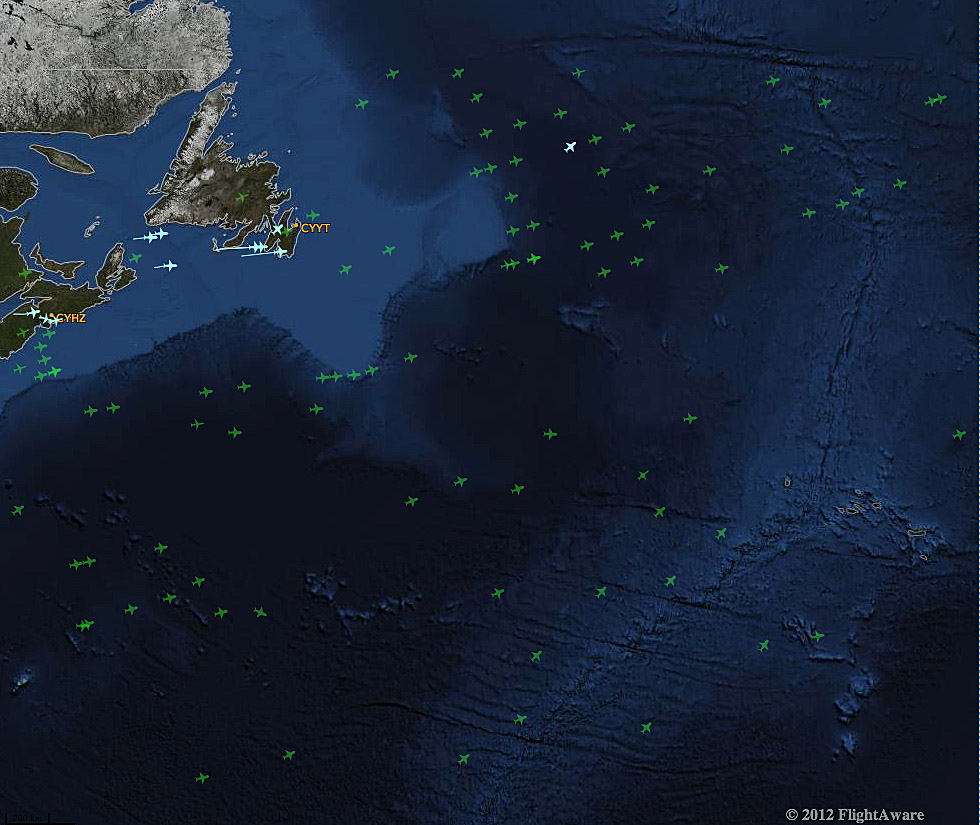
Evening near Newfoundland
Like chimney swifts they are drawn back to their nests amid the cities, warehouses, and factories. Like starlings they whirl in an endless murmuration as they move toward their roosts in the golden light of dawn. But they will not rest long. Soon they will take to the skies again in their ceaseless quest. Read more…
Legislative Harmony
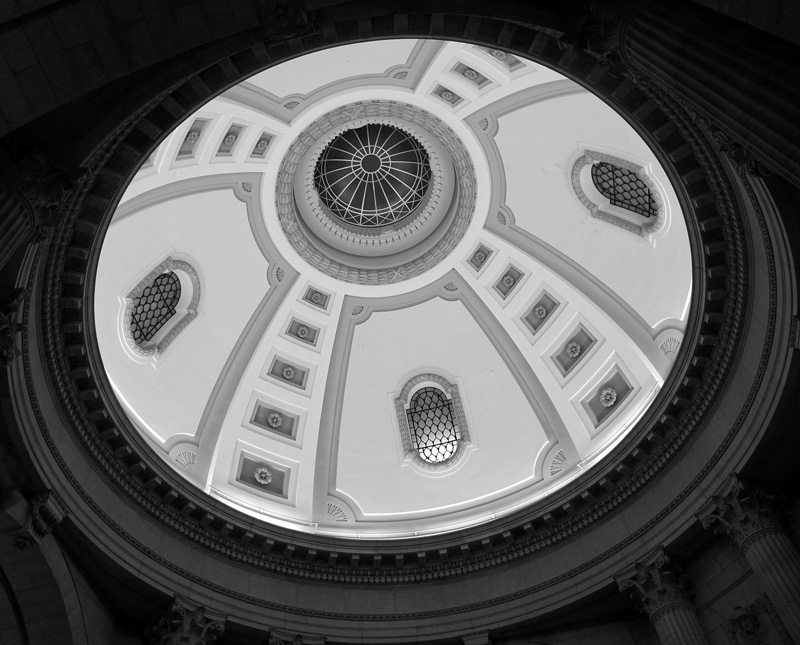
The interior of the Legislature’s dome
This winter I am heavily involved in preparations for the Geological Association of Canada – Mineralogical Association of Canada Annual Meeting (GAC-MAC), which will take place in Winnipeg this May. One of the more agreeable tasks has been collaborating on the preparation of guidebooks for two fieldtrips: one to examine the Ordovician-Silurian boundary at various sites in south-central Manitoba, the other a relatively simple afternoon walking tour of the Manitoba Legislative Building.
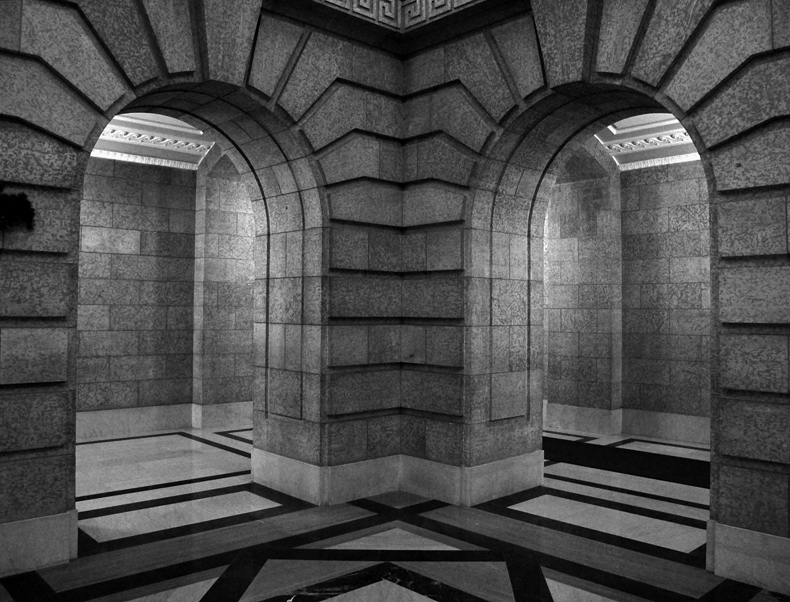
In a corner of the Grand Staircase Hall, the walls are of Tyndall Stone, baseboards are Botticino marble, and the floor is grey-pink and pink-red Tennessee marble and Ordovician black marble.
The Legislative Building (or “The Leg” as it is often called*) is such a common sight to commuting Winnipeggers that most of us probably barely think of it, but it is a gem, both architecturally and geologically. Opened in 1920, the Legislative Building is commonly described as a neoclassical structure, but its detailing betrays a bit of Beaux-Arts exuberance, and the statuary is a strange melange of Canadian history and classical, Egyptian, and prairie mythology. Read more…
Cross-Platform
In the modern world, it seems to be increasingly common for “intellectual products” to pass from one medium to another. It has long been the case that books have been turned into films or plays, but nowadays we have films that are made into games, Disney rides that are made into movies (I don’t think the Pirates of the Caribbean series can really be called “films”, do you?), and books that are made into websites.
But what about blog posts? What can they be turned into? Last week, I carried out an interesting experiment on the conversion of a blog post, or more properly a few blog posts, into the live lecture medium. Translation to a different platform, indeed.
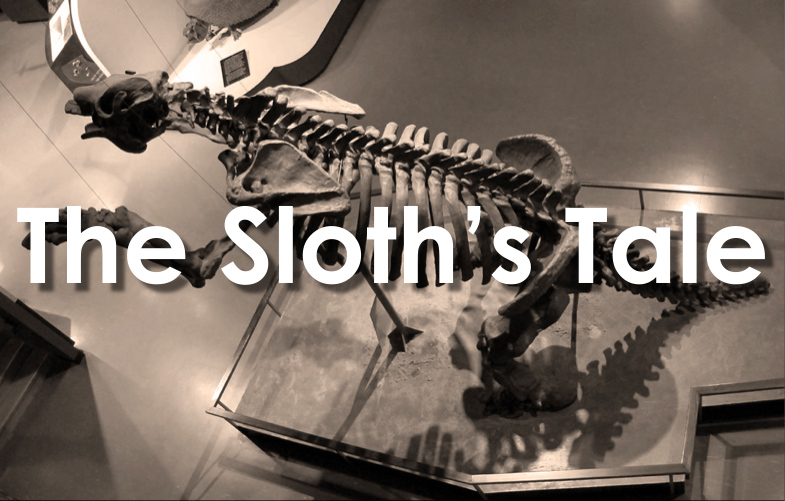
A while back, my friends at the Mineral Society of Manitoba asked me if I would give a lecture at one of their monthly meetings. In the past I have often made presentations about my research, on topics such as collecting the giant trilobite, or the fossil record of jellyfish. This time I thought I would do something different, so I said, “why don’t I just tell you about the history of one or two of the exhibits we have at the Museum?”
Tech. Savvy?
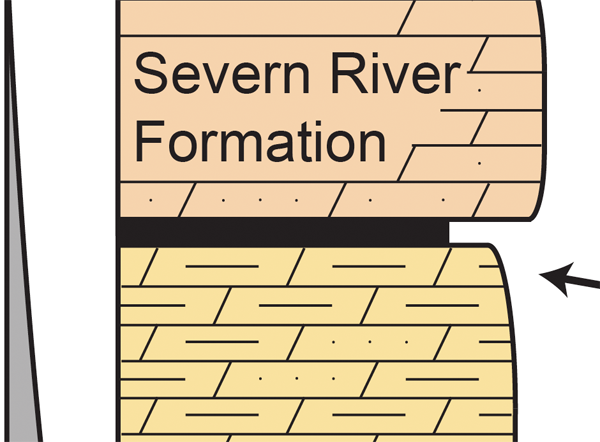
I have spent much of the past week assembling a geological map on the computer. While I was doing this technical task, I had plenty of time to think about other things … like the changing nature of this sort of technical task.
Younger people occasionally ask me how they might go about achieving a career in paleontology or a related science. Much of what I tell them probably falls into the “blindingly obvious” category: get a good undergraduate degree in Earth Science or a relevant area of Biology … learn to write … a course in field methods would be very useful … learn how to gather data, and how to tabulate, graph, and statistically analyze those data … do a graduate degree … get some training in appropriate modern research tools, such as scanning electron microscopes, microprobes, and digital image analysis.
There are, however, other essential skills that may not be so obvious, but that are critical to the success of most paleontologists working at most institutions in the modern world. These are the skills involved in basic technical work. In most institutions, it will be essential that you know one or more of rock cutting and polishing, thin section manufacture, specimen preparation, technical photography, and computer graphics.
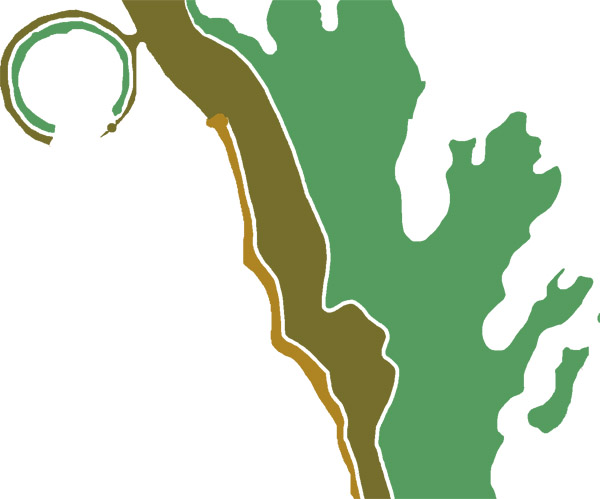
Blanketed

Lord Dufferin, snuggled beneath his blanket
Outside the Manitoba Legislative Building, a gentle snow was falling. On the west porch, feather-light Hollywood snow gathered on the statues of Lord Dufferin and General James Wolfe, blanketing them deeply in its fluffy whiteness. In the absence of wind, Dufferin grew a stunning mohawk, a coiffure midway between those of Mr. T and a tamarin monkey. Meanwhile, Wolfe acquired an ermine stole and a layer of striking white lipstick, furnishing him with the mien of a mature Boy George.

General Wolfe’s white lipstick
This scene was completely mundane and yet wonderfully strange. And it helped to show why these statues have weathered the way they have.
The Dawn of Experimental Taphonomy
Charles Walcott’s Jellyfish Experiments
At the end of November, I had the pleasure of spending several days in Denver, working with my colleague Whitey Hagadorn toward an improved understanding of the jellyfish fossil record. During that time I ended up re-reading most of Charles Walcott’s 1898 monograph Fossil Medusae, and rediscovered my admiration for this scientific pioneer.
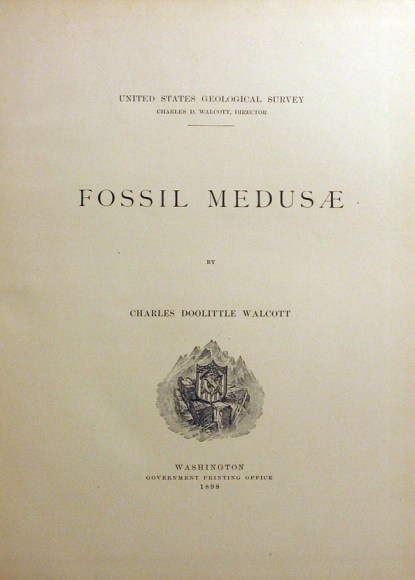
Those who work in other fields sometimes denigrate paleontology because it is largely a descriptive science, lacking the experimental underpinnings of other disciplines. This criticism no longer holds the sort of strength it once did; paleontology has become much more of a quantitative, analytical subject in the past few decades as it has incorporated approaches from geochemistry and statistics.
A century ago, it was almost unheard of for paleontologists to carry out experiments, but there was the occasional exception as individuals attempted to find out just how their fossils might have been preserved. The discipline of experimental taphonomy (the study of decay and fossilization) actually goes back a long way, and one of its earliest practitioners was the great Charles Doolittle Walcott of the United States Geological Survey. I am tempted to say that Walcott was the earliest to do this sort of work, but undoubtedly there are other examples I am not aware of.
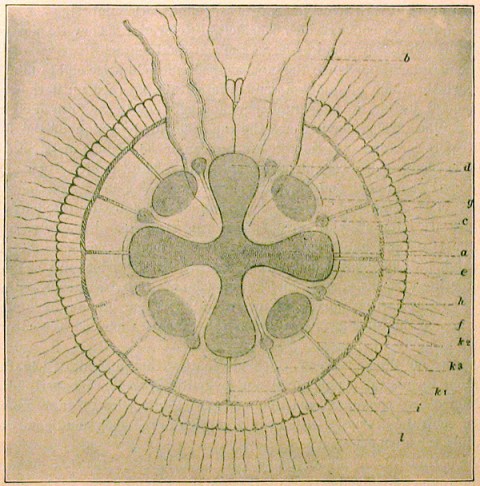
Haeckel’s diagram of the Solnhofen fossil Semaeostomites (re-published in Walcott, 1898, fig. 17)
A couple of decades before his 1909 discovery of the Burgess Shale, Walcott became interested in the idea of jellyfish fossilization. In part, this was because he was trying to understand some fossils he had received, collected from the Cambrian of Alabama. This interest also came from his reading of the work of Ernst Haeckel, who had published a series of papers on the remarkable fossil jellyfish from the Jurassic Solnhofen limestone of Bavaria (Haeckel 1866, 1869, 1874). Read more…
Clearing the Decks
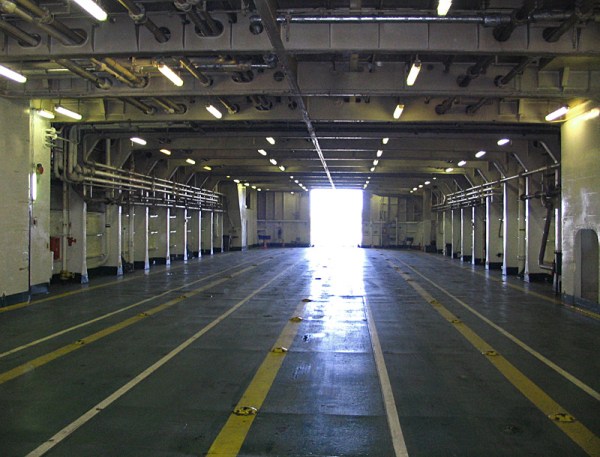
Car and passenger ferry, Kuivastu, Estonia
This week has seen one of those very odd conjunctions of events. Yesterday, I completed the journal edits on a review paper that has been in the works for at least a year. This morning, we resubmitted a manuscript on Ordovician pycnogonids (“sea spiders”) that has been going through the mill for even longer. Since I also just finished preparing a couple of PowerPoint presentations and am done with travel commitments for the moment, this means that there is suddenly a bit of time to think. Not spare time by any means (there is still much to be done before the year is out), but at least a lull in the action.
The Inmates Take Over the Laboratory


Norman Criddle’s first entomological laboratory at Aweme (top), and a window in the lab (above)
The preserved entomological lab of Norman Criddle at Aweme, Manitoba, is the remarkable remnant of a remarkable life. Constructed almost 100 years ago, this small building was the first purpose-built structure in which the self-trained scientist, naturalist, and artist could carry out his work. Visiting this place, I found it fascinating that so much significant research could be done by a man who had no formal education, working much of the time in a little hut on the family homestead, many miles from any library or university.
Like the Criddle-Vane farmhouse, the lab was abandoned many years ago. Unlike the house, which is in a sad state as a result of decay and vandalism, this lovely little lab building has been recently restored. It stands nearly empty, and when we visited last September the only living occupants were the swarms of flies. It seems appropriate that the workplace of the man who developed the Criddle Mixture* for the killing of pest insects should have arthropods as his only modern successors. From what I have read about Norman Criddle and his eccentricities, I think he would have appreciated the humour in this situation.

The tiny lab building stands on its own, some distance from the Criddle house.

Norman Criddle was hired as an entomologist by the Government of Canada, principally to carry out research on agricultural pest insects.


 Ancient Shore