The Potter’s Field
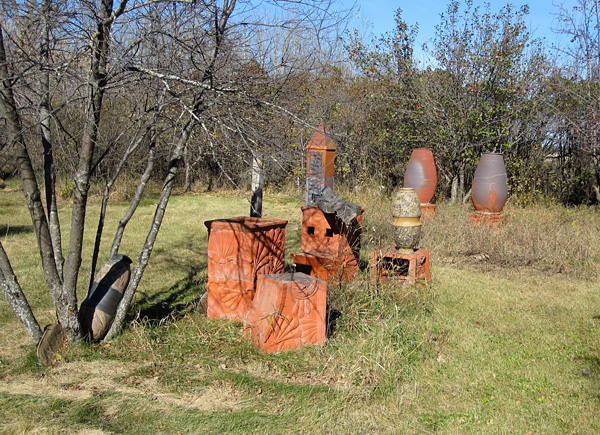
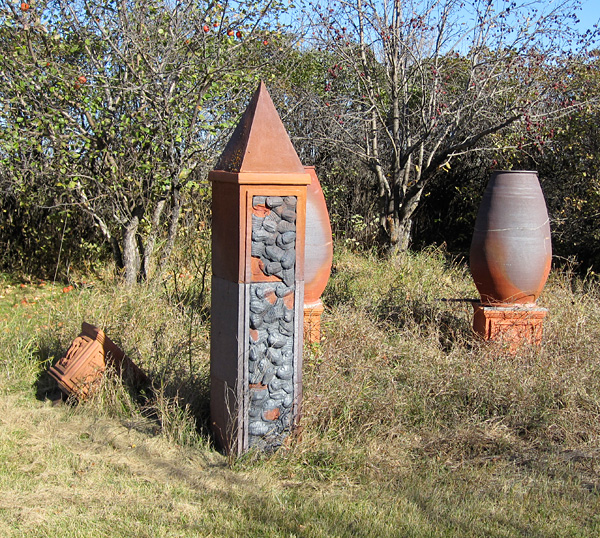
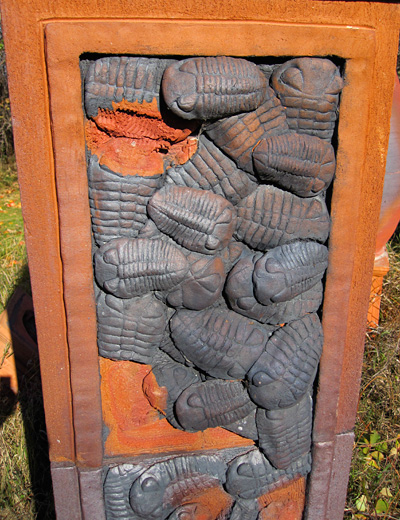
Somewhere in the wilds of rural Manitoba stands this cluster of ruined ceramic objects. Are they evidence that this region was once inhabited by an advanced culture that worshipped trilobites and ammonoids? Is this a monument to those lost, long-extinct creatures?
Skeleton Squadron
La Galerie de paléontologie et d’anatomie comparée, Part 1
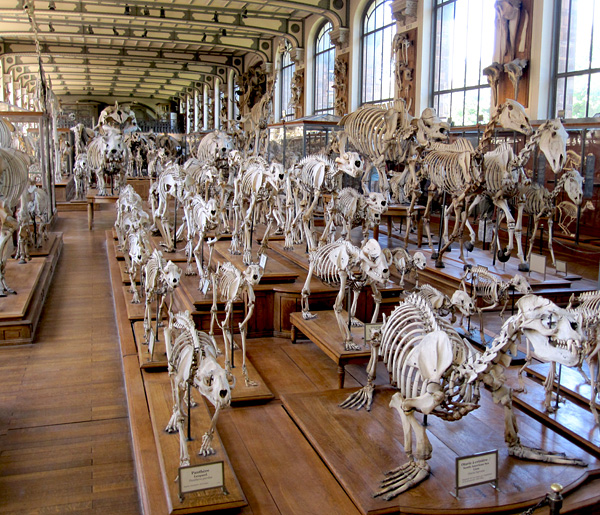
The Gallery of Comparative Anatomy, as seen from near the entrance ...
After quite a long hiatus from posts about museum exhibits, this seemed like a good time to get back into the subject. We have visited some strange and wondrous museums in the past few months, but the strangest and most wondrous of all has to be this old museum close to the Gare d’Austerlitz in Paris.

... and from above.
The Galerie de paléontologie et d’anatomie comparée opened for the 1900 Paris world’s fair, as did many other exhibit venues. Although it was built as a new museum, it was based on fabulous old collections that had been developed in Paris during the 18th and 19th centuries. It is located in a corner of the Jardin des Plantes, which served as a royal garden prior to the French Revolution.
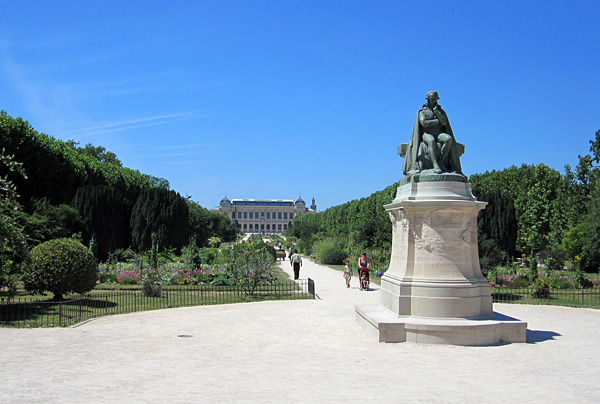
The Jardin des Plantes is overseen by a statue of the famous biologist J.-B.P.A. Lamarck. In the distance is the building that houses the newer Grande Galerie de l'évolution.
This place is an absolute wonder. Paris is often considered as a treasure house because of galleries such as the Louvre and the Musée d’Orsay. And of course those are amazing institutions. But this entire museum is itself a work of art, incorporating architecture, sculpture, design, and the natural architecture of skeletons, into an organic whole. It is an irreplaceable treasure, housing specimens many of which are themselves irreplaceable treasures.
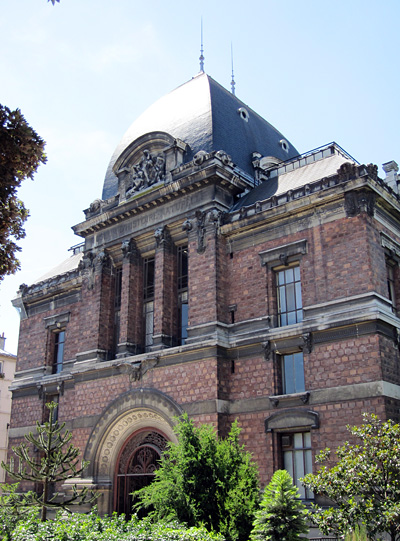
Entrance side of the Galerie de paléontologie et d'anatomie comparée.
We visited during the peak of this summer’s July heatwave. This may have given us a real period feeling for the building, because of course this museum lacks modern features such as air conditioning in the galleries. We sadly had to curtail our visit due to the heat, which became more intense as we climbed to the palaeontology gallery above this one, but I was able to take many photos. What follow here are images of the lower floor of the museum, the level that is based on the comparative anatomy collections.
If you want to see more of this Paris museum, please see Ghost Giants, about the fossil vertebrates, and Life’s Dusty Attic, about fossil invertebrates.
Over on my Museum blog, there are photos of an exhibit of skulls here.
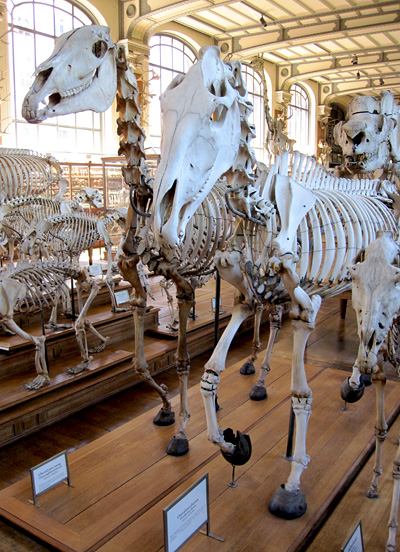
Horses: that's a Percheron in front, with a Thoroughbred behind.
The Uplands 2010: Field Language

During an afternoon coffee break, Debbie Thompson cringes as I attempt a pun. Matt Demski looks on with bemusement. Note that we are wearing multiple clothing layers for fieldwork in mid August! (photo © David Rudkin, Royal Ontario Museum)
If all language can be simply considered as either “good” or “bad,” then field language often falls into the latter category. The field is a setting in which the members of a group are required to labour together for many hours in frequently unpleasant conditions, doing boring, repetitive, and dirty work. A close camaraderie must arise if the team is to be effective, and bad language seems to be a common feature of this familiarity.
Most paleontologists are relatively polite people in our workaday life – it would be rare for anyone to hear us use “strong language” when we are in the hallway or meeting room. The field is a very different place, however and it calls for a different approach. In many effective field teams, the somewhat salty language is combined with a cheerful give-and-take. The conversation flows throughout the day, rising and falling like gentle waves, with the occasional explosion of sound as someone finds an exciting fossil (or makes a particularly bad pun).
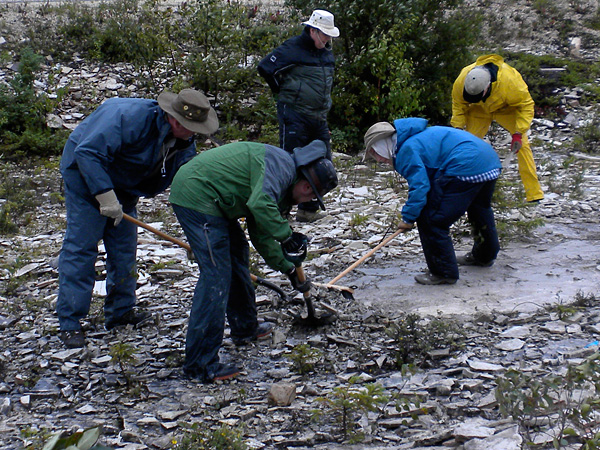
Everyone works together to clear off the bedrock surface. Left to right are Sean Robson, Matt Demski, Michael Cuggy (behind), Debbie Thompson, and me. Dave Rudkin paused work briefly to snap this shot! (photo © David Rudkin, Royal Ontario Museum)
Last month, as in previous years, we had a field group working in the Grand Rapids Uplands, collecting from Ordovician strata and looking for unusual fossils such as horseshoe crabs, jellyfish, and eurypterids.
This is often mind-numbing work, even under the best of conditions, as we must patiently split bedding planes, clear mud from surfaces, and examine the rock with a lens in the hope that it will reveal scraps of fossil material. In the past we have generally had good weather in the uplands, but during the few days we planned this year, the weather gods decided to compensate for their previously tractable behaviour.

Driving northward through the morning drizzle
We saw a couple of days of steady rain, punctuated by the occasional torrential downpour. When the precipitation stopped, the weather became grey, windy, and unseasonably cold (this was mid August, and the sun struggled to push through daytime high temperatures of +12 C). Our chatter, like the fleeces and rain suits, was required to sustain us through the long hours.
Michael described it as “the usual retarded banter,” to which Sean replied that, “my banter is witty and urbane.”
And some of it was clever, or seemed so at the time, particularly when heard between the gusts of wind. Many of us on this particular trip like wordplay, puns, and associations, so we would talk about someone as a “roly polymath,”which then became a “holy roly polymath,” and then a “solely holy roly polymath.”

Sean and Michael banter while re-examining a rubble heap. (photo © David Rudkin, Royal Ontario Museum)
We got onto the subject of names for groups of various objects or animals, such as a pride of lions or a murder of crows. This may have started because, in the early gloom one damp morning, Dave and I saw two ravens perched immediately outside our window, looking down on us as though we were weak and sickly creatures that might shortly become rather juicy carrion. We questioned whether they might know something that we did not, given the conditions of this particular field expedition. An “unkindness” of ravens seemed particularly apt.
Since we were collecting large tube-shaped fossils of uncertain affinity, which appear to have been sometimes gregarious, I suggested that a group of tubes could be called a “tubal legation.” This observation was greeted with near unanimous groans.

Taking advantage of the weather, Debbie Thompson fills buckets with wash water from a temporary stream that sprang up beside the outcrop. (photo © David Rudkin, Royal Ontario Museum)
Of course the banter was associated with teasing, most of it generous and good-natured. Sean pretended to be annoyed that I have often taken photos of the group which show him standing with his hands behind his back, while Debbie is always pictured working very hard. He was teased for his “supervisory” tendencies, while he suggested that we tried to take shots of him not working. Neither of these is true, of course … or at least, the first isn’t. It’s just that Sean tended to take a break from work at the same time that I got up to get photos of the group, and for the same reason. He and I both have knees that don’t take kindly to crawling around on hard rocks. On the other hand, Debbie WAS always working.
Along with the possible or marginal cleverness, there is no question that field language also tends to be much ruder than lab language. In part, this is related to the physical nature of the work. If you mash your thumb with a hammer, you don’t tend to say “golly gee whiz” or “oh my goodness.” And when you feel the pain as you get up from having crouched on cold rock for the past hour, there is a temptation to share your agony using the most colourful words at your disposal.

Splitting rock to search for fossils are (L-R) me, Michael Cuggy (standing), Sean Robson, Matt Demski, and Debbie Thompson. (photo © David Rudkin, Royal Ontario Museum)
We also tend to use strong language when someone finds something really exciting, which breaks the monotony and tedium of the day. On the last day of this particular trip, Michael found a eurypterid (“sea scorpion”) far larger than any we had ever seen at this site. Our delight at this discovery was abundantly clear and loud, even if Michael was teased that he had found it only because he was working beside Debbie, who always finds the good fossils. From then on the specimen became known as the BFE (for big friendly eurypterid, of course!).

Glacial striations on a dolostone surface in the Grand Rapids Uplands
Writing this piece reminds me of another story … back in 1998, we collected the world’s largest articulated trilobite from Ordovician strata near Churchill (we would later publish this as the holotype of Isotelus rex). Dave Rudkin was the first to find the specimen, as he examined the outcrop at some distance from the rest of the field party. He excitedly told us about his find, and we all walked quickly over to take a look. Without exception, each person used an identical two word phrase as they first observed this remarkable fossil. When we announced the find to the world, we were asked by members of the media what we said when we first saw it. Nobody was able to give them a suitable answer, other than to blush a bit and say that “we were excited.”
It is only later that I thought we should have simply said that our response was in equal parts sacred and scatological.
© Graham Young, 2010
Research Posters

As promised long ago, I have finally begun to add some more serious research content to complement this blog. There is now a Research Downloads page on this site. It currently holds a copy of the poster we produced for this year’s International Palaeontological Congress; over time I plan to add copies of older posters, and perhaps other research publications (copyright permitting).
In Between
If you are wondering why it has been so long between posts on this page, it may be because this is really the “in between” part of the summer. It is between vacation and fieldwork, between starting work on new exhibits and installing them, and between the beginning and the end of so many research projects. At the museum, I have been playing catch-up in between the steaming mounds of administrative backlog, leaving very few focused grey cells in between my ears.
There will be new material to post soon: I will be in the field later next week, and there are also trip photos from the past month that I want to edit and comment upon. In between, here are a few additional photos of last month’s Ontario fieldwork, courtesy of Dave Rudkin …
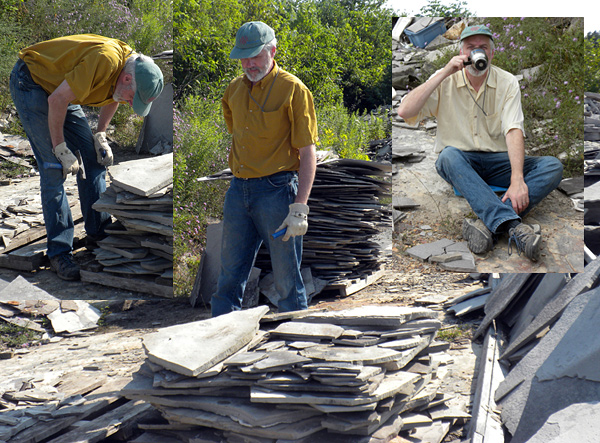
Action shots of me doing field research in south-central Ontario (or perhaps they should be termed "inaction shots"?). From left to right, assessing a fossil slab, preparing to shift another slab, and realizing I am jetlagged and need more coffee. If you want to gain an appreciation of this sort of fieldwork, imagine these images stitched together and animated in an infinite and very slow loop. (photos © David Rudkin, Royal Ontario Museum)
blob, blob, blob, …
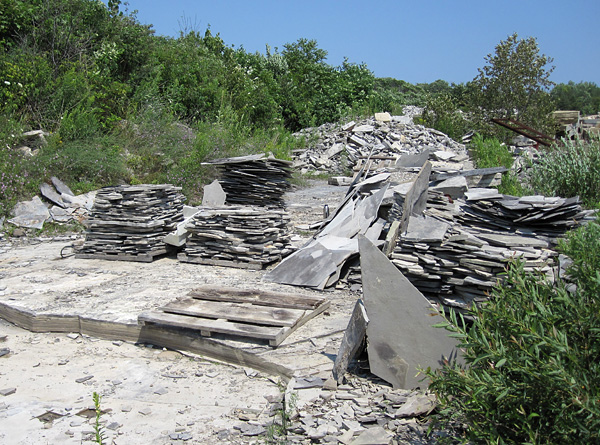
Stacked on pallets, Peter's slabs await our inspection.
After vacation time enjoying the good life, there’s nothing like a little bit of manual labour to get the body and soul back on track.
Last week, on a stopover while returning from Europe, I spent a couple of days doing paleontological field collecting in south-central Ontario. As some of you know, I have been working for quite some time to understand fossil jellyfish that occur in various places, most notably in central Manitoba. Dave Rudkin of the Royal Ontario Museum had told me about some structures in Silurian rocks of Ontario that bear at least a passing resemblance to the Manitoba jellies, and a year ago he sent a few specimens to whet my appetite. Although the fossils he sent look not dissimilar to amorphous inorganic blobs, they had enough jellyfish character to make a visit to the site essential. There are no definite jellyfish fossils known so far from the Silurian (444 to 416 million years ago), so these could fill in a significant gap in the jellyfish record.
So last Thursday lunchtime, there I was in the hot Ontario sun, jetlagged and shifting rock. The site is one of several currently being studied by Peter von Bitter (of the ROM) and his colleagues, and Peter had kindly agreed to let me look at the fossils in conjunction with him, Dave, and Henry Choong (also from the ROM). The rock there is a finely laminated carbonate, and over the years Peter and his associates have mined out an almost infinite number of thin platey slabs, stacking them on pallets so that they can weather for further evaluation.

Dave and Henry are prepared for some quality fossil-hunting time.
In addition to the “amorphous blobs”, the rock holds a great variety of fossils both commonplace (brachiopods, trilobites) and unique (very unusual arthropods and possible conodont animals). The latter are, of course, the reason Peter has been studying this place. The blobs have been of minor interest to previous workers, other than for the fact that some of them contain what seems to be a great variety of different minerals: sulfides, calcite, and possibly fluorite.

At first glance, most of the blobs are featureless and unprepossessing. At second glance I begin to pick out some features, but they are still far from "possessing."
The procedure for examining these slabs can be described thus:
1. Lift heavy slab from layer low on pallet to a level where it can be considered;
2. Mash fingers with slab while attempting to stabilize it on top of stack of rock;
3. Curse, then blow dust from surface of slab, managing to get most of the dust into eyes and nose;
4.Wipe eyes, smearing sunscreen from forehead into eyeballs;
5. Repeat cursing;
6. Rotate slab surface carefully in the blinding light, trying to determine if it holds any interesting fossils;
7. Put nose close to rock to observe amorphous blob through hand lens, inhaling a whiff of sulfur from the bituminous material in the carbonate;
8. Turn slab over to examine other side;
9. Repeat steps 2 to 7;
10. Place slab on stack of examined slabs, mashing fingers once again;
11. Re-repeat cursing;
12. Repeat steps 1 to 11.

Viewed edge-on, the beds show a fine-scale alternation of light-coloured carbonate and darker bituminous layers.
Now, imagine doing this for two days solid (or more, if you like). If you, like some people, consider paleontological fieldwork to be “exciting” or “exotic” or “romantic,” just remember: the above description is really quite accurate. Except that we were in a relatively civilized location and had the luxury of not dealing with snow, or torrential rain, or high temperatures, or hail, or sleet, or mosquitoes, or bears. Add in any or all of those exciting variables if you want to get a feel for the true romance of fieldwork.
The first 10 or 15 minutes of a field collecting project can be quite exciting. The next 10 or 15 hours … less so. But if the work produces results, it is worth whatever effort is required.
By the end of the second day, I had examined many dozens of amorphous blobs. Most of them are just that: amorphous blobs. I suspect that they were originally jellyfish, but any recognizable features were long ago lost to the (evil) forces of taphonomy and diagenesis. Nevertheless, I was able to find 20 or 30 blobs that are at least somewhat morphous, and I have hopes that, when examined in exhaustive detail, they will reveal their true jellyfish nature. Stay tuned …
© Graham Young, 2010
Addendum (July 22) provided by Dave Rudkin:
“There’s a 12th stage that Henry documented quite nicely: Sit outside motel room – drink beer, ponder blobs while watching torrential rain.”

There are obviously some very good fossils hidden in southern Ontario ...
Hans
The science of paleontology is going through an interval of “great dying.” In the past month or so, we have lost three giants of 20th century paleontology: Harry Whittington, Thomas Dutro, and Hans Hofmann. I knew none of them well, but I was fortunate enough to have had several good conversations with Hans, at conferences and on field trips. I was particularly saddened by his sudden death at the age of 73 or so. Read more…
Neandertals and Their Mitochondria
At the International Palaeontological Congress this morning, I attended a wonderful presentation by Svante Pääbo of the Max Planck Institute. Pääbo is the leader of the team that is studying the genome of Neandertals, trying to understand how this extinct group is related to modern humans.
This research group has found evidence that Neandertals interbred with modern humans, and that some Neandertal inheritance can be found in people from Europe and Asia. I thought that the entire presentation was quite compelling, but Pääbo made one statement that really made me think: apparently there is no evidence for Neandertal genes in the mitochondrial DNA of modern humans.* Mitochondrial DNA is different from our other genetic material in that it passes to a child only from the mother, not from both parents.
I have a question for the geneticists and statisticians: if many humans carry Neandertal DNA in our genomes but lack it in our mitochondria, what is the cause of this distinction? What is the likelihood that this pattern arose as a result of Neandertal men breeding with Homo sapiens women, but not vice versa? And if that was the case, then what does that tell the anthropologists about the nature of ancient societies in both groups?
Please let us know when you have an answer.
* And if I misinterpreted Pääbo’s statement, please let me know so that I can re-phrase the question!
The Other Place
As of yesterday, there are now two of me. I guess I could say that I have electronically budded or been e-cloned. If I were a jellyfish, then I have strobilated in an online sense. In coral terms, I have undergone polyp fission, although that sounds as though it might be particularly unpleasant and painful. In blogging, a search suggests that the expression would be “bi-blogual,” but I don’t think we want to go there … I might prefer to call it blogomitosis.
Anyway, I now have an official curatorial blog at The Manitoba Museum. There’s not too much posted yet, but I am looking forward to it. I hope that some of you will take the time to occasionally visit both of me.
Dinosaur Provincial Park
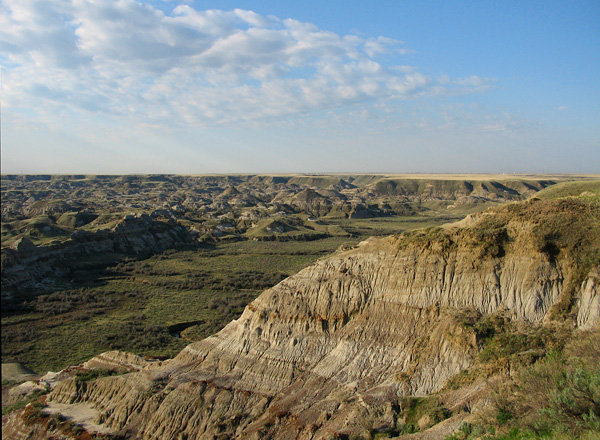
View into the valley of the Red Deer River
May 14, 2010
I arrived at 8 am, travelling northeast from Brooks across the flat farmland of southern Alberta. Out past Patricia, past the horse farms and the last of the irrigation machines, the land begins to drop away. Over a rise, a lookout on your right presents the wonderful panorama across the valley badlands, with the Red Deer River at the bottom.
Stopping at the gravel parking lot, I walked across the edge of the valley, gauging the angles of morning light on the sandstones and ironstones of the upper slopes. Sadly, this was the moment that my long-serving and long-suffering camera chose to explode. The lens ring, which had apparently ruled the front of the camera like a band of iron — well, metallic plastic in this case — popped off. The spring-loaded doors, freed from a half-decade of thankless servitude while the lens ring got credit for their work, took advantage of their newfound freedom and immediately spring-unloaded, spewing metal and black plastic across the dry grass. I managed to retrieve most of the pieces, but there was no way that I would be able to re-assemble them under “field conditions.”
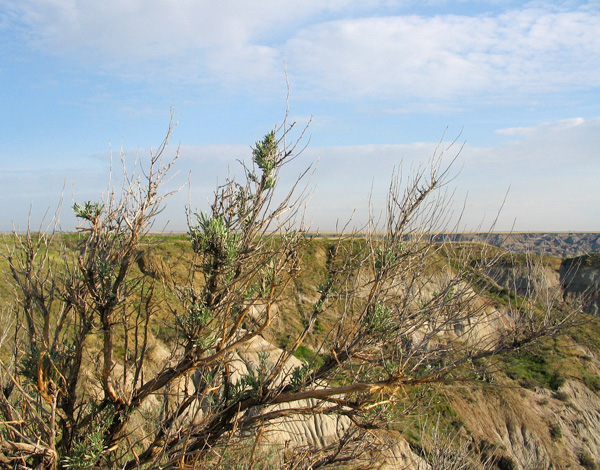
Sage
Anyway, the rest of the camera looked OK to me, and it still seemed to be taking reasonable photos. It was only later that I would discover that any image taken under angled light would suffer from interesting (and not necessarily “good interesting”) effects. I shot many photos while I was in the park. Only a few would turn out to be presentable for general consumption.
Down the slope there were vehicles at the visitor centre and campground, but once I got out into the park proper I found it abandoned. It is wonderfully strange to be absolutely solitary on the trails at a major tourist site, on a perfect morning under the bright sun. When I am alone, I tend to move quickly without realizing it. Time slows when there is no one to discuss things as they appear, and observations that actually take a split second appear to crawl past in slow motion.
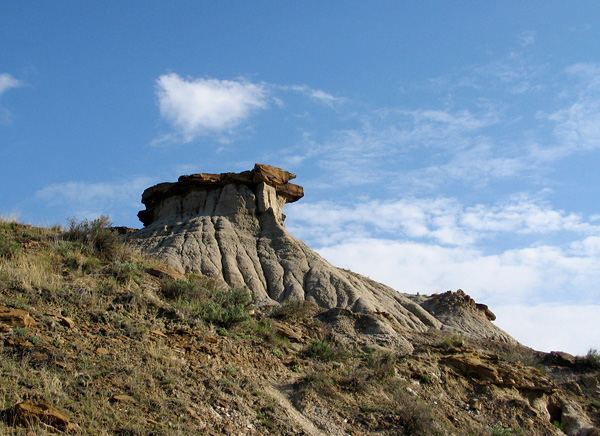
One of an almost infinite number of hoodoos
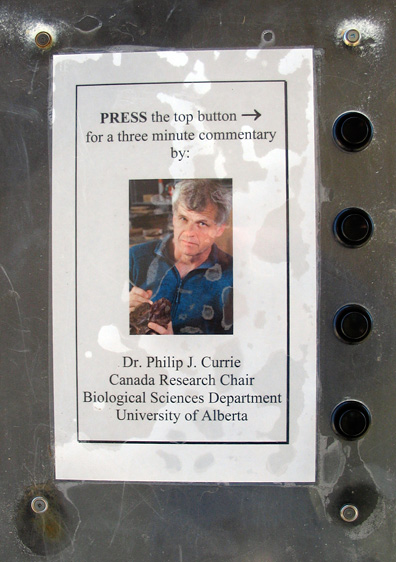
Philip Currie is omnipresent at DPP. I found these listening stations particularly entertaining because we had just had Phil give an excellent presentation at our Great Canadian Lagerstätten conference session two days earlier.
I walked the well-tended gravel path of the “Trail of the Dinosaur Hunters”, a gentle stroll to a fossil quarry of Barnum Brown’s, dating from the early days of dinosaur excavation in this area. The Dinosaur Park Formation and other Cretaceous units of southern Alberta are incredibly rich in dinosaurs and a great variety of other fossils; this place is the epicentre of Alberta’s dinosaur abundance and diversity.
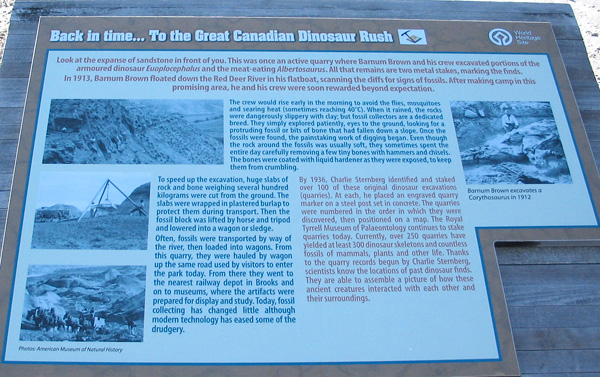
Sign at the entrance to Barnum Brown's excavation site
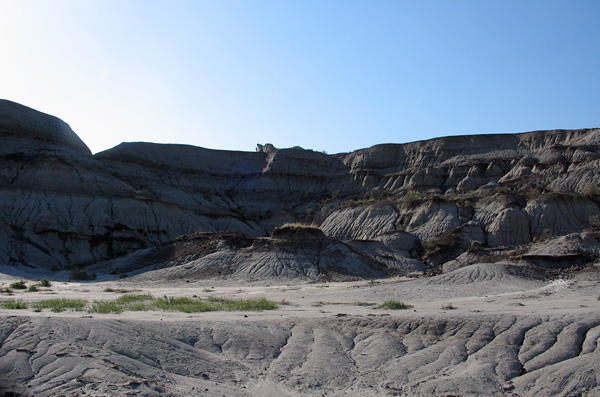
Barnum Brown's site
Many years ago I spent some happy weeks collecting dinosaurs northeast of here, so my eye is reasonably attuned to finding dinosaur fossils. Since the park is so rich in fossil material, my objective was to not see fossils, but to simply observe the rocks and the landscape. Collecting is forbidden, and I didn’t want to have to fight the natural reflex to pick up any piece of bone that I might happen to come across!
By 9 am I had already completed a second trail. This was a lovely meandering wander through the cottonwoods and sages down by the river. The sign at the beginning indicated that it could take an hour to complete, but this would clearly have been an hour with speed set at “slow amble,” maybe punctuated by breaks for lunch, a nap, and a quick game of blackjack.
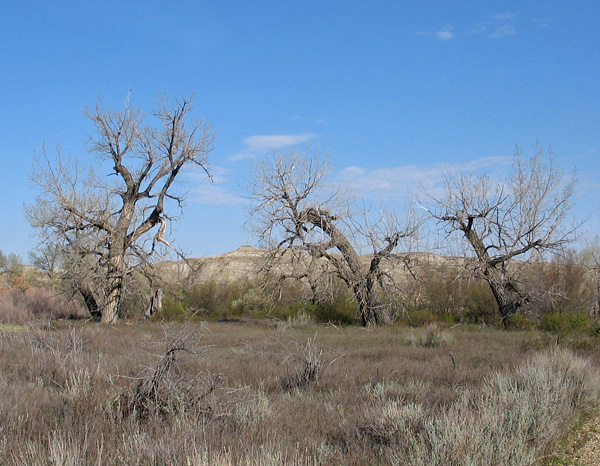
Gnarled old cottonwood trees rise from a sea of sage along the banks of the Red Deer River
Heading up to the visitor centre, I was pleasantly surprised to discover that the exhibits had been completely refurbished since my last visit. I was given a tour by the manager, who explained how the development had taken place. The front end, which was put together by the park in collaboration with a design firm, includes some excellent visual explanations of badlands phenomena. At the back of the centre are the dinosaur exhibits, developed by the Royal Tyrrell Museum of Palaeontology in Drumheller. These are really Tyrrell exhibits in miniature, and include some superb specimens such as a skull of Styracosaurus. My only quibble was that there now seem to be fewer fossils than there were before. The previous exhibits had some wonderful examples of how specific bones vary between dinosaurs, but of course a design team can never fit every possible feature into a limited space.
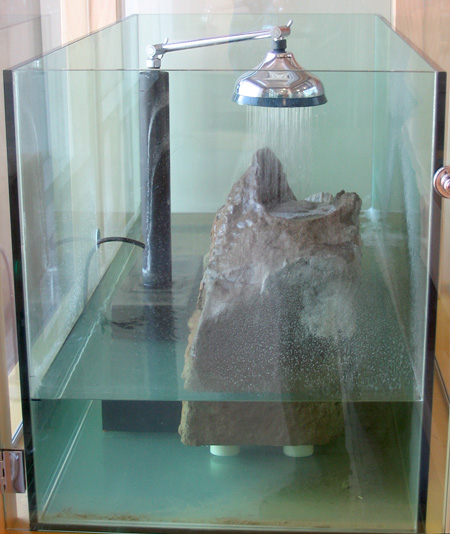
The visitor centre has some lovely exhibits. This case dramatically demonstrates the erosion of soft sandstones by flowing water.
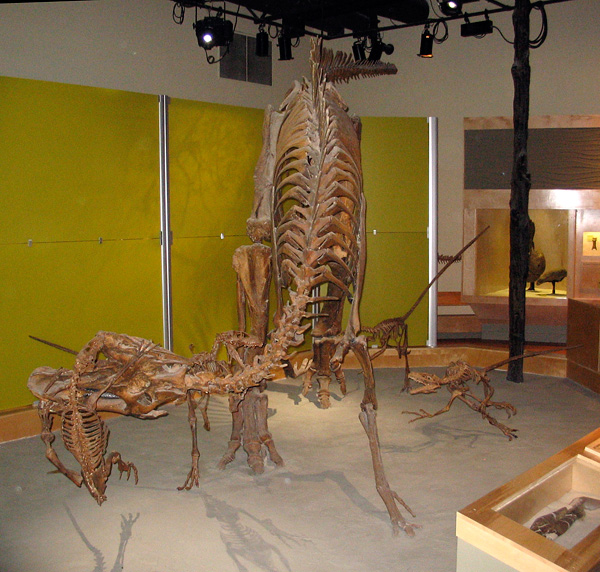
Small theropods (Saurornitholestes?) attack a hadrosaur in this exhibit at the visitor centre. The mounts are very good, but I find it psychologically troubling to contemplate several skeletons attacking another skeleton. This exhibit has a horror movie just waiting to get out!
Behind the visitor centre, a sign indicates the presence of the Coulee Viewpoint walking trail. I noted that the sign warned of “steep slopes,” but I was still surprised just how precipitous some of them turned out to be, after the gentle paths elsewhere. This route was only sporadically marked with little signs, which demonstrated that you would have to scramble up and down across sandstone, ironstone, and popcorn shale. Having done badlands fieldwork before, I found that I adapted quickly, but I did wonder whether having this trail directly behind the visitor centre might tempt those clad in loafers or stilettos into places where they could really regret their choice of footwear. It was a dry day when I was there, so navigating the rills and gullies was relatively straightforward. My recollection of wet popcorn shale slopes elsewhere is that they are far more challenging, since they are about as easy to scramble up as a tilted board coated with lukewarm lithium grease (they are, however, remarkably easy to descend, as long as you don’t care where and how you stop).
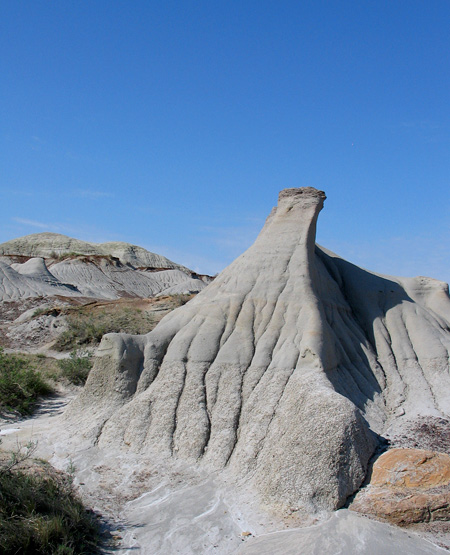
Over the top of the slope, a pair of Canada Geese on either side of a coulee warned me in no uncertain terms that they were nesting nearly. If that was true, I did wonder about their sanity, since this seemed the most ill-thought goose nesting site I had ever seen (on consideration of this sentence, however, I realize that this may be redundant: Canada Geese probably never do anything that could be described as “well-thought” or “planned”).
Toward the end of the trail, perhaps under the influence of my erstwhile companions, my movements must have also been ill-thought. I took an unplanned turn and found myself descending a slope behind the campground, rather than returning to the visitor centre. Even though it was a mild day in May, the rocks were already getting hot at 10:30 am; the memories of badlands field conditions came flooding back! This place is very beautiful, but I was glad that I needed to head south and resume my long drive homeward. Still, there must be enough time to take a quick look at a few of the hoodoos along the Badlands trail …
© Graham Young, 2010
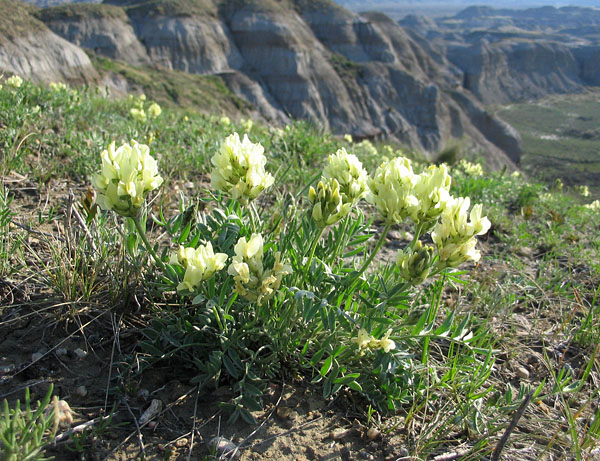
Spring flowers at the top of the valley


 Ancient Shore