Welcome Aboard
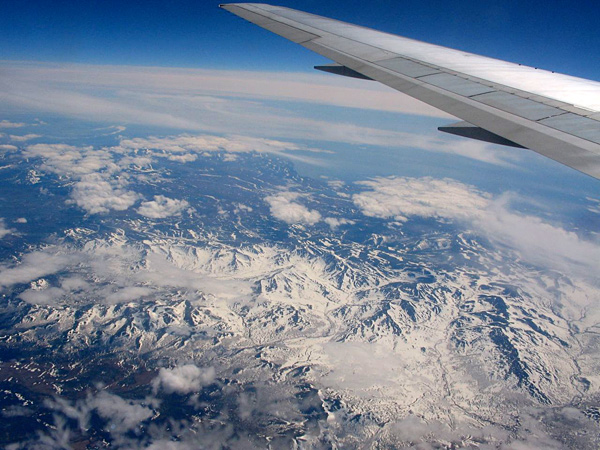
Eastern Siberia from 40,000 feet
As has happened far too often lately, I was woken in the night by planes passing over the house. We don’t live all that close to the airport, but in the past few years they seem to have added many late-night courier and freight flights, which are generally routed over our house at about 3:30 am. I got back to sleep just in time to wake up, and my bleary eyes could barely focus on a newspaper report about the Copenhagen meeting of climate change scientists. The article stated that many of the scientists at this meeting think that global warming has already progressed past a “tipping point”: we will be coping with some very serious effects of climate change, regardless of what we do now.
From this conjunction, I began to think about the linkages between airplanes and climate change. Of course, we all know that air traffic is a significant contributor of greenhouse gases, but the airplane itself is also a potent metaphor for our modern society. The way we behave when we are traveling by air says much about our relationship to the natural world, and helps to explain how we have gotten ourselves into this predicament.
About a dozen years ago, when our first daughter was a toddler, my family was taking a daytime flight from Europe to Canada. Those of you who have flown across the North Atlantic more than a few times will know that cloud cover is the rule in that part of the world, but this was one of those rare days on which you could see almost forever. I was sitting by the window with our little girl so that my wife could have a nap (she had been child-wrangling through Madrid while I was relaxing at a conference), when the pilot’s voice over the intercom announced that we were coming up to the east coast of Greenland. I could see the icy land looming ahead, and along our side of the plane the window blinds opened so that people could see what the pilot was telling them about. But after about 30 seconds, they began to close again, and within a couple of minutes ours was the only blind open in that entire part of the aircraft.
The movie was starting (I recall it being part of the Die Hard franchise) and I’m sure that many of the passengers didn’t want to miss any of Bruce Willis’ acting, but there seemed to be more to it than that. Some of them appeared to be afraid to know that they were actually flying over this remote and forbidding part of the world, and many others seemed to have no interest in knowing. In any case, they were all quite disconnected from the landscape sliding by below. And so we passed the East Greenland coast, with its glaciers calving into numerous icebergs. We floated over the Greenland Ice Sheet, punctuated by angular nunataks with their tendrils of mist. West Greenland was obscured by cloud, but then it cleared for a while over Davis Strait and Baffin Bay, so that we could view the rugged land and ice of Baffin Island. We did not see south Baffin, but then again passed out of the cloud as we slipped smoothly above Hudson Bay and Churchill. It was a wonderful, unique opportunity, the only time in my years of traveling that I have had the chance to see those sights. And yet, at least 95% of the people on that flight could just as easily have passed the time in a suburban shopping mall for all the effect it had on them.
In the years since, there have been many times that I have stood on the shore at Churchill on a clear day, watching the growing contrails of a plane headed from London to LA. Where I stood, belugas fed in the bay nearby, gulls circled, and the shotgun lay at the ready in case a polar bear expressed an interest, but a few kilometres above there were 400 people watching a movie and enjoying their drinks. This disconnect seemed even stronger when we did fieldwork at McBeth Point and Cat Head, on the North Basin of Lake Winnipeg. This area is sufficiently remote that it requires major logistical planning: we chartered a floatplane, hauled in all of our food, slept in tents, and assembled a zodiac so that we could get around on the often-treacherous lake. On long quiet evenings I would sit on the shore; if I sat sufficiently still I could see a beaver swim across the little harbour, or even better, the family of otters might run playfully from the water, oblivious to my presence. But again, if I looked up, there were the jets, rushing from Paris to San Francisco, or New York to Tokyo.

Cliff between Cat Head and McBeth Point

Two of the otters at McBeth Point
If I was thinking about the otters, beavers, rocks, or weather, were the people on those planes aware of any of the wonders they were passing? I very much doubt it. They had passed from a large city to a nearby airport, gone through ticketing and security, wandered through a huge mall-like duty-free area, found their seats on the plane, and were being cossetted through hours of forced inactivity in an internally focused metal box. They would arrive in another big city, which, given the extent to which they had experienced anything between, might as well be a short commuter train ride away from the place they had left.
We are, effectively, living in a world that has been reduced to a single urban connurbation, linked by rides in sealed tubes. The great majority of humans in the developed world are “city people.” To them, London is linked directly to LA, and Berlin is next to Beijing. The only “nature” they see is in the groomed areas that developers have chosen to keep adjacent to beach resorts and cottage developments. Their world is a world of people; the only issues that really matter are human issues, the only important news is news that affects people, and empty time must be filled with the consumption of goods and entertainment.

One corner of the world city: Beijing's traffic and smog
When people have spent all of their time in the human-created world, they seem to find it difficult to understand and appreciate the natural one. In conversations with people possessing graduate degrees in non-science disciplines, I have often been shocked that some of them are not only ignorant of the natural world, but that they have little curiosity about it. In contrast, I have had conversations with relatively unschooled fishermen in backwoods places in Quebec and Manitoba, and have discovered that they possess deep knowledge of and respect for nature. But which of these two groups is more likely to have a say in the development of government and business policy?
Can we learn to travel differently? Is it too late for us to learn to appreciate and respect the wonders that can still be found between our cities? Nature does not exist simply for our enjoyment and profit; it exists because it exists. I don’t claim any moral superiority; my treatment of the environment is no better than anyone else’s. But if we ignore the world, how can we begin to treat it properly? When we next get on a plane, let’s put away the laptops and iPods, darken the movie screens, and keep the blinds open.
Drumheller’s Dandy Dinos
It seems appropriate, on a day marked in many parts of the developed world by blatant and unrelieved commercialism, to talk briefly about dinosaurs and kitsch. Ever since dinosaurs were first understood in the mid 19th Century, there have been popular depictions of what these strange antediluvian creatures must have looked like. These imaginings have often descended to remarkable depths: think of the pet dinosaurs in The Flintstones, or the creatures in One Million B.C. But what could be the most egregious offences against taste and nature fall into the category of “tourist attractions.”
About a year ago I was lucky enough to visit Drumheller, Alberta, home of the Royal Tyrrell Museum of Palaeontology. The Tyrrell is famous for its fossil collections, wonderful exhibits, and leading scientists. I spent a couple of days wandering through the museum and its back rooms, studying and savouring fossils public and hidden.

This ornithomimid in a death pose is an example of the fabulous dinosaur exhibits at the Royal Tyrrell Museum of Palaeontology.
At the end of each day I had some time, so I took my wandering to the town. Now, many small towns would consider it a great honour to host a world-renowned museum, and would try to develop features to complement it. In the case of Drumheller, they seem to have decided that what is needed are more dinosaurs, preferably larger and more spectacular than the real ones you can see at the Tyrrell. Here in the middle of town is the world’s biggest dinosaur:

If you wish, you can climb up into this Ubertyrannosaurus superrex through the, ahem, backside. And to accompany it, there are many other prehistoric beasts spread around town. Some, created long ago (perhaps in the 1950s or 60s), are of extremely questionable accuracy and parentage:

Other, newer ones are not quite so bad, if perhaps a bit “vaudeville”:
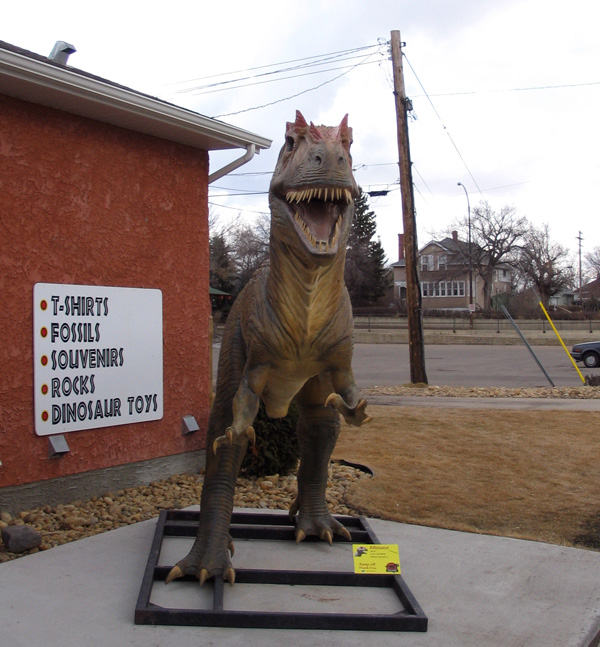
And some are, well, examples of nothing but naked commercial opportunism:


After making the rounds I was preparing to leave town with a bad taste in my mouth, but then I saw that some of the dinosaurs had been repainted with a tongue-in-cheek postmodern approach. Instead of just being bad North American kitsch, they had (to my eye) been made so bad that they became good:


Perhaps, on this rampantly commercialized day, if someone somewhere is drinking a toast in green beer, to a giant leprechaun perched on the back of a stegosaur of uncertain antecedents, the rest of us should just lighten up and enjoy the spectacle. At least for today.
Eternal Jellies in the World Ocean
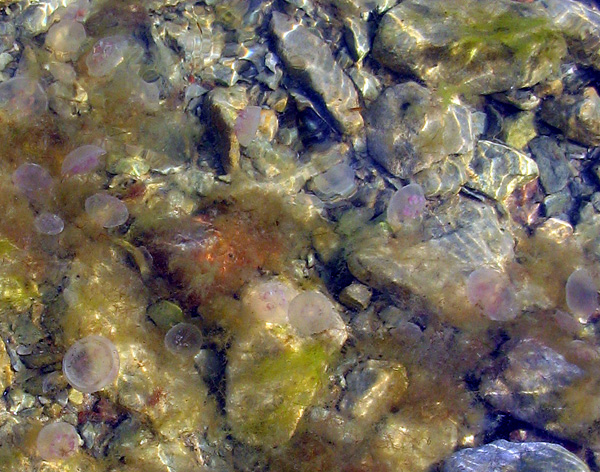
Abundant moon jellies in the Baltic shallows
I have lived much of my adult life here in landlocked Winnipeg, but I grew up much closer to the sea and spent many summers in my 20s doing fieldwork beside the mercurial Atlantic and the more peaceable Baltic. It is strange to consider that I now live in a place that may be almost as far from the sea as anywhere in North America, yet most days I spend hours contemplating marine organisms present and past, trying to understand the environments of ancient shorelines and long-lost salt seas. I often feel the emotional tide of the ocean, and every year I try to spend days or weeks absorbed by its sights, sounds, and smells. Sometimes I collect fossils beside the cold and often fog-bound Hudson Bay, but I have also had many days beachcombing on both sides of the Atlantic, along the Baltic, Mediterranean, and Caribbean, and on the east and west shores of the Pacific.
For the past several years, I have been trying to make sense of 445 million year-old fossil jellyfish that we discovered in central Manitoba (1). These are, effectively, jellyfish that were washed up on an ancient shore and buried in fine sediment before they had a chance to rot away completely. They are strange fossils, and difficult to understand, so each time we go to the seashore, my patient family has to put up with my constant searching for beached modern jellyfish to examine and photograph (“Daddy’s looking for jellyfish. Again!“).
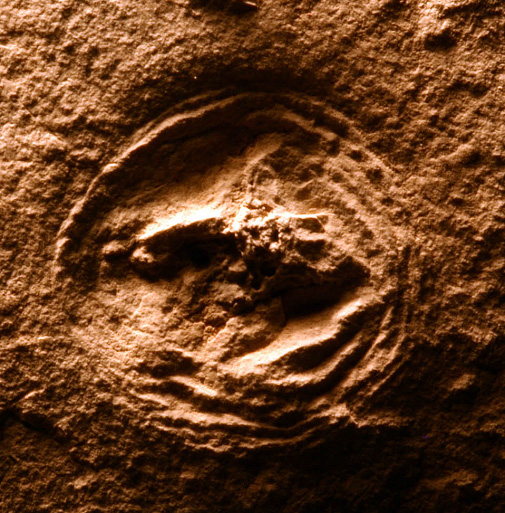
Ordovician fossil jellyfish from central Manitoba (The Manitoba Museum, specimen I-4056A)
Some of these modern jellies are remarkably widespread organisms. I have looked at examples of the moon jelly Aurelia in Florida, in the Baltic, and in the Pacific, and they are all very similar. They may differ in how much “jelly” they have, or in what colour their gonads are, and they apparently represent a few species (the experts don’t seem to really agree), but nonetheless, this is obviously a type of organism that can be found in seas and oceans almost everywhere. Similarly, I have examined the lion’s mane jellyfish Cyanea capillata on the coasts of Scotland, Prince Edward Island, and Hudson Bay. How many other kinds of organisms are this widespread? There must be billions of jellyfish in this world, yet all of them belong to a remarkably small number of species – it is estimated that there are only about 200 species of “true jellyfish” (Scyphozoa), plus 20 species of box jellies (Cubozoa), and 1000-1500 species of the hydrozoan jellyfish (hydromedusae; many of these are minute, almost microscopic in size). By way of comparison, there are hundreds of thousands of species of mosquitoes, gnats, midges, and their relatives; jellyfish diversity is very different from that of the land-dwelling animals with which we are more familiar.
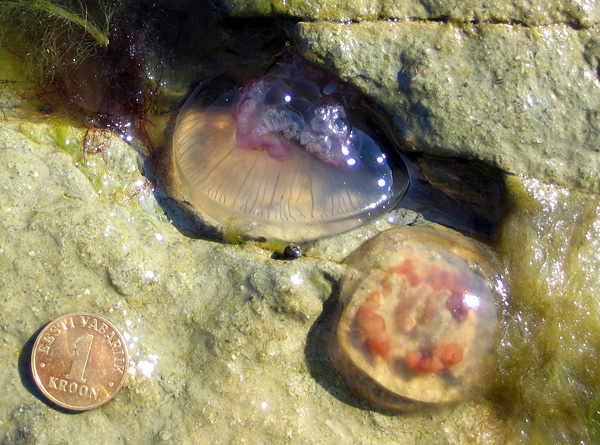
Dead moon jellies, Island of Saaremaa, Estonia

Lion's mane jelly, northeast tip of Prince Edward Island
How can it be that the diversity of jellyfish is so relatively meagre, when the oceans are far larger in area than the land, and when jellyfish are widespread and abundant through much of this three-dimensional medium? Much of the answer, as far as I can determine, lies in basic differences between land and water environments. When I stand on the shore of the Baltic, or the shore of the Pacific, I am effectively on the edge of the same body of water. These seas and oceans, even if they are on opposite sides of the planet, are linked by liquid, as indeed are all oceanic bodies of water. This is most obvious when the Earth is looked at from the south polar perspective, since around Antarctica the Atlantic, Pacific, and Indian oceans all flow together to form the “Great Southern Ocean.” But follow the tentacles of that ocean northward, and you will see that it links into the Caribbean, the South China Sea, the North Sea, the Bering Sea, even dear old Hudson Bay. To animals that live within the water column, these water bodies are all one, and the animals move around the world as the currents, water conditions, and food resources allow.
This situation has been similar through most of geological time. Four hundred million years ago, the land of the world was divided into continents that would be completely unfamiliar to our eyes, but they were surrounded and partly covered by that same liquid environment. In the intervening millennia, continents have risen and fallen, land has come and gone, but the ocean has changed very gradually, with only a few jarring knocks to trouble its otherwise placid existence.

The Great Southern Ocean, as seen from above the South Pole (Wikimedia Commons)
Since the ocean is a liquid, not a solid, its shape is not so material to the organisms that make it their home, particularly those that spend their lives without touching land or the seafloor. The great majority of these life forms fit within the broad definition of plankton, which basically includes all those things that drift with the currents. Animal plankton, or zooplankton, are immensely varied: crustaceans, salps, polychaete worms, gastropods, larval fish, and numerous other forms. Many of these are microscopic, and most jellyfish are at the “macro” end of the zooplankton scale. Since the really big true jellies are among the largest of the plankton, they are the easiest for the casual observer (such as myself) to see, and, perhaps, to understand.

Crystal jelly Aequorea (a big hydromedusan), Pacific coast of Canada (photo: Gavin Hanke)
It was recognized long ago that the evolution patterns for the plankton are quite different from those of organisms that live attached to the seafloor, which are different again from land animals. Many plankton species are extremely long-lived, as are the groups to which they belong (2). Since many zooplankton (such as my familiar jellyfish) are geographically widespread and exist in unimagineably huge numbers, they may be protected from most of the phenomena that cause other things to become extinct. But their numbers and distribution are themselves related to what is called the “paradox of the plankton.” The basic idea is that zooplankton, living in such immense and widespread populations, surrounded and fed by water, are in a situation where physical conditions affect them much more than any competition between species. The paradox of the plankton uses this to explain the generally high diversity of plankton, but a lack of direct competition could also potentially explain the relatively low diversity of jellyfish. New species arise where selective forces are driving evolutionary change, often on small and separated populations; the huge populations, continuous distribution, and apparently low competition among jellyfish make it unlikely that new species would arise frequently.
Some groups of plankton have hard skeletons and have left good fossil records in sedimentary rocks all over the world. Others, such as jellyfish, lack hard parts, and are remarkably rare and sporadic as fossils. Together with my colleague Whitey Hagadorn of Amherst College, I have been working on a review of the fossil record of jellyfish (3). There are only a few good jellyfish sites in the entire fossil record, but several recent papers have described ancient forms that are remarkably similar to those we can see today (e.g., 4, 5). Hundreds of millions of years ago, moon jellies and box jellies and many other forms were washing up on shorelines, just as they do today.

Modern moon jellies (Aurelia) from the southern end of Vancouver Island

This fossil jelly, similar to a moon jelly, was discovered in a schoolyard in Winnipeg. Its age is uncertain, but the rock in which it occurs is consistent with an Ordovician age, about 450 million years old (The Manitoba Museum, specimen I-2555).
It appears that, once planktonic organisms find their niches, it may take some sort of cataclysmic event to displace them. They seem to be immune to the sorts of ordinary “day-to-day” factors that caused the extinction of mere mortals such as the dodo or mammoth, and that threaten so many other creatures today. It is still likely, however, that mass extinction events will affect them. Many groups of skeletonized zooplankton were severely affected by the end Cretaceous extinction, the same catastrophe that saw the demise of the dinosaurs and pterosaurs. The jellyfish fossil record is so sporadic that we can’t say whether that event made them miss their dinners, but I suspect that at least some of them must have been pushed onto the “extinct” side of the ledger.
I plan to write more pieces about fossil jellyfish, and about modern jellyfish blooms, but today in snowy Winnipeg I feel much more compelled by thoughts of their relationship to the ocean itself, in all of its endless and trackless wonder.
References
(1) Young, G. A., Rudkin, D. M., Dobrzanski, E. P., Robson, S. P., & Nowlan, G. S. 2007. Exceptionally preserved Late Ordovician biotas from Manitoba, Canada. – Geology 35, 10: 883-886; Boulder.
(2) Rigby, S. & Milsom, C. V. 2000. Origin, evolution, and diversification of zooplankton. – Annual Reviews of Ecology and Systematics, 31: 293-313; Palo Alto.
(3) Young, G.A. and Hagadorn, J.W. Accepted for Publication. The fossil record of cnidarian medusae. Proceedings, X International Symposium on Fossil Cnidaria and Porifera, St. Petersburg.
(4) Gaillard, C., Goy, J., Bernier, P., Bourseau, J.P., Gall, J.C., Barale, G., Buffetaut, E., & Wenz, S. 2006. New jellyfish taxa from the Upper Jurassic lithographic limestone of Cerin (France): taphonomy and ecology. – Palaeontology, 49, 6: 1287-1302; Oxford.
(5) Cartwright, P., Halgedahl, S. L., Hendricks, J. R., Jarrard, R. D., Marques, A. C., Collins, A. G., & Lieberman, B. S. 2007. Exceptionally preserved jellyfishes from the Middle Cambrian. – PLoS ONE, 2: e1121 (online journal).

Scenes from Northern Summers (1)
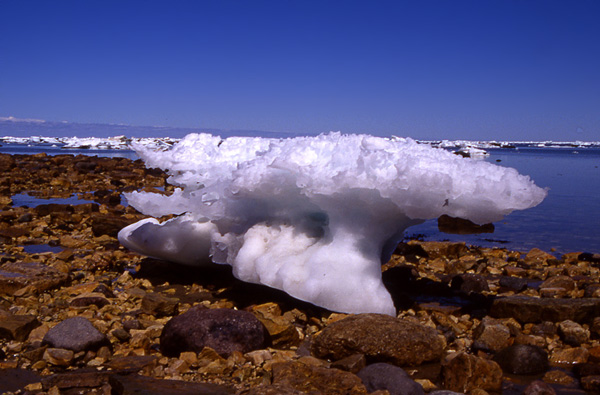
Ice sits on the Hudson Bay shore in July
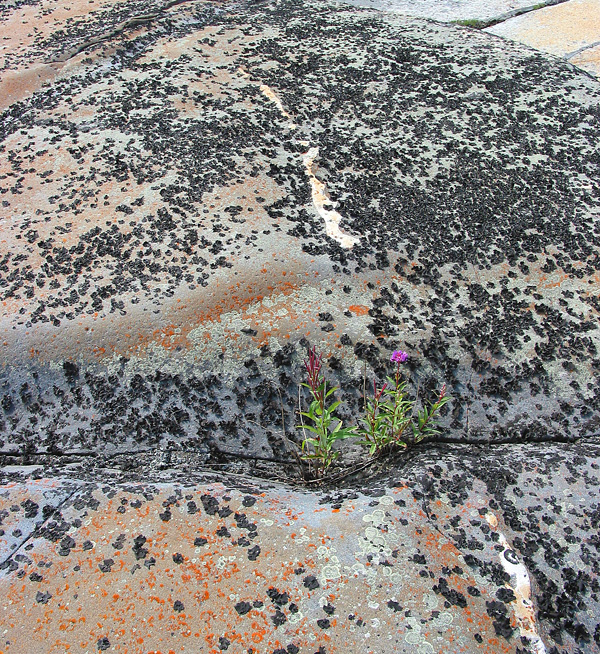
Tenacious arctic willow herb grows in crevices on the quartzite surface.

In summer, the tundra is covered with flowers.
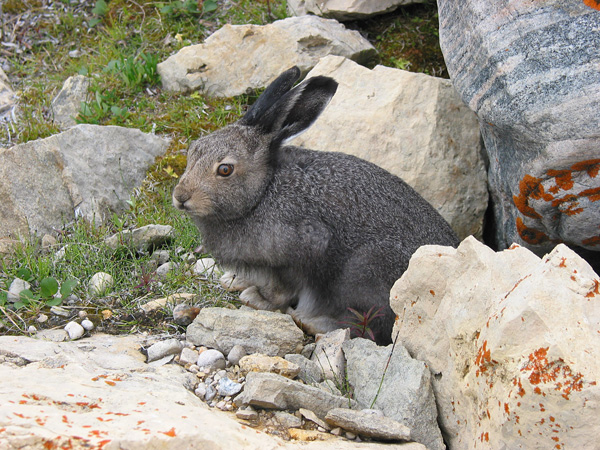
An arctic hare in summer pelage


At twilight, the moon hangs over the old Churchill rocket range.
Bones and Sinews
When you deal with fossils every day, even unusual or remarkable fossils, it somehow becomes easy to take their existence for granted. If I am repairing fossils or moving them around, I tend to see them as objects that simply “are,” but when I stop to think I can appreciate that every specimen is the result of a series of remarkable coincidences. Of the many billions of organisms on Earth at any given time, what are the chances that one animal will have died in a place where it would be buried before the dark forces of entropy could reduce it to dust or mud? What are the chances that the sediment in which it was buried would not be eroded away in the intervening millennia? What are the chances that the rock containing this rare treasure would be exposed at the Earth’s surface within our modern times? And what are the chances that it could be discovered, recognized for what it is, and collected with the necessary care? Each one of these has an infinitesimally small probability of ever occurring, so each fossil that reaches exhibit in a museum has its own unique story that links together all of these chance occurrences.
Right now, I am concerned with the last parts of those stories. Fossil-finding is a chancy and laborious task, and many of the fossils that you can see in museums were collected long ago when there was a particular convergence of fossil site, collector, and resources. The fossils in museums connect us to the long-ago times in which the animals lived, but many of them also link us physically to the historical times in which they were collected, and to the life stories of their collectors. Some of these are famous, almost mythical, such as the ichthyosaurs collected in England by Mary Anning in the early 19th Century, or the mosasaur skull that was taken to Paris as war booty by Napoleon’s army. The examples I have closer at hand are more pedestrian, but they are the ones of which I have direct experience, and thus they strike me deeply.
We are currently refurbishing part of our gallery, and I have been thinking a lot about Cretaceous reptiles (or, as I said to a friend, “my head is full of mosasaurs”). One of the largest pieces in our Earth History Gallery is a mounted plesiosaur, which bears the wonderful name Trinacromerum kirki. It has been on exhibit there ever since the gallery opened in the early 1970s. I’m sure that many visitors are struck by its fearsome appearance, but how many of them have ever considered how it came to be there?
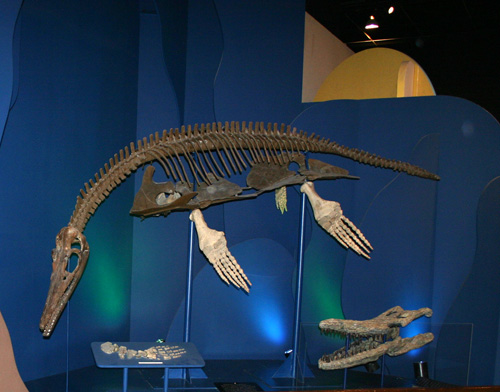
The plesiosaur, as it appeared on exhibit between the 1970s and 2008 (The Manitoba Museum, specimen V-216)
This plesiosaur links us to an earlier age of fossil collecting, for it actually arrived in Winnipeg long before the present museum was ever thought of. In the early 1930s, a Mr. Mayhew of Treherne found the bones close to where the Assiniboine River cuts through the Manitoba Escarpment (today this is a beautiful and remarkably peaceful place). At that time, the Manitoba Museum had just been founded in Winnipeg; this was a small institution that had its exhibits in the newly built Winnipeg Auditorium (which, interestingly, was a depression-era capital project!). The museum was largely run by an enthusiastic and knowledgeable group of volunteers. Mr. Mayhew contacted the museum about his find, and in 1932 Professor Stuart Kirk of the University of Manitoba collected the fossil, assisted by the museum’s two staff members, Messrs. Rand and Stokes.
Through 1933, Prof. Kirk worked to prepare the bones. Kirk was just in his early 30s, so he probably approached this exciting project with youthful enthusiasm. I can imagine him with his students putting in time in evenings or on weekends as they endeavoured to complete the preparation. The plesiosaur had been found without a head and lacked some vertebrae and some of the limb bones on its left side, but it was still a remarkable find worthy of exhibit and study.
One of the people who worked with Kirk at this time was Edward Leith. Ed was then a young teaching assistant, but he would remain at the university for a very long time, being associated with the same department from the 1920s until the late 1990s. Toward the end of Ed’s time there, I shared an office wall and phone line with this remarkably cantankerous, energetic, kind-hearted, and knowledgeable old man. He told me many stories about his early days and the people he had worked with (though I wish I had asked him more about Kirk and the plesiosaur).
Although Ed was destined to live almost to the end of the millennium, the slightly older Kirk was far less lucky, for in the spring of 1934 he died. I haven’t been able to discover why, but from some correspondence it seems that he developed a rapidly-progressing fatal illness. The museum now had a large, partly-prepared plesiosaur filling up its space, and no paleontologist to oversee its preparation. Since this was the early 1930s, job prospects for paleontologists were probably even scarcer than they are today, so the museum scouted around to see who might be available to do this work (presumably for very little compensation). In any case, they lucked out, for they were able to bring in a “ringer”: Loris Shano Russell.
Russell was another young guy, only about 30 years old, but even at this age he must have shown plenty of promise (he was later to become one of Canada’s pre-eminent paleontologists). He traveled to Winnipeg, prepared the bones, and had them mounted and placed on exhibit before the end of 1934. So the museum had the big skeleton that it wanted as an exhibit draw. But perhaps more importantly, Russell took full advantage of the opportunity to work on these bones, for he also wrote up a full description of the specimen. He decided that it was a new species of plesiosaur, which he named Trinacromerum kirki in honour of Kirk. Trinacromerum kirki has the further distinction of being the first largely complete plesiosaur to have been described from Canada.
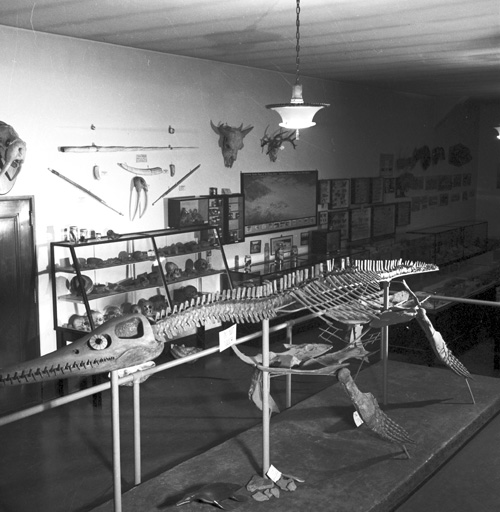
The plesiosaur, as exhibited at the old museum after 1937
Russell’s mount of the plesiosaur was a relatively simple horizontal layout on a flat surface, and in 1937 it was re-mounted by Ed Leith and others using a more conventional steel pipe framework. It had a somewhat hideous replica skull made of plaster and wood, and the vertebrae and some of the limb bones were also replaced with plaster replicas (the original vertebrae were too crushed to be mounted). In this configuration, the plesiosaur sat quietly through the Second World War and the 1950s, frightening small children who visited the little museum.
By the 1960s, the world had changed. Winnipeg recognized that it was a large city, and large cities needed appropriate cultural facilities. Moves were afoot to build a new and much larger museum, which would be run by a numerous and professional staff. The new Manitoba Museum of Man and Nature was built as part of the Manitoba Centennial Centre, which also included a planetarium and a concert hall. The wonderfully antiquated exhibits of the old museum were disassembled and most of the specimens disappeared into the back rooms of the new facility, where they formed the basis for its growing collections.
But what was to become of the plesiosaur? Since it was such a splendid piece, it was re-mounted in the Earth History Gallery in the early 1970s, with a few further modifications such as a new and much more accurate skull (fortunately the charmingly inaccurate old one was not thrown out, and we are now saving it for just the right exhibit opportunity!). And there the skeleton sat through several decades, again frightening small children as the world outside continued to change.
By the turn of the new millennium, it was clear to us that the Earth History Gallery was due for major “refreshment,” and that the substantial Cretaceous exhibits were a top priority. But what would we do with Kirk’s plesiosaur? Like our predecessors, we had become very fond of it (did I mention that it frightens small children?), so of course we wanted to keep it.
At the moment the plesiosaur is hidden from view, and is again headless with its body covered with plastic. The refurbished replica skull, bearing freshly-moulded artificial teeth (courtesy of artist Debbie Thompson), sits in another room awaiting re-attachment. Meanwhile, our exhibit team is working on the gallery. I fear that, when its head is returned, it will not recognize the space around it, because most other things will have changed.
Big skeletons such as this one have become permanent touchstones, for both museums and their communities, and I suspect and hope that Kirk’s plesiosaur will still be on exhibit in Winnipeg long after any of us have had our own chance to become fossils. This specimen links us to many different pasts. Of course it provides direct evidence of the Cretaceous seas in which it once swam, seas that covered the place where I sit writing this. But it also links our museum to long-dead scientists, and to the spirit of an age where museums could be built from nothing by dedicated amateurs. The fossil bones, in their own way, act as sinews anchoring our museum to its own heritage.
The Ithica

The MV Ithica (also spelled Ithaca) has long been a fixture in the Churchill area. This small freighter was transporting a load of iron ore from Rankin Inlet to Montreal in 1961, when it was caught in a storm and wrecked at Bird Cove, 20 km east of Churchill. The legend goes that this ship was once owned by Benito Mussolini, though it is not at all clear to me what use he made of it.

A typically scruffy paleontology field crew visits the Ithica. L-R are Pete Fenton, me, and Norm Aime (perhaps you can understand why the people at the Churchill Northern Studies Centre called us “the guys with the funny hats”). (photo © David Rudkin, Royal Ontario Museum)
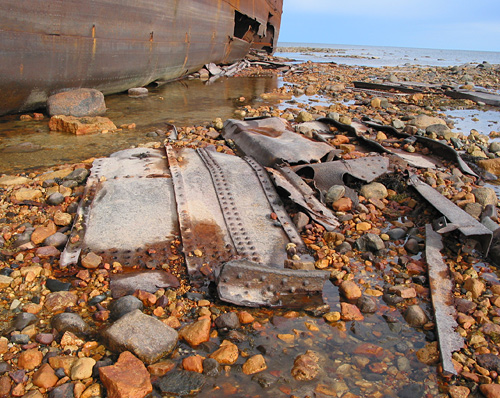
The ship was long ago stripped of its cargo and any valuables, and has been left to gently rust and decay on the tidal flat.
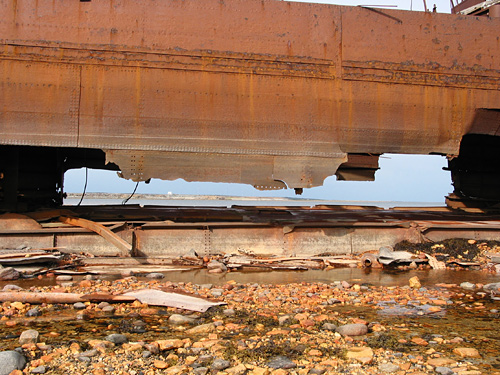
A gap in the hull frames the view westward along the shore.
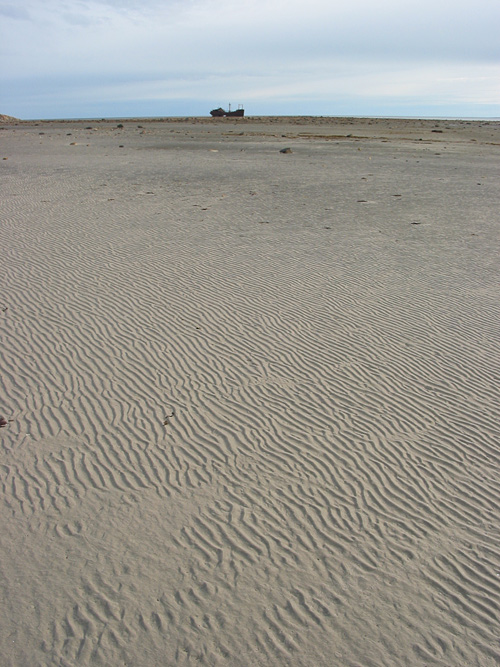
At low tide, Bird Cove becomes an immense sandy tidal flat, with the Ithica toward its seaward edge.
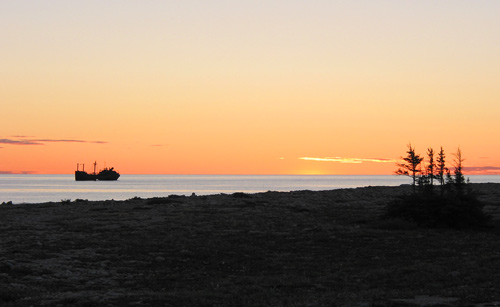
Ithica from the east at high tide
Catching a Crab
Imagine yourself visiting the east coast of the United States in the early summer. You decide to take a romantic moonlight walk on the sandy shores of Delaware Bay. But wait … what are the primeval “giant bugs” coming out of the water by the thousands? Looking like creatures that time forgot, these “living fossils” mating and laying eggs on the shore are horseshoe crabs (or limulids). Horseshoe crabs have a long fossil record, but are represented today by only four species: one along the east coasts of North and South America, and three on the shores of the Indian and Pacific oceans. About four years ago, my colleagues and I found fossils that show these animals have been living in the same sort of shoreline environment for almost half a billion years…

Ordovician horseshoe crab Lunataspis aurora from the Grand Rapids Uplands (L) shows a strong resemblance to the modern horseshoe crab Limulus polyphemus (R).
The story of the fossil horseshoe crabs shows how scientific progress, though the result of knowledge, skill, and hard work, also depends on the following of hunches. In fact, it suggests to me that scientific instinct is a skill that can actually be trained and cultivated. This story also indicates that, if paleontologists are to continue to discover new and unknown fossils, we will have to change our approach to field research. Since we like to study superb fossils, and large numbers of them, paleontologists tend to quickly walk across potential sites to determine where the fossil-rich horizons are. They then home in on those horizons and focus their collecting there. This approach works beautifully for known groups, which are known because they are relatively common and because they can be found at fossiliferous sites. If you want to find the rare and unique things, though, you will need to look elsewhere. In other words, to find unusual fossils, you should be looking in the places where you think fossils are absent.
But enough of this philosophizing. Let’s get on with the story…
In about the year 2000, Ruth Bezys, who was then at the Manitoba Geological Survey, told me that a man working on their drill rig had found some interesting fossils in the Grand Rapids Uplands, while looking for rocks on which to do artwork. Ruth thought that the fossils were eurypterids (an extinct group commonly called “sea scorpions”). In the fall of 2001, I traveled to Grand Rapids with my associate Ed Dobrzanski. Grand Rapids is 400 km north of Winnipeg, and the site is some distance beyond that, in an area many kilometres from any habitation, so this is not the sort of trip undertaken at the spur of the moment.
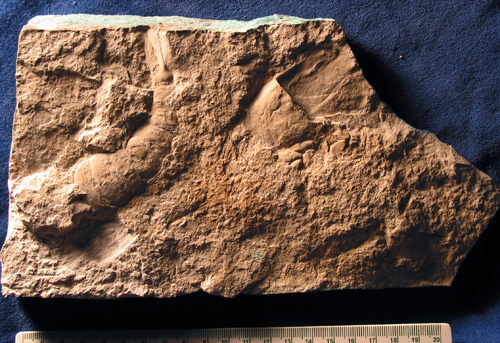
This slab full of fossil eurypterids was found by Mr. Fournier. It is the piece that made us interested in field research in the Grand Rapids Uplands. (collection of The Manitoba Museum)
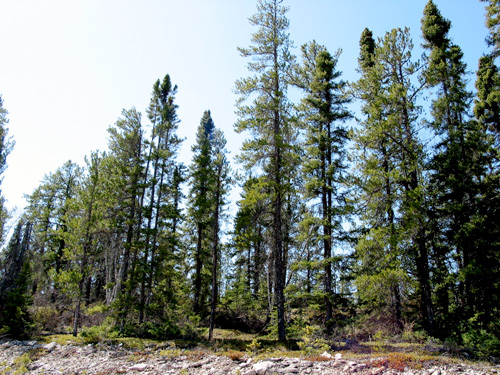
Jack pines in the Grand Rapids Uplands
The site was at a place where patches of exposed bedrock are spread over a large area, interspersed with loose rubble and vegetation. Although it now sits within a boreal wilderness characterized by long and bitter winters, the setting was very different when the rock was deposited. This dolostone formed as sediment during the Late Ordovician Period (about 445 million years ago), when this region was covered by broad tidal flats and lagoons under a hot tropical sun.
In two days we discovered one beautiful eurypterid specimen and a few lamp shells, but otherwise had nothing to show for the immense number of loose slabs that we had flipped and examined. The unusual fossils were present, but they were extremely rare. Since I was heavily involved in exhibit work at that time, I could not begin a new field project. When I had a spare moment I would think fondly of the promise this site held, telling myself that I would eventually get back there for some serious collecting.
After a long wait, in late 2004 I spent a week in the Grand Rapids Uplands with a group of Museum associates and volunteers. For the first few days we found very little. This was a frustrating time; we knew that the unusual fossils had to be there, but they were obviously rare and were probably “hiding” in a small area of the large exposure. One could almost imagine the eurypterids scuttling deeper into the crevices between the rocks as they sought to escape our prying eyes.
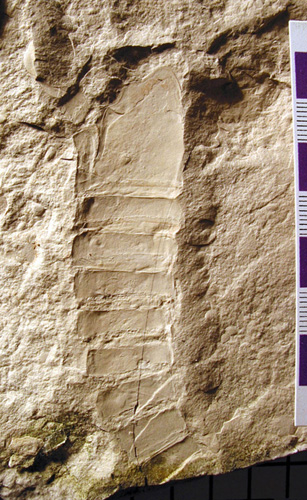
The eurypterid found by Ed Dobrzanski and me in 2004 (collection of The Manitoba Museum)
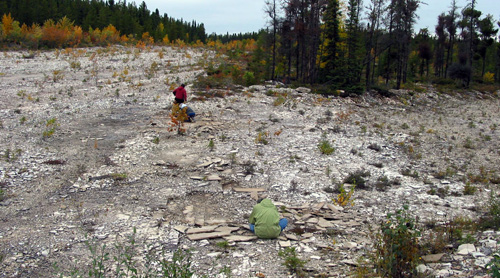
Members of the field party doing exploratory work in 2004.
Finally, in the golden light of the evening before our last full day, volunteer Debbie Thompson discovered an almost complete eurypterid, giving us an idea of where we should be concentrating our efforts (this was par for the course for Debbie; she always finds more fossils than anyone else!). On that last day, we began to collect wonderful things: more eurypterids, but also jellyfish, cephalopods (relatives of squids), and other fossils that we couldn’t identify. It was clear that the site was going to yield many exciting creatures; it was also clear that it wasn’t going to give them up without a struggle.
In the early summer of 2005 I returned for a few days with Ed Dobrzanski and Sean Robson. Now that we knew where to collect, we were able to find fossils more steadily, but we still felt fortunate if a morning’s efforts resulted in one good specimen. Again, the last day of work produced remarkable results. Splitting apart a bed, I saw the fossil of a joint-legged animal with which I was not familiar. It looked like a tiny horseshoe crab, just a few centimetres in length (this is the specimen in the photo at the top of this entry). I knew, however, that the fossil record of horseshoe crabs started much later, so I thought it must be something else (I was not an expert on such animals). We packed it up with the rest of our samples and brought it back to the Museum.

This is me collecting fossils in the summer of 2007. To find fossils at this site, one has to crawl around for hours, cleaning and splitting rock. After a day or so, my knees are bruised and in constant pain.
Six weeks later, Ed and I were 600 km from Grand Rapids, working with Dave Rudkin and others near Churchill on the coast of Hudson Bay. We had spent several field seasons in the Churchill area since 1996, and we thought we had discovered many of its secrets, but we were in for another surprise. Among many other fossils occurring in this area, we had previously found an excellent eurypterid head, but it was within a boulder that had been transported from its original location. Dave and I had discussed where similar fossils might occur but had not tracked down the source bedrock. Looking for rocks with characteristics similar to those in the Grand Rapids Uplands, we quickly narrowed our search, focusing in on a quantity of likely-looking material. Washing slabs and turning them in the light, we began to find wonderful and strange fossils within the first hour. It is truly shocking is that this was less than 20 metres from a spot where we had parked the truck on many previous visits, but we had written off this rock as “unfossiliferous” and had paid it no further attention.
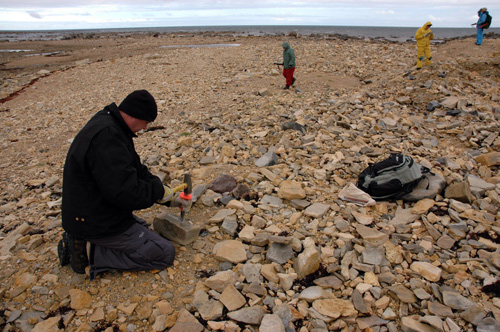
Norman Aime splits rock at the Churchill site. In the background, both Ed Dobrzanski and Pete Fenton are carrying shotguns for protection against polar bears. (photo © David Rudkin, Royal Ontario Museum)
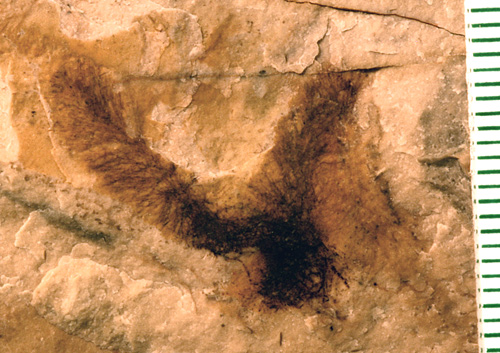
Fossil "bottle brush" seaweed from the Churchill site (collection of The Manitoba Museum)
We found a lot of pieces of eurypterids, beautiful seaweeds, and intriguingly, arthropod heads that looked to be the same as the one from Grand Rapids. The next day, we hit the jackpot; Dave found a complete animal, and it was almost identical to the Grand Rapids one. In the evenings we carefully washed and examined the specimens. They certainly looked like horseshoe crabs, but Dave, with his greater knowledge of such groups, thought that this could not be the case. How could we, in the space of six weeks, have found specimens at two separate sites that would push the age of a known group back by 100 million years? They had to be something more common – but what?
Back at the Museum I photographed the fossils using many different kinds of lighting, so that all of their details could be assessed. The more we looked at them, the more we realized that they could not be fitted into any of the groups known to occur in the same geological period. They did share characteristics with younger fossil horseshoe crabs, though of course they were more primitive than any known so far. The preservation of some specimens is quite wonderful; they have unmineralized outer surfaces showing preservation of eyes and other features similar to those of the horseshoe crabs that are still with us. On the basis of our careful studies, we prepared a scientific paper, published by the journal Palaeontology in January 2008. We have named the fossils Lunataspis aurora, literally “crescent moon shield of the dawn.”

This is the beautiful horseshoe crab found by Dave. It has been designated as the holotype (type specimen) for the new species Lunataspis aurora (The Manitoba Museum, specimen I-4000A)
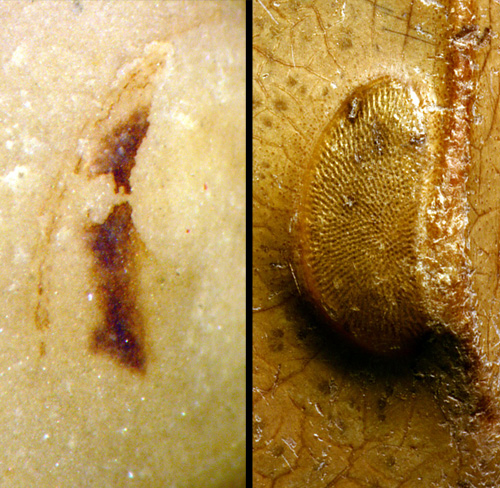
Some of the fossils from the Churchill site show wonderful preservation, including unmineralized soft (keratinous) exoskeletons. These images show the eye of the holotype specimen of Lunataspis aurora, compared to the eye of the modern horseshoe crab Limulus.
Why should this discovery be of interest? Of course, it gives us important new information about animals that are still with us. Horseshoe crabs are clearly among the oldest kinds of animals to share our planet. This discovery will also necessitate the development of new scientific theories, because these specimens are older than any member of a different group that was previously thought to be ancestral to horseshoe crabs! But it is the environmental story that intrigues me most: as we are discovering the ancient tropical shorelines of central and northern Manitoba, we are finding along those shores the members of a group that can still be seen on warm shorelines today. It is another piece of the wonderful puzzle of the evolution of life and environments through deep geological time.
(a shorter article containing some of this content was published previously in Features, © The Manitoba Museum)
Click here if you want to hear an interview I did about fieldwork at these sites.
Weather and Other Bugbears

Airport Cove in July
During Churchill’s short summer, there is no question that local conditions greatly affect one’s perception of the landscape. The most important of these conditions can be broken down into three variables: weather, flies, and bears. Of these, the first two are always physically present but fluctuate wildly from one extreme to another. The third is rarely visible, but always present in the mind of anyone who is on foot and away from a vehicle. The quality of any given day is largely dependent on the interaction of all three.
The one word that best describes Churchill’s weather is “changeable.” My colleague Ed, a retired meteorologist, delights in saying “if you don’t like the weather here … wait a minute.” Though he sometimes follows this up with “…and it will get worse.”
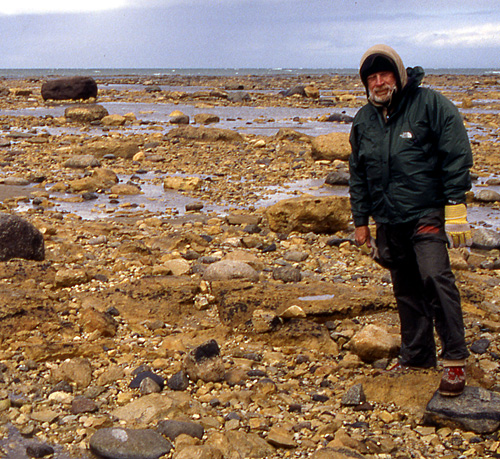
Ed Dobrzanski braves the summer weather on a boulder shore
The perfect field day is about +10 to +15 degrees Celsius, with a steady onshore breeze. We work in cooler weather, of course, but it is not all that comfortable, especially if one is crawling over wet rocks. Hotter weather tends to bring out the bugs. Also, any extreme in one direction tends to be followed by an extreme in the other. I remember one July day when it was a stifling +34 C, very still at midday with the stink of the scum on the shelving rocks becoming most unpleasant. It was so hot that Dave stripped down to underpants and went for a swim in Hudson Bay, using the excuse that he needed to look at an offshore rock outcropping.
The following night, powerful thunderstorms struck. By the next morning the temperature had dropped to +2 and a northeast wind blasting in sleet and rain had broken the telephone link to the outside world. We found ourselves sitting out the weather at the Churchill Northern Studies Centre, hearing the storm hammer on the tin roof and watching swirls of mist and water sweep past across the tundra. Outside the window, a boulder, satirically suspended from a telephone-pole tripod as a “wind indicator,” was indeed being blown out sideways by the powerful gale. There was nothing to do but drink coffee, read a book, and perhaps wander occasionally into the lab to see if another slab of stone needed to be strategically placed to hold the window shutters against that frightening wind.
Churchill’s flies come in three main varieties, horseflies, mosquitoes, and blackflies, each of them drawing blood in its own wonderful way. Most southerners think that mosquitoes are likely to be the main northern annoyance, but on the shore you are more often pestered by horseflies, or “bulldogs” as they are called locally in honour of their toughness and persistence. These tabanids appear at mid-morning on any day with a temperature above the low single digits, so that by lunchtime you are usually surrounded by a swarm of 20 or 30 of the blighters, all of them trying to land for long enough to sink their mandibles into you. They are slower and stupider than southern horseflies, but they are also very hard to kill; I have seen a swatted bulldog fall into a tide pool, only to flip itself over and take to the air to resume the assault. Bulldogs “think” that trucks are large animals similar to caribou, and there will often be a swarm of them sitting on the vehicle when we return to it. When the truck begins to move they will follow it in a small black cloud, and if the truck stops or suddenly changes direction they will do a double-take, like bees in a Bugs Bunny cartoon.
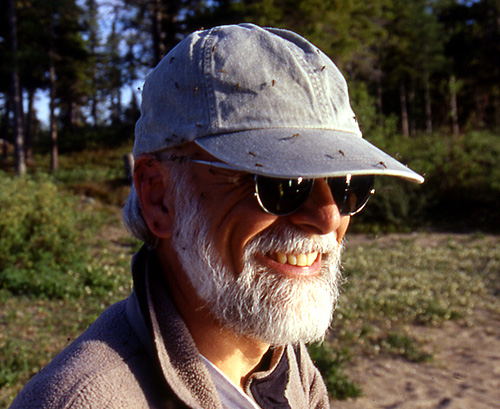
Dave Rudkin feeds the mosquitoes at Twin Lakes
Mosquitoes are rarer on the shore, but they can be voracious on still days. Inland, the mosquitoes and blackflies can instantly drive a person to utter distraction. It is impossible to think of anything except escaping the bloodsucking hordes, which is of course impossible to do. And while the mind is thus occupied, it can’t consider developing an understanding of the ancient landscape. Nor can it be wary of bears … and this can be dangerous.
Polar bears are the constant threat to life and limb. Fortunately, we have had no particularly dangerous encounters with bears at Churchill, though we have seen them on many occasions (Dave has had rather closer encounters with them on Akimiski Island, in James Bay). The problem with bears on the Hudson Bay lowlands is that they often aren’t really all that obvious. Given that they are the world’s largest land carnivores, and that the coastal area has few trees taller than I am, this may seem a bizarre statement. But the Churchill landscape is characterized by quartzite, and this sculptured bedrock has a lot of ups and downs. The downs in any patch of quartzite are plenty large enough to hide a gang of adult polar bears, and as we walk across the ups we are constantly on our guard.

Polar bear at Akimiski Island (photo © David Rudkin, Royal Ontario Museum)
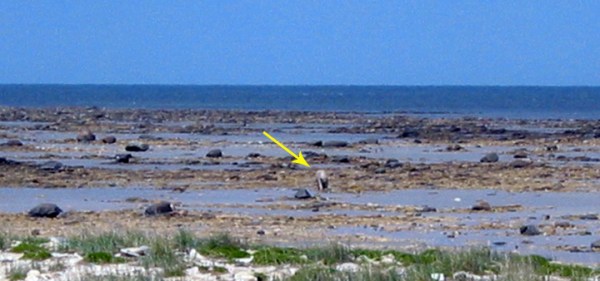
Dirty polar bear (arrowed) in a boulder field
When we step off the quartzite into a level vegetated area, we still can’t relax, because bears like to avoid the summer heat by digging down to permafrost between the willows. Even in a relatively open boulder field, I have discovered on two occasions that there is an uncanny resemblance between a big brown boulder and a big dirty polar bear (see photo above). And in the sea, a bear’s head looks little different from a chunk of rock sticking out of the water – you have to watch to see if it is moving. Given that these beasts have no fear of humans and can run 40 kilometres per hour (and there’s no way that I can run 40 km/H across a boulder field!), I prefer to stay close to Ed and his shotgun. Polar bears are beautiful, majestic animals to watch, something I am quite happy to do once I have regained the pickup truck (although now, of course, I am being swarmed by the bulldogs and mosquitoes, which makes wildlife viewing very uncomfortable …).
Exhibit Development (1): Tripping Over the Words
Today was spent on exhibit development work, so museum exhibits are near the front of my thoughts as I sit back and contemplate things this evening. Over the past few years I seem to have spent a lot of my working time on exhibit projects, and as I’m sure is the case for other self-trained people, I have developed an idiosyncratic approach to this work. Some of the “young people” have studied the development of museum exhibits as an academic discipline; the rest of us continue to believe that we can make it up as we go along.
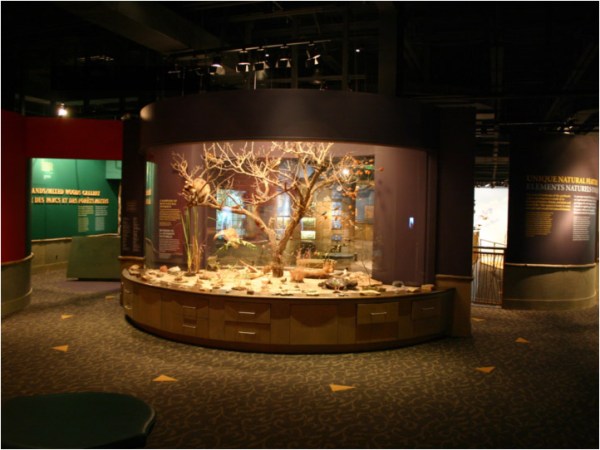
Diversity case, Parklands/Mixed Woods Gallery, The Manitoba Museum
As a scientist, one of my first tendencies when I began to work at the museum was to try to get as much INFORMATION as possible across within the space available. Needless to say, this doesn’t work in the exhibit context, just as it doesn’t work in the classroom. It is not our job to ensure that the visitor remembers as many facts as possible. It is our job to ensure that the visitor has a memorable experience, has fun (if possible), sees some interesting things and, perhaps, develops an improved understanding of the subjects we present.
Many of us like to deal with the world visually, so it is not difficult to recognize that we should be exhibiting specimens, artifacts, and images that have visual impact. Many of us have a childish love of touching things, so we put out items for the visitor to touch, handle, or stroke (no sharp knives or saw blades, though, OK?). We also like things that smell (or stink), and we like music and loud or rude noises, so we can think of exhibit materials that engage those other senses. And we enjoy pushing buttons, watching videos, opening doors, playing with computers … the list of possible exhibit experiences is almost endless. But how can we actually WRITE the WORDS of the exhibit content? This is often the most difficult stage of exhibit development, for both curator and audience.
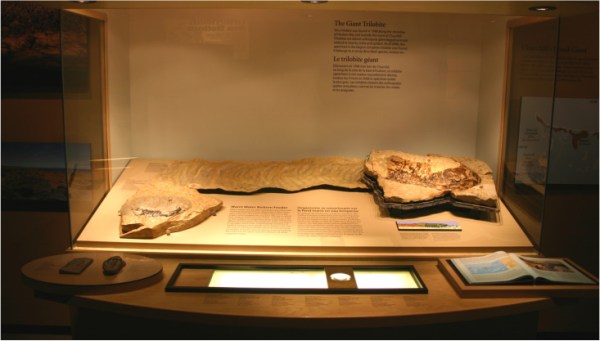
Trilobite exhibit, Earth History Gallery, The Manitoba Museum
I used to think that writing copy for an exhibit was a bit like preparing an article or a research paper. One would do the research, make notes, prepare an outline, distill the information, and then write, rewrite, and edit until a satisfactory piece was completed. Having done more exhibits than you have had hot dinners (or at least it feels that way by this time in the day), I can state that this simply doesn’t work. Writing an exhibit is more like telling a story, and the things that are really important are the things you will remember. So by all means do the research. Make notes. Take pictures. Contemplate and gestate. But when you write the copy, just go into an empty room and do it. The typical modern museum exhibit allows for very few words, maybe no more than a couple of hundred for a large case (including specimen or artifact labels). When you sit down with a blank piece of paper (or screen), you will already know what words those are.
First Sight: Churchill
I first saw the site on one of those fabulously clear long evenings of the short northern summer. We drove the rusty Suburban down the potholed road, between verges clad in purple vetch. After parking beside the cemetery, we waded through soaked sphagnum behind the perimeter fence and up onto the Precambrian quartzite ridge. Among all the memories, what comes through most strongly is the golden quality of that evening; I can’t even recall the clouds of mosquitoes and biting flies, but no doubt they were there too if it was summer in Churchill.

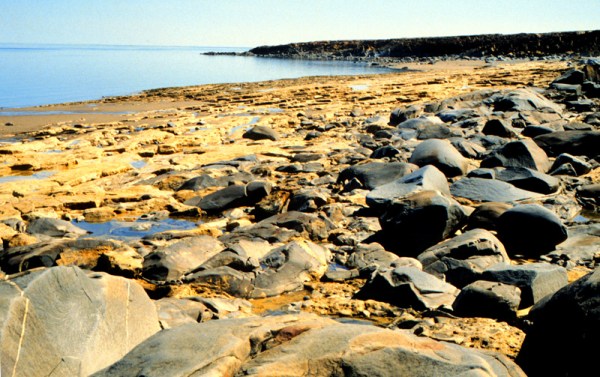
We trooped down through deepening shadows on the north side of the quartzite, constantly nervous, constantly on the lookout for polar bears. Being southern greenhorns, we thought that “this is Churchill – there must be bears everywhere.” Down from the quartzite towards the quiet sea, on the first outliers of the site we could see dark boulders on the shore, with patches of paler rock between them. An interesting outcrop, certainly, but not quite the visceral experience we were anticipating. Continuing a few hundred metres to the east …. now this is the place!

the boulder field
The receding tide is gradually exposing an expansive field of boulders, 300 metres long and in places tens of metres wide. A pale brown dolostone (a rock derived from limestone) is wrapped around the boulders, which sit beneath a scarp of dark grey quartzite. This is an aspect of this site that I still find it difficult to comprehend; it is probably beyond human capacity to really grasp what this place represents. These boulders have sat at the foot of this scarp for more than 440 million years. They were here when this was the edge of a shallow equatorial sea. They were buried under thick layers of sedimentary rock for hundreds of millions of years, during which the sea covered and uncovered the middle of this continent on many occasions, the crustacean-like trilobites left forever, land plants, birds, and mammals appeared on this planet, and the dinosaurs arrived and disappeared. This shoreline we are standing on is much older than the Ice Ages, older than the Rocky Mountains, older than Pangaea.

corals between the ancient quartzite boulders
As we walk over the dolostone, we can see hundreds, no, can it be thousands of fossil corals? These remain where the waves had rolled them between and in front of the boulder field. Here and there the tapered cylindrical shells of cephalopods, top carnivores of that ancient sea, lie in crevices between the boulders. The cold modern sea continues to move lower on the shore, beginning to expose sloping dolostone beds in front of the boulders. As we slowly follow the tide across these beds, we can see fewer and fewer corals until, some metres in front of the boulder field, they disappear completely. Dolostone beds farther out appear to be blandly unfossiliferous at first glance, but as we look more closely we can see that the rock comprises a complex tapestry of ancient burrows.

a tabulate coral colony rests between the boulders
That evening was a turning point in my life, perhaps as close as I’ve ever come to a religious experience. I had already spent about 15 years studying fossils of this age, but before I visited Churchill I was like one of the blind men with the elephant. I had examined rocks and fossils in many different places around the northern hemisphere, but I was only seeing fragments of the ancient world, drawing conclusions from numerous minute clues. Here on the shore in Churchill I was viewing a whole “place”; I could see the long-extinct beasts where they lay between and in front of the boulders, below the now-rounded scarp that had stood as a steep giant headland in that distant past time.
unless otherwise stated, all images on this site are © The Manitoba Museum; text © Graham Young, 2009


 Ancient Shore