Dead Fall
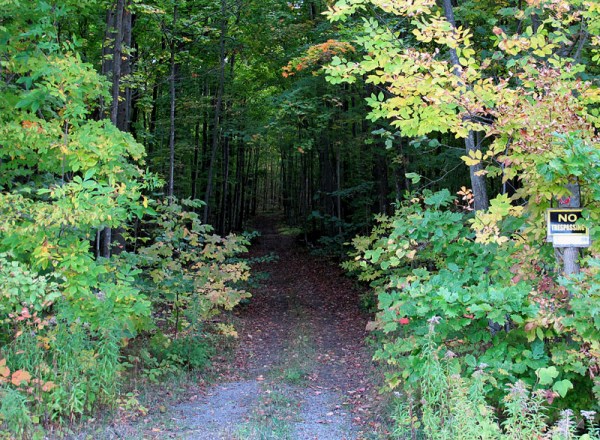
- Kawarthas, Ontario, September 2012

Autumn’s colours arrived like a wake for the perfect green of summer.
Last summer really was perfect. Splendidly dry and warm, it was the summer for which the definition of the season was written. It was summer as depicted in Van Gogh paintings of golden fields, or in sepia-toned family-rated movies. Heck, it was summer as depicted in Hallmark cards. In Winnipeg … Winnipeg … it was so dry that mosquitoes were absent. In Winnipeg!
Out on the prairie, the entire land billowed with ripening grain and sunflowers. Far to the north, paleontologists in the field baked in the hot wind, our skins burnished by dust and sun. Back home in the garden we lay on wooden chairs, too contented to contemplate physical labour. On vacation at a lake we sat by the fire, played guitars, drank wine, and sang.
After such a summer, autumn was pleasing and anticipated, but its beauty seemed mournful. Out in the countryside trees were dropping their foliage, in brown and yellow, as they passed from growth to dormancy. Mould and fungus flourished on the damp leaves, and everywhere the air was tinged with death and decay.


Kawarthas, Ontario, September 2012
In a few places I was reminded that not only the trees are deciduous, as the leaves were interspersed with the remains of creatures. All organisms are ephemeral; like the leaves from a woody stem, the soft tissues fade away, leaving only the more resistant structures beneath. I photographed the colourful leaves, and the more subdued tones of crumbling bone, sinew, and feather.
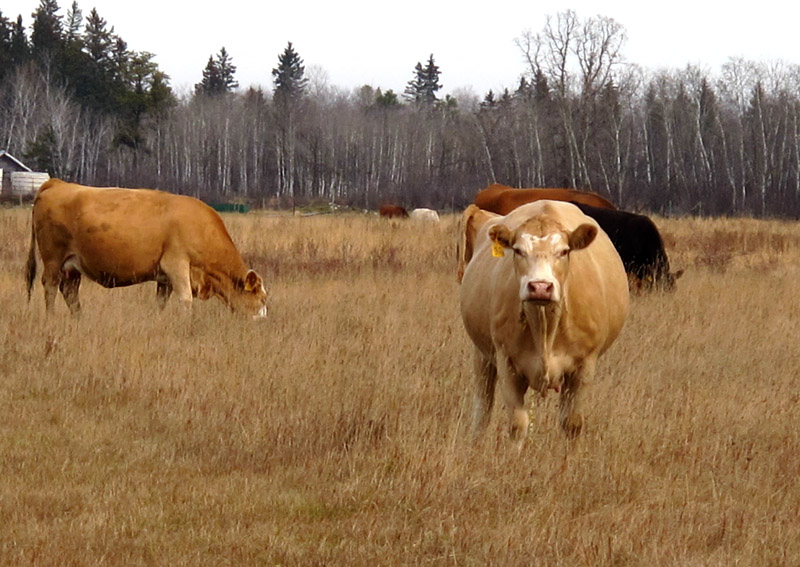

Interlake, Manitoba, October 2012
If you spend any time at all travelling with paleontologists, you will know that we are fascinated by dead things. We like to think about our fossils as living organisms, and to understand them in that light, but the specimens we find and collect are not the living creatures. Rather, we find preserved dead remains, those few skeletons and fragments that have had the good fortune to survive the lottery of decay and fossilization. They have passed through the shade of taphonomy, survived transport and decomposition, and come out on the other side as beautiful relics.


Interlake, Manitoba, October 2012
If we encounter a recently dead creature during our wanders through the countryside, then, do we do as any normal person would? Do we turn our heads the other way, wrinkle our noses, or complain about the smell? Of course not. Instead, we crouch over the long-deceased crow, or shrew, or fox, or beluga whale, photographing it from every possible angle. And if decomposition has proceeded far enough that the bones may be bearable to share a vehicle with, we scoop them up and take them back to our lab or office (or house).
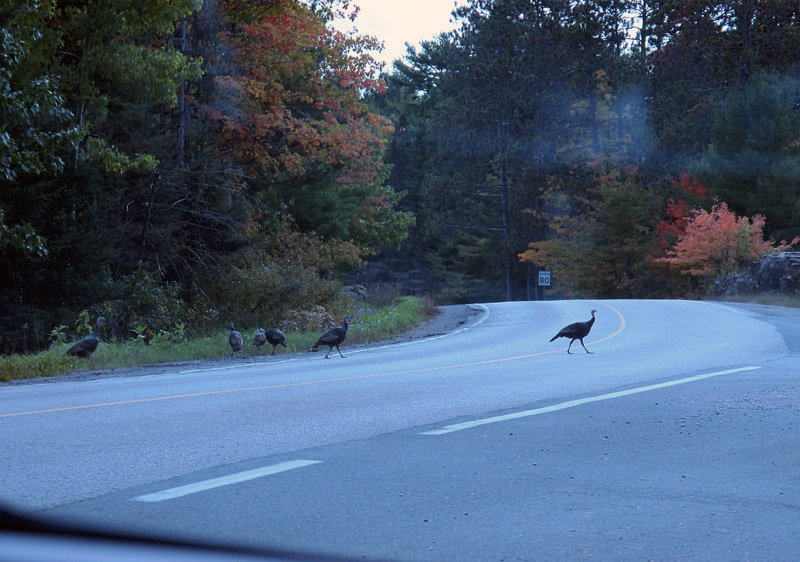
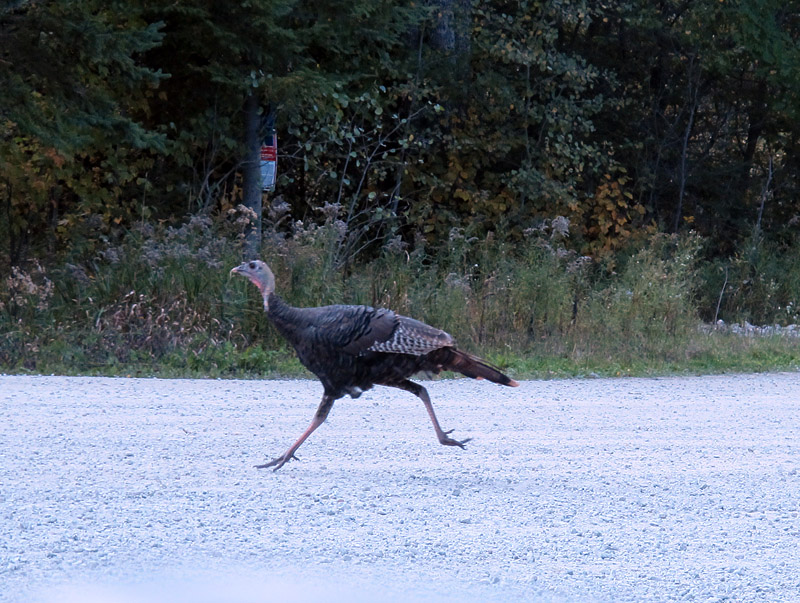
Kawarthas, Ontario, September 2012
As I sit here, without leaving my chair I can see the vertebra of a cow that was crushed by a collapsing hoodoo, picked up 20 years ago during a dinosaur dig farther west. On other shelves I have bison teeth, the skulls of a gull and a mink, and many other pieces. Skeletal detritus inspires paleontologists as we think about fossils, but I also think that we gather and exhibit bones and skulls simply because we find them beautiful.
In a way they become our “precious,” though I suspect they only make us invisible in the sense that they encourage potential visitors to avoid us and our strange ways!


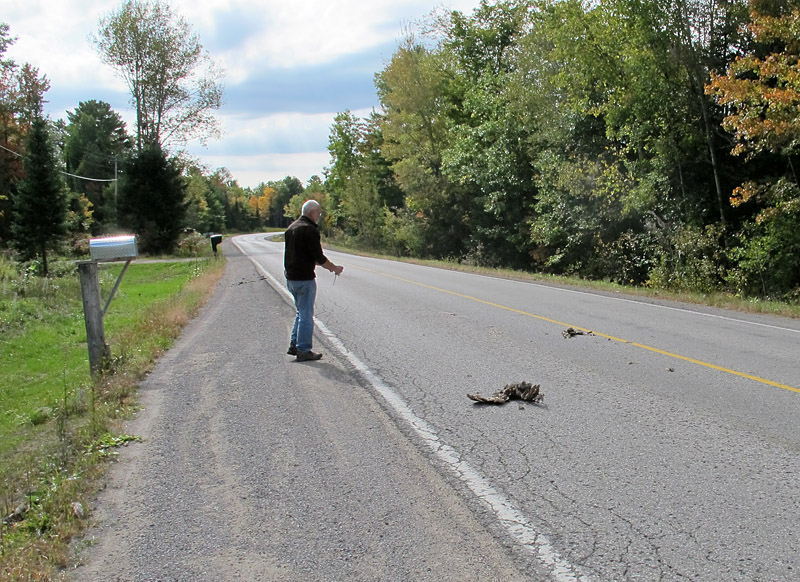
Dave Rudkin photographs a turkey; Kawarthas, Ontario, September 2012
© Graham Young, 2012
Stonewall Striations
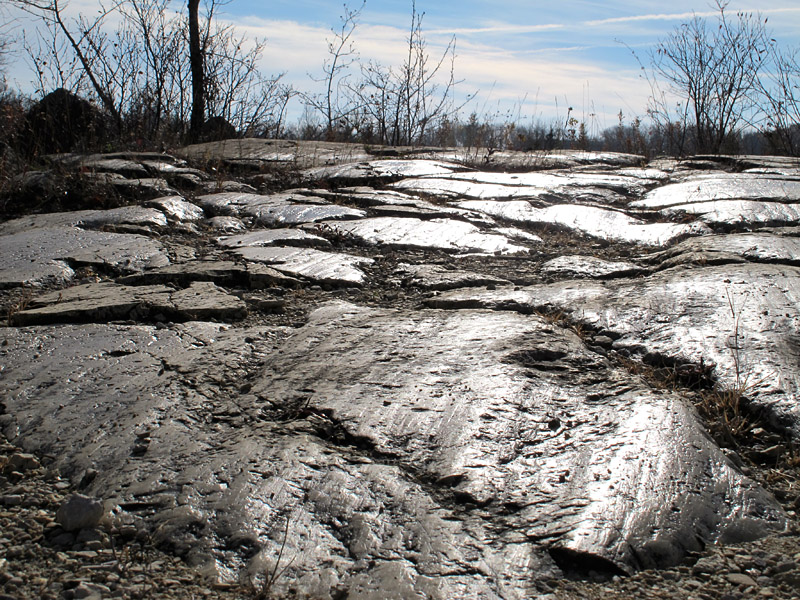
On the same October morning that we visited Stony Mountain, we also drove a few kilometres northwestward to Stonewall Quarry Park. There, we examined strata of the Stonewall Formation, deposited in a warm tropical sea some 445 million years ago. The rocks at Stonewall contain a variety of marine fossils, most notably corals and stromatoporoid sponges.
Their pleasant greenhouse world was “messed up big time” by the Late Ordovician mass extinction, the first of the big five in the Phanerozoic history of life. The extinction was associated with and may have resulted from a glaciation on the southern paleocontinent of Gondwana. It was far distant from our local rocks, which were deposited in tropical Laurentia, but its effects on sea level and water chemistry were global.

The horizon represented by the top surface of Stonewall Quarry is also roughly the horizon after which the world went bad. As my friend Bob Elias is fond of pointing out, that surface at the quarry is covered with glacial features, striations and chatter marks! Are these at all related to the end-Ordovician glaciation? Of course not, as these striations are just a few thousand years old and the result of the last of the Pleistocene continental glaciers. But it is another excellent example of adjacent analogues.
And on this lovely morning, with the fog lifting and the sun still relatively low, the striations showed wonderfully across the damp dolostone.
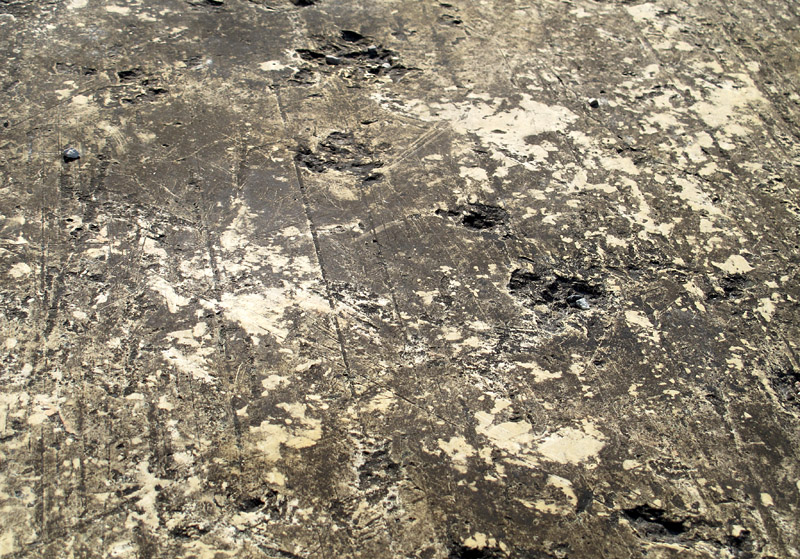
This surface shows at least two directions of striations, indicating variation in glacial movement through time.
In Which Poo(h) is Entirely Surrounded by Water*

A marine coprolite (reptile or fish) from Paleocene? rocks at Big Muddy Lake, Saskatchewan (The Manitoba Museum, specimenV-2388)
The subject of this piece is, literally, old crap, as a change from the metaphorical version that some people might think occupies this page at other times.
A few weeks back, I saw a specimen labelled as a coprolite, a fossilized piece of dung. It wasn’t stated what the coprolite had been extruded by, but the implication was that it was from the back end of a dinosaur (and was therefore, perhaps, exciting). Even from a quick glance it was clear that this was unlikely, as this dropping had obviously been deposited in water, not on land.
Fossil feces, when you think about it, can carry a variety of signatures. They can tell us about the diet of the animal, either from visible enclosed material such as bone bits, or from chemical signatures preserved in the dung. They can tell us about the intestines of the producer, if these have a distinctive form (for example, shark excrement has characteristic spiral markings produced by ridges in the creatures’ intestines). And finally, coprolites can tell us a lot about their environment of deposition. Read more…
By Misty Crags
Stony Mountain Quarries, October 16th
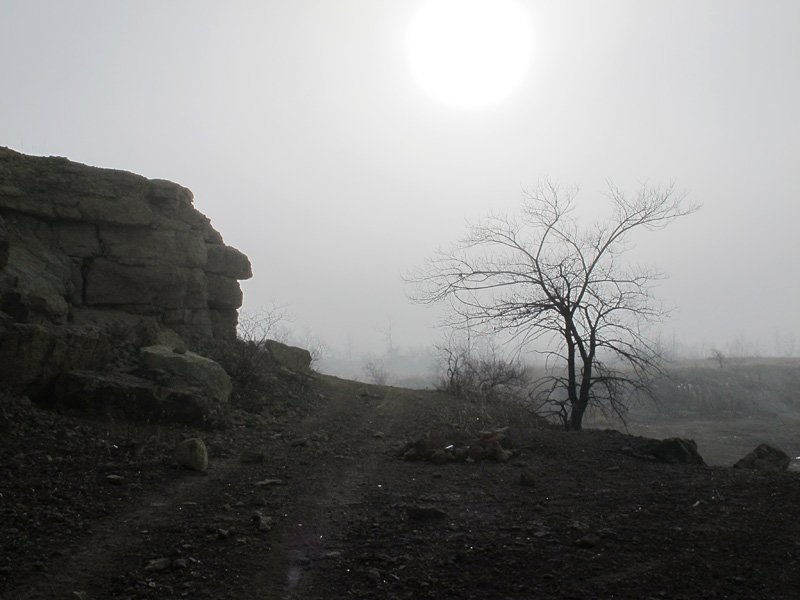
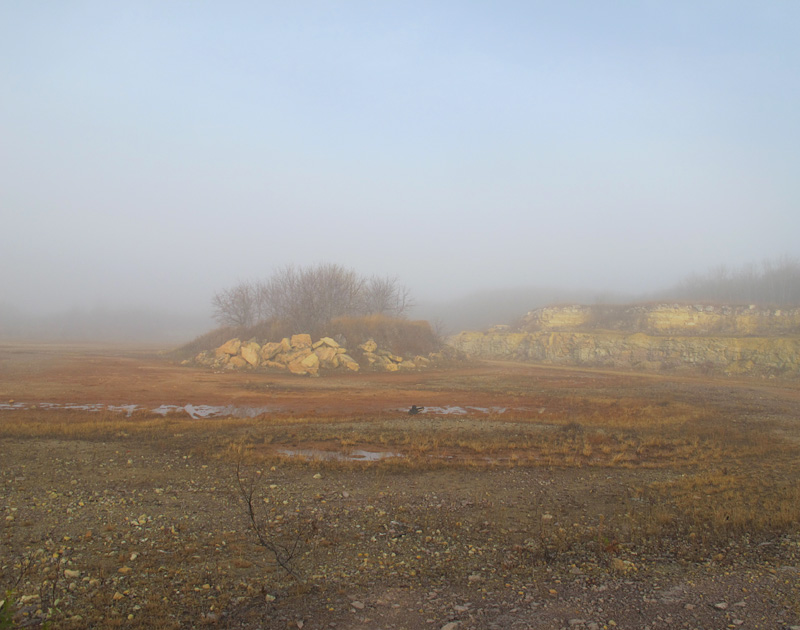
In normal daylight, the old west pit at Stony Mountain is really not all that much to look at: just another post-industrial landscape. Sure, for the paleontologist or rock-hound it might be a wonderland full of slightly hidden treasures, but for the average visitor it is just another hole in the ground. Add dense fog and autumnal morning light, however, and it becomes something quite different. Instead of a worked-out quarry, one sees an idealized romantic landscape, a place of rocky crags with slopes of broken scree and pools of dark water, a place where wizened trees loom out of the mist.
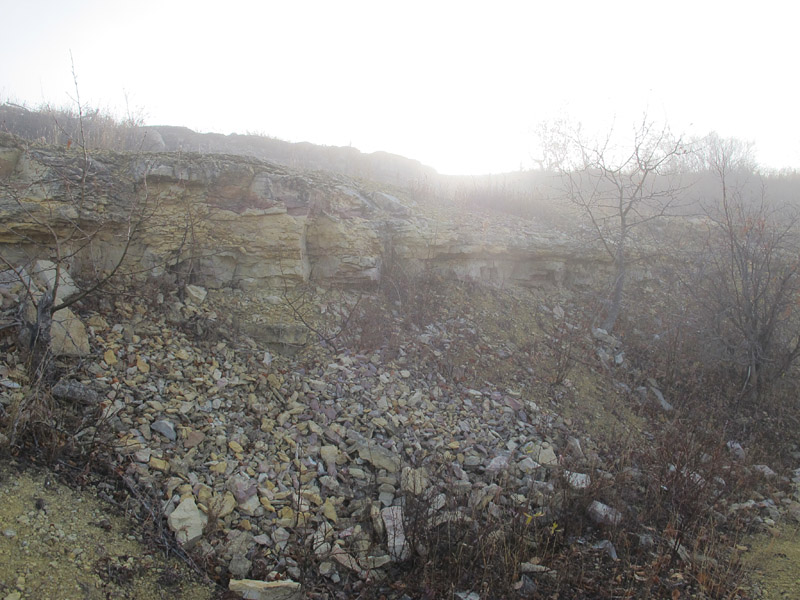


Our eyes adjust slowly as we make our way down from the Jeep, treading carefully on the moist rocks and watching our step in the dim light. Which way is the deepest part of the quarry? Why does the knoll look so different? And . . . what is that moving across the distant slope? Surely it is a hound, an enormous coal-black hound, but not such a hound as mortal eyes have ever seen. No . . . wait a minute . . . it is just a collie out for its morning walk with a raincoat-clad owner . . . Oh well, that is probably for the best. Still, this morning this is a place where the great Grimpen Mire cannot be at all far away.
Enough of these notions. Time to crawl around and look at some fossils.
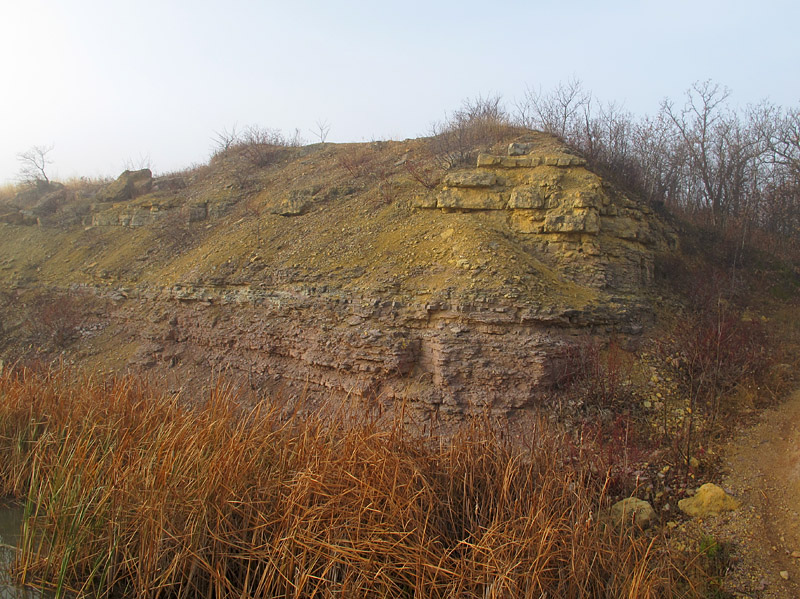
There are places where the misty light really enhances the appearance of the outcrop. Here, there is a vividness to the colours of the Gunn Member (red, below) and Penitentiary Member (yellow, above) of the Upper Ordovician Stony Mountain Formation (I haven’t really enhanced any of these photos very much; this is the way it looked that morning).

Mouldic examples of the brachiopod Diceromyonia storeya in the Penitentiary Member (coin diameter 28.5 mm)

A coiled cephalopod in the Gunton Member (maybe Charactoceras)

Large ripples of the ancient seafloor stand up from modern sediment that infills their troughs.


© Graham Young, 2012
If you would like to know more about the geology of Stony Mountain, information can be found in:
YOUNG, G.A., R.J. ELIAS, S. WONG, AND E.P. DOBRZANSKI. 2008. Upper Ordovician Rocks and Fossils in Southern Manitoba. Canadian Paleontology Conference, Field Trip Guidebook No. 13, CPC-2008 Winnipeg, The Manitoba Museum, 19-21 September 2008, 97 p.
I Love the Smell of Fossils in the Morning!
He ain’t got no distractions
Can’t hear those buzzers and bells.
Don’t see no lights a flashin’
Plays by sense of smell.
(Pete Townshend, Pinball Wizard)
♦
Earlier this week, Dave Rudkin and I visited quite a number of outcrops in southern Ontario. We were looking for several things, but most of all we sought evidence of the sorts of unusual Ordovician fossils we have found in Manitoba at William Lake and Airport Cove. On the afternoon of the second day, as we crawled over yet another roadcut, I had a flash of intuition and suddenly said to Dave,
“We won’t find the fossils here. These rocks just don’t smell right.”
Because they really didn’t. I had recalled that there is a particular “tang” in the air when we hammer the rocks at William Lake and Airport Cove. Part of this tang may result from the strata at those sites being dolostone rather than limestone, but they also share a subtle aroma that is lacking at many other dolostone fossil sites. What that smell is I really don’t know, but it was entirely absent in the flat scent palette of these Ontario strata.
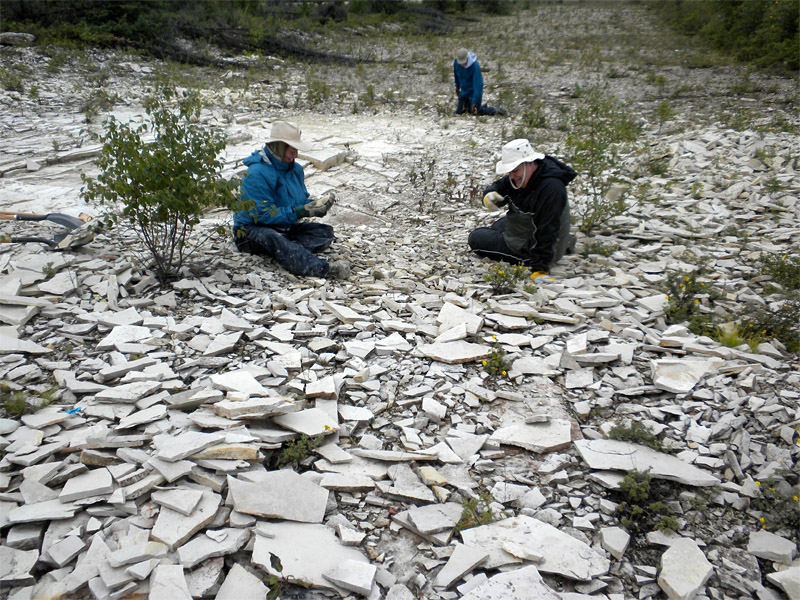
At William Lake, there is often ample opportunity to smell the rocks. Here, Debbie Thompson and Michael Cuggy work through one of our previous rubble heaps, while in the background I am examining a “new” dolostone bed.
You might think it odd that I would sniff rocks. I don’t really go around purposefully inhaling these aromas, but doing this sort of paleontological work one really has no choice about it. The fossils are often tiny and obscure, and after you split the rock you have to get your nose right up to it as you peer through a hand lens. If the rock has a dust coating then the surface must be wetted to make the fossils visible, and if you aren’t near to one of the water pails you end up using spit instead. I have to admit that there have been times I have licked the surface of a rock in my hurry to see what a particular small fossil might be. So I know very well what those fossil-bearing strata smell like! Read more…
Marmora

Today was a nearly fossil-free day of fossil-hunting in southern Ontario. Sometimes you just have to go with the flow and enjoy the landscape . . . and of course, tomorrow we might find those remarkable specimens we seek!

The former Marmoraton iron mine contains immense exposures of Ordovician limestone. It is a pity that we cannot get in to examine them!


Small-scale ripples in the Ordovician Shadow Lake Formation
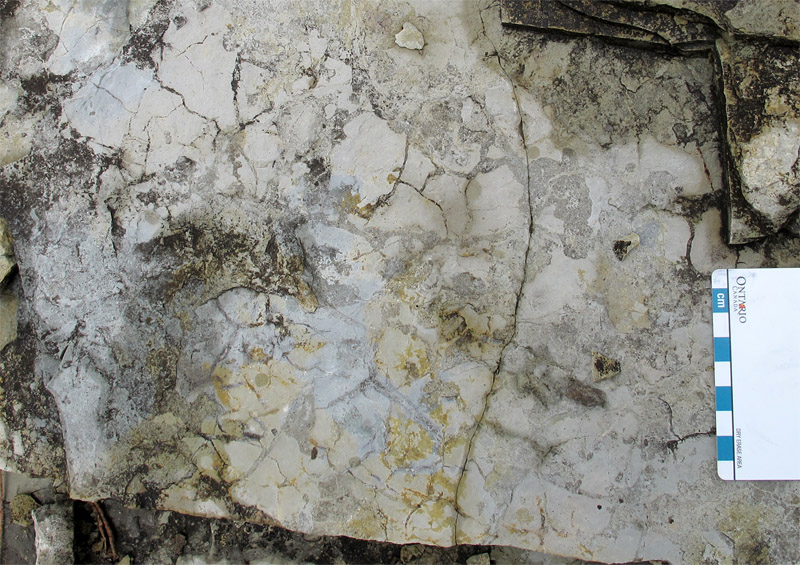
Possible Ordovician mud cracks
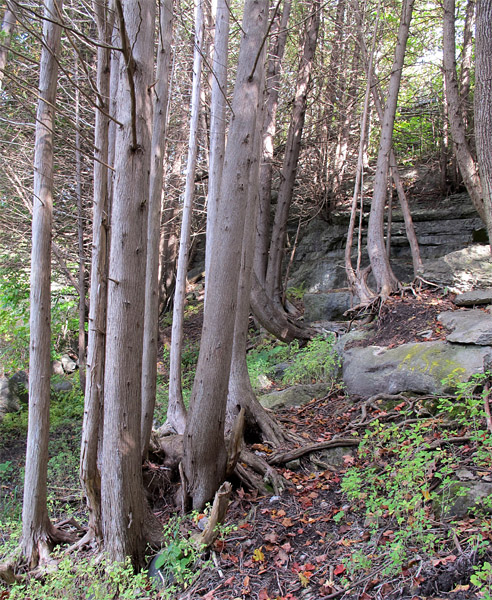
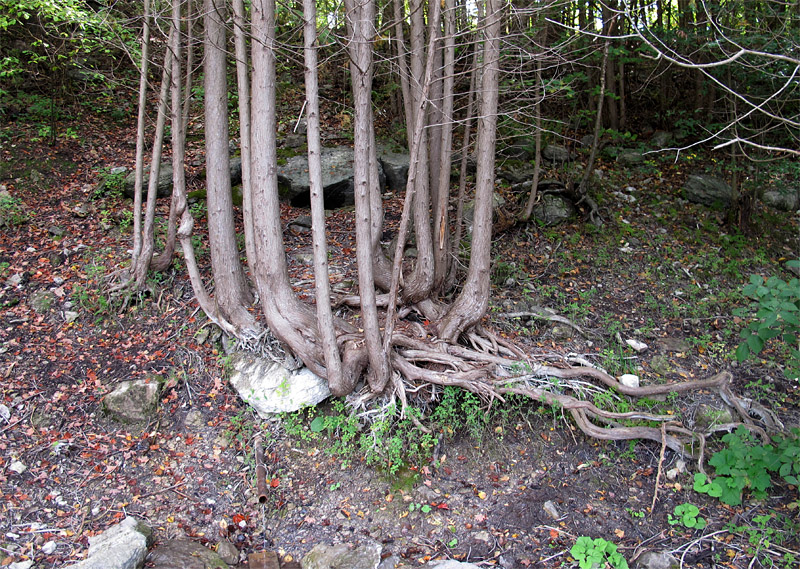
Cedars on the slope seem to be almost growing out of the bare limestone of the Gull River Formation.
© Graham Young, 2012
Took the words right out of my mouth.
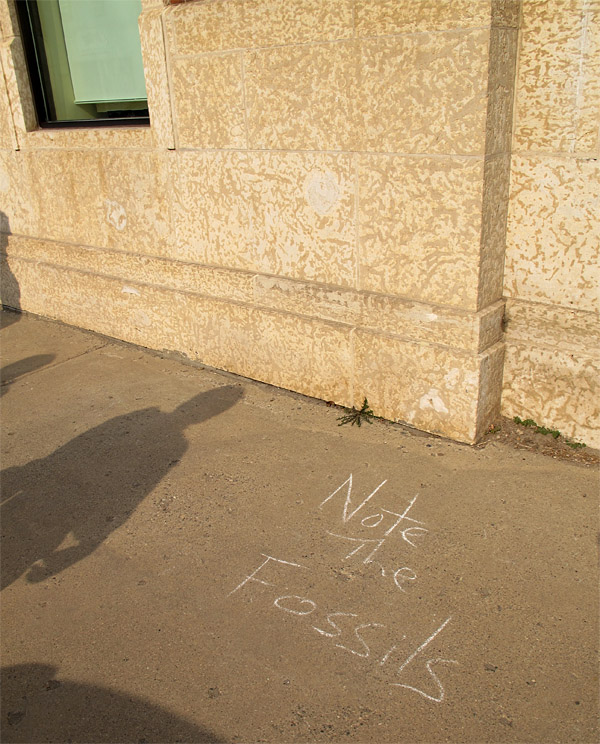
This anonymous graffito was chalked onto the sidewalk in Virden, Manitoba, last week, strategically placed below a beautifully Thalassinoides-mottled, Fisherites-laden wall. It was so good to see that someone out there gets it!
Swarms
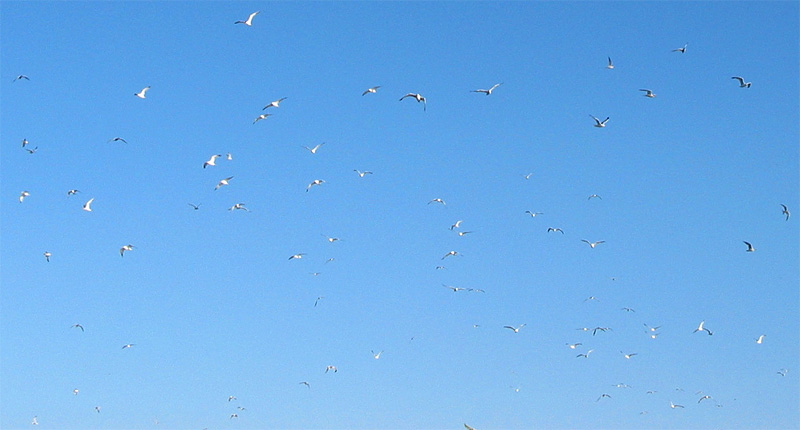
Gulls at McBeth Point, Lake Winnipeg
For most of the past month I seem to have been on the road in various parts of central Canada. The other morning, as we drove just north of Lake Huron near St. Joseph Island, we were struck by the abundance of Sandhill Cranes. Every kilometre we would see these magnificent birds fly past, in groups of two to five. They all seemed to be headed northward, probably leaving safe roosts along the lake to forage in the farmland and woods.
Since I was in the passenger seat and had nothing better to do, I began to look up Sandhill Cranes on my phone. I discovered that they are widespread creatures, occurring across much of North America and part of Siberia. And they really are abundant; although we tend to see them in small numbers in most of Canada, they can occur in huge flocks in certain parts of the migration season. So I guess it isn’t really surprising that I was seeing so many in Ontario, after observing family groups in central Manitoba last month.
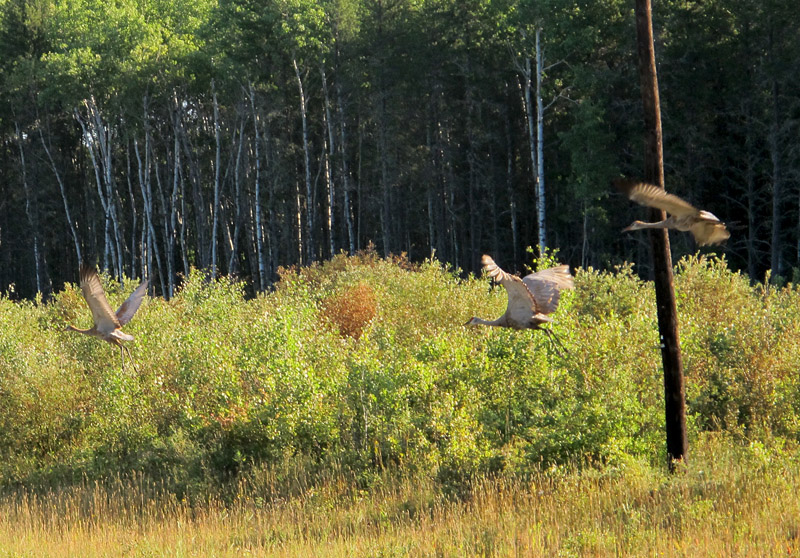
Sandhill Cranes in the Grand Rapids Uplands of Manitoba, August, 2012
It is wonderful for the mind to be free to wander, so the Sandhill Crane got me interested in its larger relative, the elegant white and black Whooping Crane (the former is Grus canadensis, the latter, Grus americana). Why is the Whooping Crane one of the poster children of endangered species, while Sandhill Cranes are common? Read more…
Northward, Again

The gear is sorted, bags are packed, food is purchased, maps have been studied and organized. Dave and Michael arrive at the airport tomorrow morning, and then it is time to head northward. It feels like just yesterday that Dave and I returned from William Lake, but I guess it was sometime around last September. Now the north is calling again.
The correspondence has been cleared off the desk, or at least some of it has. The reports have been written, or at least those parts that could be written are done. Anyway, there is no more time, so it is not worth thinking about any other work, just the fossils that are out there somewhere. Out there in splendid little patches of limestone hidden among all those spruce trees.
Now there is only the anticipation. What fossils will we find? What will be the condition of the sites? Will there be any new stories of bears, or blackflies, or the vagaries of northern dining?
I really can’t wait.
© Graham Young, 2012
Coincidence?
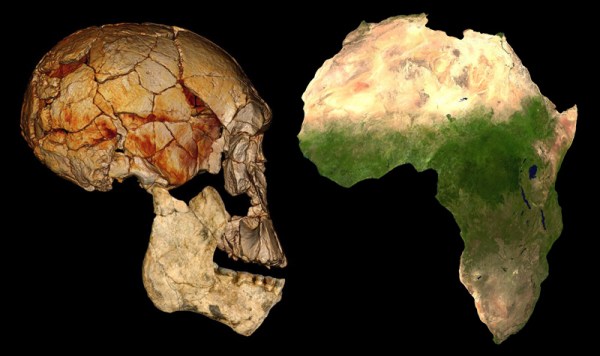
The photo on the left is © Fred Spoor and derived from scitechdaily.com. The image on the right is from wikimedia commons (I admit that I did skew this satellite image slightly).
Apparently our ancestors used to think that objects having a similar shape or appearance were connected or had a shared origin. Looking at the beautiful composite image of Homo rudolfensis that was released this week, I was struck by a similarity of shape, as shown above.
Is it a coincidence that early hominids originated in the continent that looks the most like their skull? Almost certainly. Still, on the basis of this comparison, imagine what we might look like if we had evolved in North America.


 Ancient Shore